

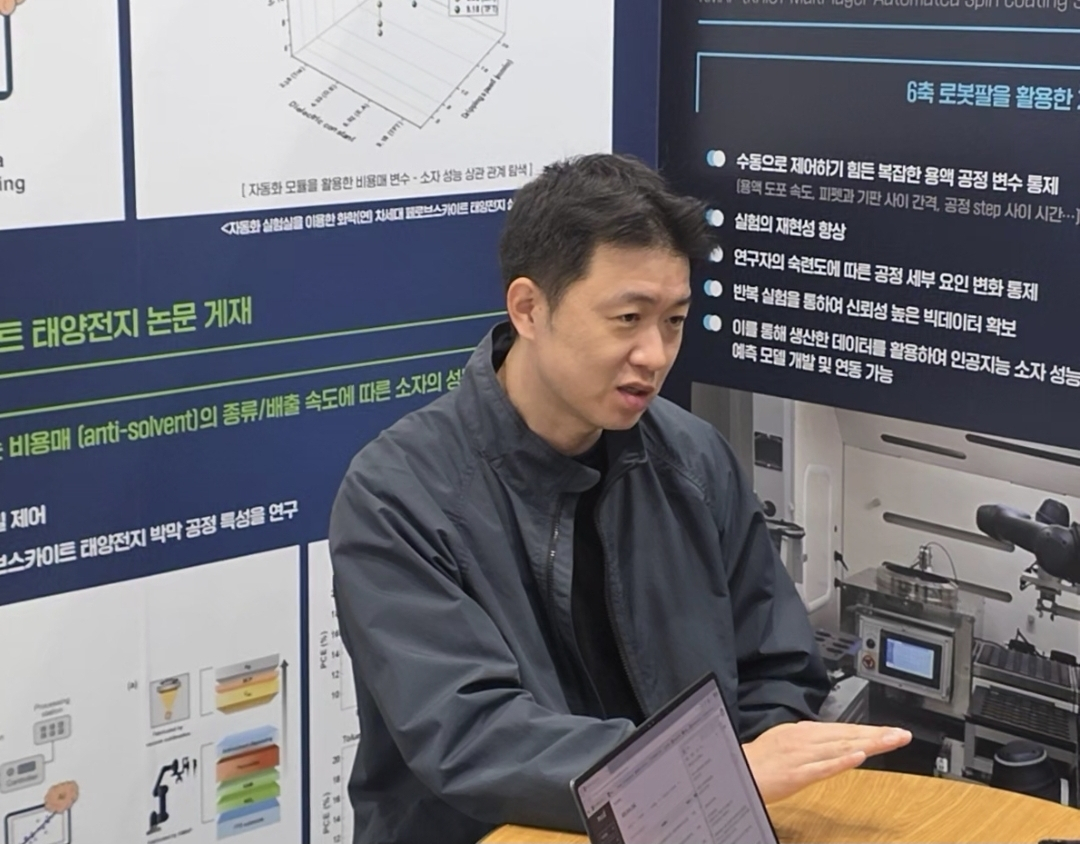
“Robots now assist with experimental processes that are difficult for humans to control manually.”
The Korea Research Institute of Chemical Technology showcased the future of an “automated laboratory,” where robots assist human scientists in performing solution processes, at “Smart Energy Plus 2026,” held on the 29th at Hall B of COEX in Seoul Samsung-dong.
The Photonic Energy Research Center at the institute is building an “AI-automated laboratory” that incorporates robots into the solar cell development process. Solar cells are devices that convert sunlight into electricity. The center is developing perovskite-based solar cells. Unlike silicon, which loses efficiency in the absence of light, perovskite is a new material that maintains high energy efficiency even at low illuminance levels and is lightweight and flexible enough to be installed on curved surfaces.
In particular, it can be mass-produced relatively easily and cheaply by coating solutions onto substrates, drawing attention as a next-generation solar cell technology.
However, the path to finding an “optimal design” is not easy. Even in solution processing alone, numerous variables exist. If the solution application speed, the gap between the pipette (a glass tube used for transferring liquids) and the substrate, or the time between process stages varies even slightly, experimental results can be significantly affected.
A six-axis robotic arm being developed by the research team is deployed in this process. The robot performs the processes of thinning the solution into a film and stacking the films.
Kim Beom-soo, senior researcher at the Photonic Energy Research Center who leads the research, explained, “When humans conduct experiments, there are variables that cannot be controlled through manuals alone, and it is also difficult to 100% perfectly transfer the know-how gained from previous experience when continuing subsequent experiments.” He added, “Introducing robots will improve the accuracy and reproducibility of experiments and ensure the continuity of research.”
The team has also built a digital twin system that simulates the solar cell device fabrication process to collect necessary learning data. This project is scheduled for completion this year. Senior researcher Kim stated, “We have collected tens of thousands of experimental data points accumulated over four to five years,” adding, “An AI model trained on this data can quickly identify and report issues in solar cell processes or materials.”
Through these efforts, the institute’s research team aims to improve the efficiency of perovskite solar cell research and take a step closer to commercialization. Senior researcher Kim stated, “We will actively develop and introduce AI and automation systems for the early commercialization of perovskite solar cells.”

 in TECH
