

As concerns grow over the potential for abuse of AI (artificial intelligence) glasses, such as cheating on exams, the Korea Customs Service will strengthen customs clearance management for AI glasses purchased directly from overseas by the end of this month.
The agency plans to exclude these items from the simplified list-based clearance process and require formal import declarations in order to grasp the status of imports and enhance inspections.
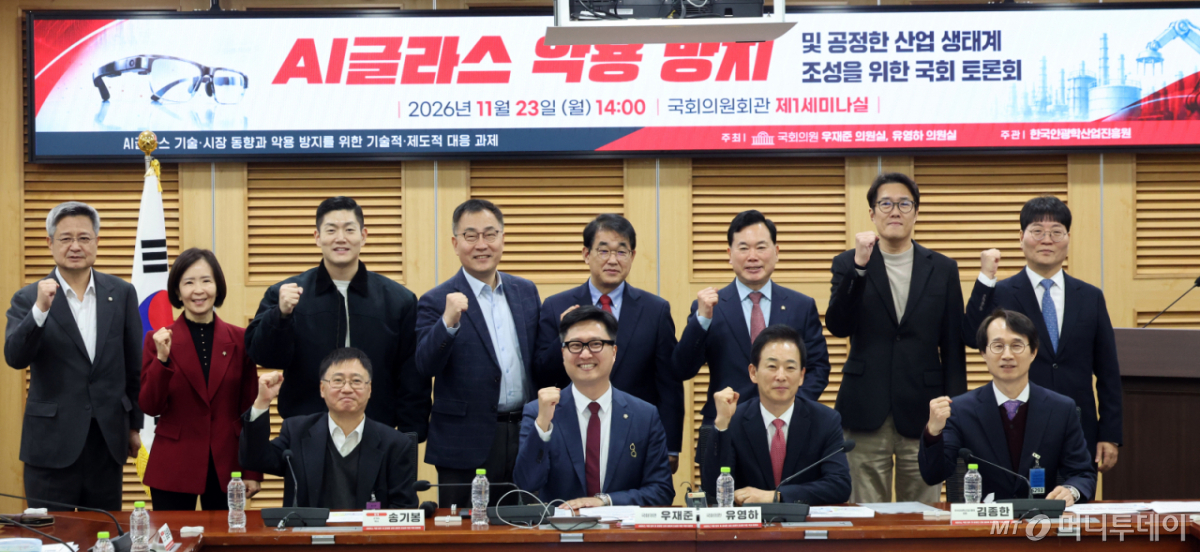
Yang Seung-hyeok, chief of the Customs Planning Division at the Korea Customs Service, said this on the 23rd at the "National Assembly Symposium on Preventing the Misuse of AI Glasses and Creating a Fair Industrial Ecosystem," held at the Seoul Yeouido National Assembly Members' Hall.
The symposium was co-hosted by the offices of People Power Party Reps. Woo Jae-jun and Yoo Young-ha, with the Korea Optical Industry Promotion Institute serving as the organizer.
Yang said, "For AI glasses purchased directly from overseas, clearance is granted simply by submitting a list," adding, "We plan to exclude them from list-based clearance by the end of this month."
He continued, "Exclusion from list-based clearance means that an import declaration must be filed," explaining that this signifies AI glasses will be subject to management through import declarations.
However, the exemption from import requirements under the current Radio Waves Act remains in place for one unit imported by an individual for personal use.
Yang noted, "There are cases where items are continuously imported and sold one by one," and stated that the agency would strengthen inspections of goods suspected to be for commercial use by analyzing transaction information and import records.
The Korea Customs Service has also established and is operating standard product names and specification codes to distinguish AI glasses, starting from the 26th of last month.
Previously, these items were reported in a scattered manner as computers, ultra-small cameras, monitors, etc., making it difficult to obtain accurate import statistics.
Yang emphasized that "due to the nature of AI wearable devices, customs clearance management alone is insufficient to prevent domestic distribution or misuse issues," stressing the need for legal improvements and cooperation from relevant government ministries.
At the event, Rep. Woo Jae-jun and others demonstrated wearing AI glasses made by China's Rokid while solving problems from this year's College Scholastic Ability Test (CSAT). When Rep. Woo presented questions in English, mathematics, and Japanese, the AI glasses provided correct answers to a significant number of the questions.
Technical measures to prevent the misuse of AI glasses were also discussed. Dr. Song Ki-bong of the Electronics and Telecommunications Research Institute (ETRI) proposed introducing markings or NFC (Near Field Communication)-based identification devices to distinguish between ordinary eyeglasses and AI glasses.
However, he explained the limitations, noting that it is difficult to apply the same standards to overseas products, and that adding security features could lead to increased heat generation and power consumption.
Government ministries expressed a stance that, alongside measures to prevent misuse, efforts should be made to nurture the domestic industry.
Lee Yoon-seop, team leader of the Display and Home Appliances Team at the Ministry of Trade, Industry and Energy, asked, "Is something with an attached camera truly AI glasses?" and stated, "Before discussing standards, we need to quickly grow the domestic ecosystem."
So Na-young, a senior official in the Digital Content Division of the Ministry of Science and ICT, also placed emphasis on creating a safe usage environment rather than regulation.
So said, "I agree with the necessity of preventing the misuse of AI glasses," adding, "Since AI glasses are an important growth area for the future XR (Extended Reality) industry, we will proceed in the direction of establishing safe usage guidelines, monitoring, and cooperating with relevant ministries, rather than simple regulation."

 in TECH
