

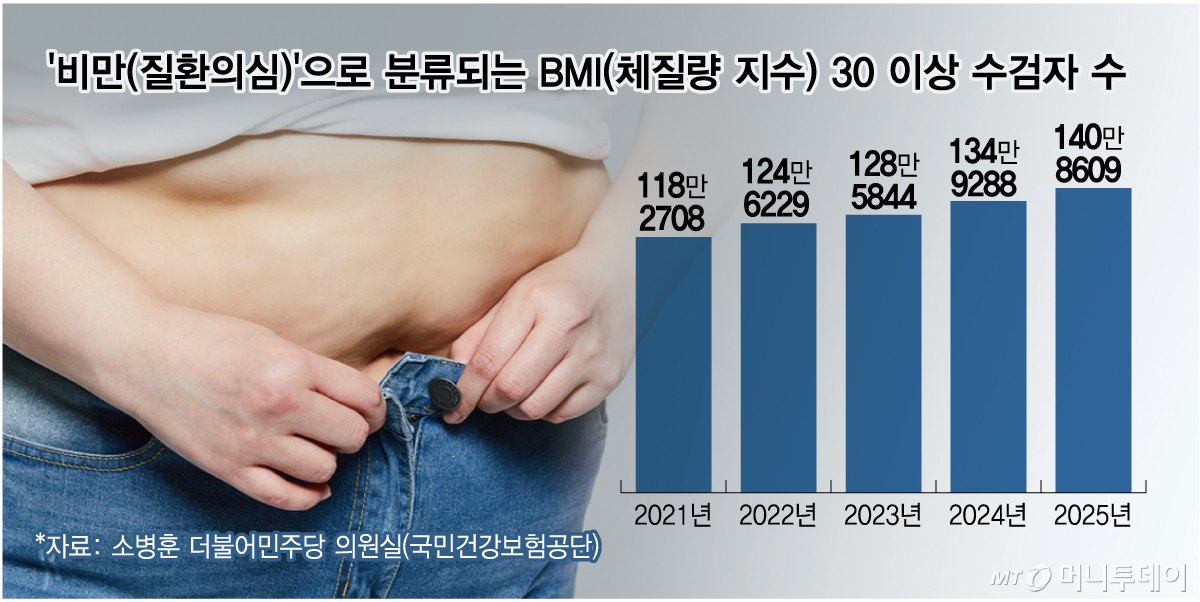
Among health screening participants, the number of individuals classified as having obesity at a level requiring treatment increased by more than 220,000 over four years. Given that obesity is a major risk factor for cardiovascular diseases and other conditions, voices are emerging calling for the “phased insurance coverage” of obesity drugs, particularly focusing on low-income groups who have limited access to treatment.
According to data obtained from the National Health Insurance Service by the office of Rep. So Byung-hoon, a member of the Democratic Party of Korea and the National Assembly’s Health and Welfare Committee, on the 1st, the number of examinees classified as “obesity (suspected disease)” with a BMI of 30 or higher in national health screenings rose from 1,182,708 in 2021 to 1,408,609 in 2025, an increase of 225,901 (19.1%) over four years. During the same period, the number of examinees with a BMI of 40 or higher (severe obesity) increased by 45%, from 30,478 to 44,317.
Medical utilization for comorbidities associated with obesity has also expanded. Among examinees with a BMI of 30 or higher, outpatient visits for diabetes increased by 25.5% in 2025 compared to 2021. During the same period, hypertension increased by 23.9%, and dyslipidemia by 35.4%. Outpatient visits for sleep apnea more than doubled from 8,894 to 21,130, while inpatient visits rose by 91.5% from 4,376 to 8,380.
The national financial burden is also growing. According to the National Health Insurance Service, medical costs related to obesity expanded by 40.5%, from 628.89 billion won in 2017 to 883.54 billion won in 2021. The socioeconomic disease burden, including medical costs and productivity losses, also increased by 30.8% during this period, from 1,195.5 billion won to 1,563.82 billion won.
As the obese population continues to grow, arguments are being made that access to treatment must be improved for those who require medical “treatment” rather than cosmetic purposes. GLP (glucagon-like peptide)-1 class obesity drugs such as Mounjaro (active ingredient tirzepatide) and Wegovy (semaglutide) are prescribed on a non-insured basis in South Korea.
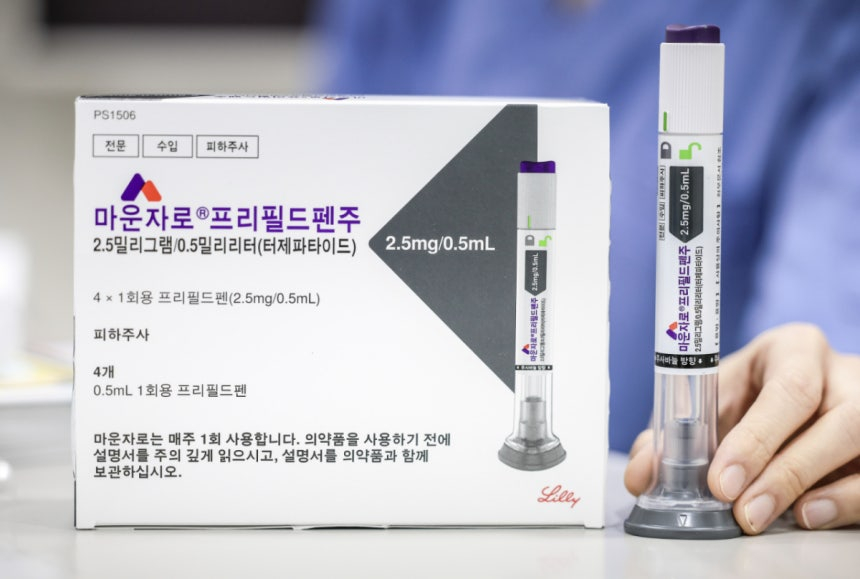
In contrast, overseas countries are strengthening national support for obesity treatments. Japan determines insurance coverage eligibility by considering BMI along with comorbidities such as Type 2 diabetes, hypertension, and dyslipidemia. In the United States, a pilot program has been underway since July last year to provide certain GLP-1 drugs to beneficiaries of the public health insurance “Medicare Part D” (elderly and disabled individuals).
Consequently, cases of so-called “Sushizaro” (sushi + Mounjaro), where people travel to nearby Japan to receive obesity treatment at relatively low prices, are increasing in South Korea. The price of Mounjaro prescribed locally is generally known to be under 100,000 won. This is about one-third the level in South Korea (approximately 300,000 to 400,000 won).
Park Jeong-hwan, Director of External Cooperation and Policy at the Korean Society for the Study of Obesity (Head of Endocrinology and Metabolism at Hanyang University Hospital), emphasized, “Preventing progression to Type 2 diabetes and cardiovascular diseases through obesity treatment is a global trend in therapy.” He added, “Especially among women, those with lower education levels and income brackets tend to have more severe obesity. Phased insurance coverage of obesity drugs prioritizing low-income groups with limited access to treatment is necessary.”
The Ministry of Health and Welfare stated in its materials for the National Assembly audit that it “can review the eligibility for health insurance listing and application criteria if pharmaceutical companies submit applications for insurance coverage determination for obesity treatments intended for disease therapy.” However, it added that estimating the expected patient scale and financial requirements is difficult because relevant coverage criteria have not yet been established. The Ministry of Health and Welfare is reportedly prioritizing the review of insurance coverage for treatments of severe rare and intractable diseases from the perspective of strengthening health insurance security.
So Byeong-hun (Rep.) emphasized, “Patients who require continuous treatment due to severe obesity or comorbidities should be addressed separately from those seeking cosmetic purposes.” He added, “It is necessary to specifically review reasonable treatment and coverage criteria, the possibility of health insurance application, and fiscal impacts by carefully analyzing the scale of the population requiring treatment based on BMI and comorbidities, as well as the disease burden.”

 in THEBIO

