


There are cases where patients who visit a hospital due to back pain or unexplained fractures are unexpectedly diagnosed with "cancer." This is blood cancer, specifically "multiple myeloma," which is accompanied by bone pain.
In the Netflix series that gained popularity last year, "Palm Tree Road," the protagonist "Yang Gwan-sik" (born in 1950) also passed away from multiple myeloma. "Gwan-sik" happened to discover the disease during a health checkup when it was already quite advanced, but despite several rounds of chemotherapy, he died in November 2006 at the age of 56.
Multiple myeloma is considered one of the three major blood cancers, along with leukemia and malignant lymphoma, but due to the nature of the disease, symptoms appear very diversely, leading to late detection in many cases. Specialists recommend getting a blood test if unexplained bone pain, anemia, or kidney abnormalities persist.
Multiple myeloma is a blood cancer that occurs when plasma cells, a type of white blood cell found in the bone marrow, abnormally differentiate and proliferate. Plasma cells normally produce antibodies to perform immune functions, but abnormal proliferation interferes with the production of normal blood cells and causes damage to various organs such as bones and kidneys.
According to the Ministry of Health and Welfare and the National Cancer Registration Office, there were 2,010 new cases of multiple myeloma in Korea in 2023. By age group, those in their 60s accounted for the highest proportion at 32.2%, followed by those in their 70s at 31.8% and those aged 80 and above at 18.1%. It is a representative blood cancer of the elderly, with patients over 60 accounting for more than 80% of all cases. While the average age of diagnosis is around 70 and it mainly occurs in middle-aged and older adults, there is no need to give up treatment due to age.
Survival rates have also improved significantly due to advances in treatment technology. According to the same statistics, the 5th-year relative survival rate for multiple myeloma from 2019 to 2023 was 50.8% for both men and women. This represents more than a doubling of the survival rate, which was only 23.7% in the early 1990s. Doctors agree that "if Gwan-sik had been diagnosed in 2025, he might have survived."
Seong Hwa-jeong (Prof.) from the Department of Hematology-Oncology at Korea University Ansan Hospital said, "Multiple myeloma is often detected late, but survival rates have improved significantly as the development of treatments has become active recently," adding, "If you have suspicious symptoms, you should see a specialist without hesitation."

The four major symptoms of multiple myeloma are 'CRAB'
The representative symptoms of multiple myeloma are summarized as "CRAB." This acronym stands for HyperCalcemia, Renal insufficiency, Anemia, and Bone lesion.
Bone pain is the most common symptom, often starting with back or Galbi bone pain, and fractures can occur even from minor impacts. Severe fatigue and shortness of breath due to anemia may also be accompanied. Proteinuria may appear due to kidney dysfunction, or symptoms such as blood becoming viscous may occur due to excessive secretion of abnormal antibody proteins. Susceptibility to infections due to weakened immune function is also a characteristic feature.
The problem is that these symptoms are easily confused with simple aging or other diseases. There are also cases where the disease is discovered incidentally through anemia tests, kidney tests, or protein level tests.
Professor Sung said, "Multiple myeloma often presents with a combination of bone pain, anemia, and kidney abnormalities, but it is frequently detected after the disease has progressed because these symptoms are dismissed as simple aging," urging, "It is important to get a blood test if unexplained back pain, fatigue, or kidney abnormalities persist."
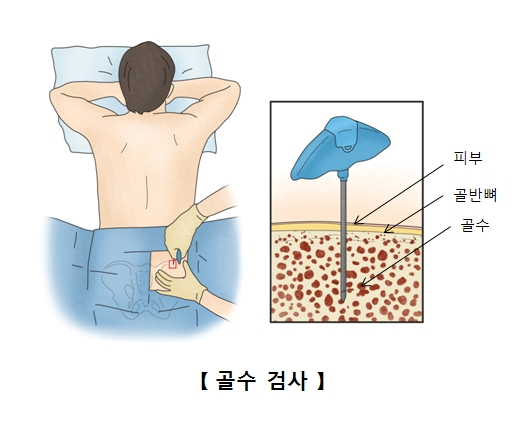
How is it diagnosed?… The reason why bone marrow examination is essential
Diagnosis of multiple myeloma utilizes blood tests, urine tests, imaging tests (X-ray, PET-CT, CT, MRI), and bone marrow biopsy. Among these, the bone marrow biopsy is an essential test for diagnosis. This is because it plays a crucial role in determining the treatment direction and risk level by confirming the proportion of plasma cells and the presence of genetic abnormalities.
M protein (monoclonal protein) detected in blood and urine is also an important indicator. M protein levels are used not only for diagnosis but also to evaluate treatment response and prognosis. The stage of multiple myeloma is classified from Stage 1 to Stage 3 according to the International Staging System (ISS). Blood cancer is characterized by having its treatment direction determined based on stage and risk level.
To date, a cure for multiple myeloma is difficult. However, it is considered a disease where long-term survival is possible as various treatments have become available to cope with continued relapses.
Treatment proceeds in three main stages. Stage 1 is targeted immunotherapy and chemotherapy aimed at lowering M protein levels as much as possible. Stage 2 is autologous hematopoietic stem cell transplantation, a method of recovering immune function by transplanting the patient's own hematopoietic stem cells after high-dose chemotherapy. This treatment is mainly applied to suitable patients under the age of 70. Stage 3 is maintenance therapy to prevent relapse, which involves taking medication for a long period.
In addition to autologous transplantation, treatment methods include allogeneic transplantation, which involves transplanting hematopoietic stem cells from another person. Allogeneic transplantation can be expected to have therapeutic effects, but due to the high risk burden on the patient, it is carefully considered only when there are no more available treatments.
Professor Sung emphasized, "Multiple myeloma is a disease with frequent relapses, but since new treatment methods can be applied each time it relapses, it is important to approach it as long-term management rather than a cure," adding, "Since patients can survive for a sufficiently long period while controlling symptoms and maintaining quality of life through treatment, it is most important to actively undergo treatment even after diagnosis."

 in THEBIO


