

Two out of every three tertiary general hospitals are found to have been supplied by the same pharmaceutical wholesaler, which has held the No. 1 spot in drug supply for three consecutive years. Among these, a significant number of wholesalers are in a "special relationship" with the school foundations that own university hospitals, prompting calls to investigate whether cost reductions through competition have been properly achieved.
According to the "Status of Pharmaceutical Suppliers at Tertiary General Hospitals" submitted by the Health Insurance Review and Assessment Service (HIRA) to Democratic Party of Korea lawmaker Nam In-soon on the 8th, among a total of 47 tertiary general hospitals in the fifth term (2024–2026), 31 hospitals (66%) have had the same pharmaceutical wholesaler as the top supplier (based on shipment value) for three years since designation.
An analysis by MoneyToday based on audit reports and other documents from each wholesaler revealed that a considerable number of these wholesalers are in special relationships with school foundations that own university hospitals. An Yeon Care, in which Yonsei University School Foundation holds a 49% stake, supplied approximately 89% (about 411 billion won), 90% (about 131.3 billion won), and 97% (about 78.6 billion won) of total pharmaceuticals to Severance Hospital, Gangnam Severance Hospital, and Wonju Severance Christian Hospital, respectively, last year. In the same year, An Yeon Care paid a dividend of 9 billion won to the school foundation. This concentration in transactions continued this year as well, with An Yeon Care’s market share at the three Severance-affiliated hospitals reaching 89% to 97% from January to July, and total supply value recording 424.8 billion won.
There are a total of 11 places where "special relationship wholesalers" in which school foundations directly or indirectly hold shares have secured the No. 1 spot in supply: △ Ajou University Hospital (Tri Medical) △ Gillee Hospital (Incheon Union Pharmaceuticals) △ Chung-Ang University Hospital (C&N Medical) △ Kyung Hee University Hospital (Pharm Road) △ Busan Paik Hospital (White Pharm) △ Ewha Womans University Mokdong Hospital (E&S Care) △ Konkuk University Hospital (K-Pharm) △ Hanyang University Hospital (S&B Pharm), among others. In addition, Via Da Vinci, a pharmaceutical wholesaler in which the Catholic Seoul Archdiocese Foundation for Maintenance, which operates Seoul St. Mary’s Hospital, previously held an 80.12% stake, has recorded an overwhelming supply rate of over 90% for several years at three tertiary general hospitals: Seoul St. Mary’s Hospital, Incheon St. Mary’s Hospital, and St. Vincent’s Hospital.
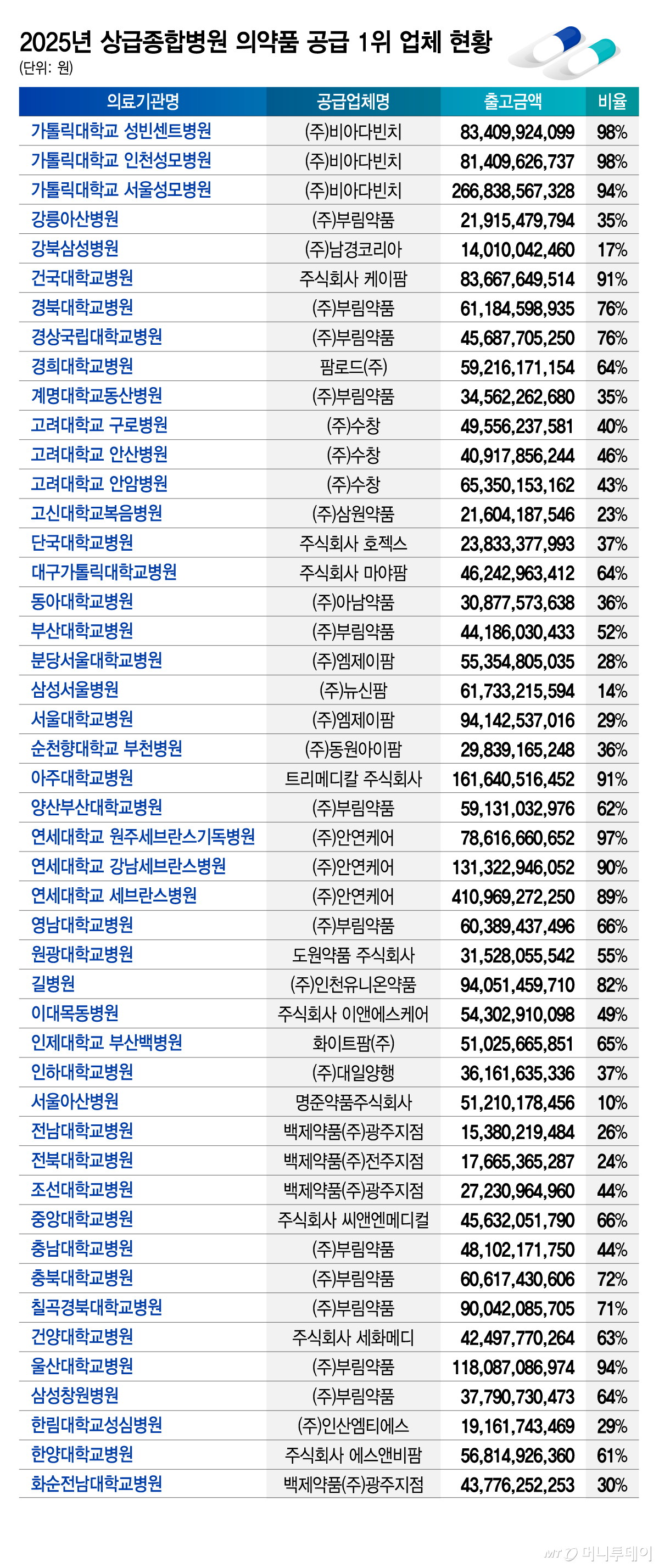
Bulim Pharmaceuticals, based in Seoul and Daegu, has held the No. 1 spot in pharmaceutical supply for three consecutive years at 11 locations, including Ulsan University Hospital, through "aggressive bidding." An industry official in pharmaceutical distribution analyzed, "It appears they are pursuing a 'growth' strategy by building brand awareness through university hospital deliveries and compensating for profit losses from lowest-price bidding through off-hospital prescriptions and other means." Excluding Bulim Pharmaceuticals and MJ Pharm, which maintains the No. 1 spot at Bundang Seoul National University Hospital, most companies, including wholesalers with confirmed special relationships, have not secured the top supply position outside of "affiliated" hospitals.
On the other hand, there were cases where special relationship wholesalers without clear track records appeared among top suppliers. Seoseok Pharm, in which Chosun University School Foundation holds a 49% stake, rose to become the third-largest supplier by supplying 23% of pharmaceuticals for Chosun University Hospital immediately after its establishment this year. Under the current Pharmacy Act, sales of pharmaceuticals and other items to medical institutional investors are prohibited for "special relationship persons," but a special relationship is only recognized if one holds more than 50% of shares or exerts dominant influence over the composition of corporate officers, business operations, etc. Special relationship wholesalers avoid this by keeping school foundation shares at 49% or below or limiting the number of officers.
Opinions coexist that long-term transactions with specific wholesalers strengthen the safety and expertise of pharmaceutical supply, while critical views suggest that the effect of drug price reductions through price competition may be limited. In particular, Nam In-sun (Rep.) pointed out, "Wholesalers connected by networks and shares with hospitals and school sides buy goods cheaply and sell them at high prices to special relationship hospitals, using the substantial difference to swell only the pockets of hospital or school sides as profits and dividends," adding, "The problem of health insurance premiums paid by citizens being privatized by hospital directors and school sides remains unresolved."
The Ministry of Health and Welfare plans to conduct a survey on the status of special relationships and unfair practices in pharmaceutical and medical device distribution until December this year and prepare countermeasures.

 in THEBIO

