

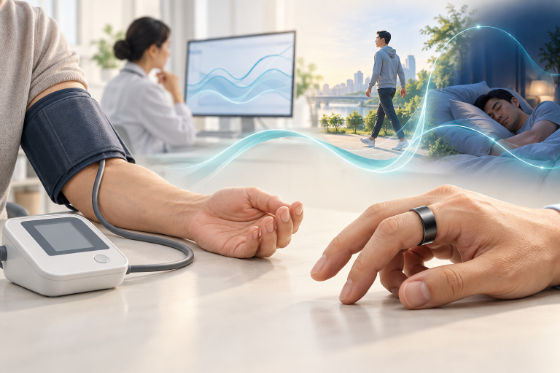
The competition over "cuffless" (non-oscillometric) technology, which measures blood pressure without wrapping a compression band around the arm, is expanding into clinical settings. As wearable devices such as rings clear regulatory hurdles in various countries, clinical validation to utilize daily blood pressure fluctuations in medical care is also underway. The focus of competition is shifting from measurement convenience to the reliability of data that healthcare providers can use for diagnosis and treatment.
According to industry sources on the 7th, U.S. digital health company Happy Health received 510(k) clearance from the U.S. Food and Drug Administration (FDA) last month for its blood pressure measurement system, the "Happy Health Blood Pressure Monitor." The device calculates blood pressure by analyzing signals collected from a smart ring, featuring no need for a calibration procedure that involves inputting measurements from existing cuff-type sphygmomanometers. However, this clearance is limited to spot blood pressure measurements in individuals aged 22 to 50; separate performance validation is required to utilize daily blood pressure changes in clinical care.
Medical demand for new blood pressure measurement technologies is significant. According to the World Health Organization (WHO), there were approximately 1.4 billion hypertension patients aged 30 to 79 worldwide in 2024, accounting for 33% of the population in that age group. Only 44% of patients had received a diagnosis and were undergoing treatment, while just 23% had controlled blood pressure. Approximately 600 million people with hypertension were unaware of their condition.
Hypertension progresses without distinct symptoms, increasing the risk of myocardial infarction, stroke, heart failure, and chronic kidney disease. The starting point for management is accurate measurement. Even after initiating treatment, it must be confirmed whether blood pressure is maintained at target levels and during which time of day it rises.
Blood pressure varies depending on activity, sleep, stress, and medication intake. White coat hypertension, where readings are high only in the hospital, and masked hypertension, where readings are normal in the clinic but high in daily life, are difficult to identify based solely on one or two measurements taken at a hospital. Nocturnal hypertension, characterized by high blood pressure during sleep, can also be missed with clinic-based measurements.
The method for confirming this is 24-hour ambulatory blood pressure monitoring (ABPM). Patients wear the monitor while going about their daily lives, recording daytime and nighttime blood pressure. Existing cuff-type devices measure blood pressure by compressing the arm at regular intervals. Cuffless devices aim to enhance the convenience of long-term measurements by acquiring data without compression.
Lee Hae-young, a professor in the Department of Cardiology at Seoul National University Hospital, explained, "Spot blood pressure (measured at a specific point in time) is an important indicator showing the condition at that moment, but it does not explain the patient's entire daily blood pressure profile. It helps evaluate the risk and prognosis of cardiovascular and cerebrovascular diseases when considering the flow of blood pressure throughout the day, including daytime, nighttime, and morning blood pressure, as well as blood pressure variability."
This is a similar approach to the use of continuous glucose monitors (CGMs) in diabetes. Measuring blood sugar only at specific points can miss postprandial spikes or nocturnal hypoglycemia. When changes over time are recorded, trends that were difficult to detect with a single test become visible. Cuffless blood pressure devices also aim for technology that displays blood pressure not as a single "point" but as a "line" continuing throughout the day.
The key is accuracy rather than the number of measurements. Blood pressure is influenced by various factors such as posture, movement, and peripheral blood flow. Even if a device can be worn for long periods, it must be verified whether the values obtained during actual daily life and sleep are reliable. Current diagnostic criteria for hypertension and treatment targets are also largely established based on clinical evidence accumulated using existing cuff measurement methods.
Professor Lee stated, "It is welcome news from the perspective of technological advancement that more cuffless blood pressure devices are receiving FDA clearance. However, for new methods to become established in actual clinical practice, they must undergo sufficient clinical validation so that healthcare providers can trust the measurements."
Domestic company SkyLabs will begin a clinical study on its ring-shaped "CART" blood pressure monitor for hospitals and clinics, aiming for official validation by the British and Irish Hypertension Society (BIHS). The study is designed to verify 24-hour ambulatory blood pressure measurement performance in daily life, in addition to accuracy at specific points.
Subjects will wear both a ring-shaped blood pressure monitor and an existing cuff-type ambulatory blood pressure monitor for 24 hours of daily living, after which the daytime, nighttime, and 24-hour blood pressure readings from the two devices will be compared. If the study results meet the criteria, it will lead to a decision on inclusion in the BIHS list of validated devices.
Institutional investor adoption in clinical settings also requires an institutional foundation beyond approval. Approval is a procedure that determines whether a product can be sold for designated uses. Clinical guidelines provide healthcare providers with criteria for which patients and situations warrant device use. Insurance coverage affects patient testing costs and the conditions for institutional investor adoption.
In Korea, SkyLabs' "CART BP Pro" has received medical device approval and is being used in 24-hour ambulatory blood pressure tests covered by national health insurance. The Korean Society of Hypertension also included cuffless blood pressure monitors as clinical blood pressure monitoring devices in its clinical guidelines revised this year. This is a case where the foundation for clinical use was expanded through insurance coverage and reflection in clinical guidelines following device approval.
SkyLabs aims to complete the UK study within the year. Based on the clinical results obtained, the company plans to pursue inclusion in the BIHS validated device list and entry into the UK public insurance reimbursement system, as well as utilize the findings for adoption in clinical settings in other European countries.
A SkyLabs official said, "The era of cuff-based blood pressure measurement, which has continued for over 100 years, will not change overnight. However, just as CGMs broadened the focus in diabetes management from 'a single glucose reading' to 'the flow of glucose throughout the day,' if cuffless technology becomes established after sufficient clinical validation, hypertension care may shift toward looking at 'blood pressure throughout the day' rather than 'a single blood pressure reading.'"

 in THEBIO
