


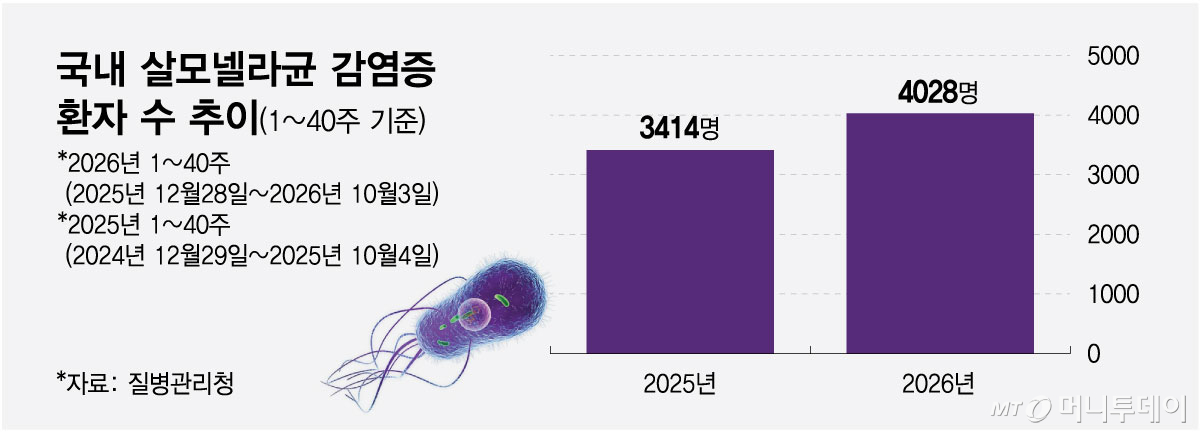
The cumulative number of Salmonella infections this year has surpassed 4,000, an increase of approximately 18% compared to the same period last year. The number of infected individuals surged by more than 90% following the Chuseok holiday.
According to KDCA infectious disease sample surveillance statistics released on the 12th, there were 750 cases of Gi Jun (Minister) infection in Week 40 of this year (September 27 to October 3), an increase of more than 50% compared to Jeonju (499 cases). In particular, the number of Salmonella infection patients in Week 40 was 275, a sharp rise of 93.7% from Jeonju (142 cases).
The cumulative number of Salmonella infections this year (Weeks 1 to 40) stood at 4,028, an 18% increase from the same period last year (3,414). The Disease Control and Prevention Agency stated, "Salmonella infections have increased significantly since the Chuseok holiday," adding that "continuous monitoring is necessary."
Cases of Salmonella infection are also increasing overseas. According to the UK Health Security Agency (UKHSA), as of mid-September last month, there were 355 confirmed cases of Salmonella infection in the UK and one death. The local Food Standards Agency (FSA) is currently investigating a recent outbreak of Salmonella infection and has urgently recommended that a company halt sales after detecting Salmonella in some egg products supplied by a poultry company in Kyiv, Ukraine.
Salmonella infection is cited as a common cause of food poisoning. According to food poisoning occurrence statistics released by the Ministry of Food and Drug Safety, the number of domestic food poisoning infections last year was 9,780, with Salmonella accounting for the largest share at 43% (4,248 cases) of the total.
Salmonella infection is divided into "non-typhoidal," which causes symptoms such as diarrhea, and "typhoidal," a severe form in which bacteria spread throughout the body via the bloodstream. Among these, non-typhoidal Salmonella infection is the most common form and can occur when consuming undercooked meat or eggs, drinking unpasteurized milk or juice, eating unwashed vegetables or fruits, or consuming street food and contaminated water or ice. Infection can also occur if hands are not washed after contact with animals such as reptiles, amphibians, and poultry.
Symptoms typically appear within 6 hours to 6 days and may be accompanied by diarrhea, abdominal pain, fever, nausea, and vomiting. Diarrhea varies from loose stools to mucus or bloody stools, and symptoms generally improve within one week. If symptoms are mild without any particular warning signs, and urine output and activity levels remain similar to normal, the condition can be monitored while replenishing fluids.
However, newborns, infants, and immunocompromised individuals should consult a medical professional early, even if their symptoms appear mild. In fact, they are known to have a higher risk of invasive infection. A domestic multi-institutional study (1996–2020) found that Salmonella was the third most common causative agent of invasive infections in immunocompetent children older than 3 months among eight pathogens surveyed (15.3%), and it was the most common causative agent in bacteremia without a localized focus in children aged 24 months or older.
Professor Song Seung-ha at Seoul St. Mary's Hospital, Saint Nicholas Children's Hospital (Pediatric Infectious Disease), emphasized, "In some cases, bacteria can invade beyond the intestinal tract, causing bacteremia or extraintestinal localized infections such as meningitis, osteomyelitis, and suppurative arthritis." He added, "Especially when Salmonella infection is confirmed in children, it is essential to evaluate the possibility of invasive infection by observing age, general condition, and fever progression, while also checking dietary history and exposure to animals or breeding environments."
To prevent Salmonella infection, the most important habit is washing hands with soap and running water after contact with animals. Children should be educated not to eat food or touch their faces or mouths with hands that have touched animals such as reptiles or amphibians. Particular care must be taken to ensure that children under 5 years of age and immunocompromised individuals, who are vulnerable to infection, avoid direct contact with reptiles and amphibians and do not approach breeding environments.

 in THEBIO

