

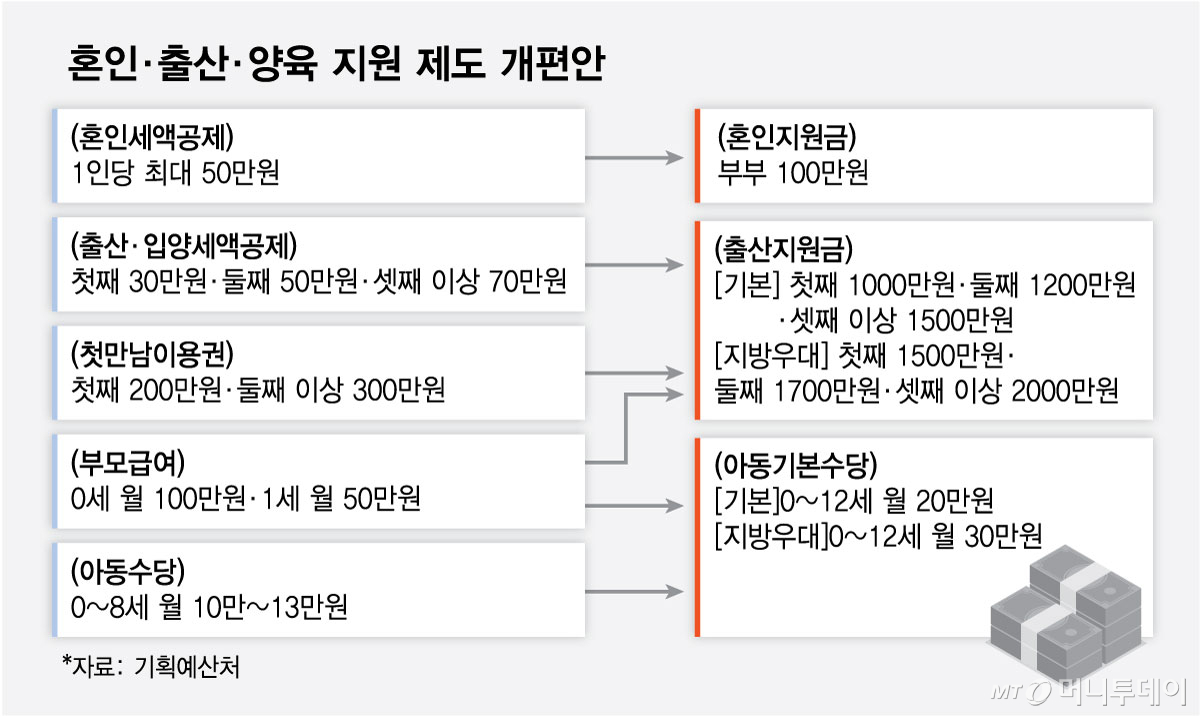
Starting next July, a childbirth support system providing up to 20 million won will be introduced. Child allowances will be renamed "Child Basic Allowance" and increased to at least double the current amount, with monthly payments of 200,000 to 300,000 won. President Lee Jae-myung's election pledge, Our Child Independence Fund, will apply to children born from September this year onward.
According to the '2027 Budget Proposal' finalized at the State Council meeting on the 1st, a new three-package system for marriage, childbirth, and child-rearing to address low birth rates will be introduced starting next July.
The existing marriage tax credit, which provided tax reductions, will be converted into a marriage support grant. Couples who register their marriage will receive one-time payments of 1million won during their lifetime. The marriage support grant will take effect in the second half of next year but will also apply retroactively to couples who registered their marriage after January of next year.
The "First Meeting Voucher," which was paid as vouchers at 2 million won for the first child and 3 million won for the second child and beyond, along with parental allowances providing 1million won per month for infants aged 0 and 500,000 won per month for one-year-olds, and childbirth/adoption tax credits ranging from 300,000 to 700,000 won, will be consolidated into a single childbirth support grant.
The childbirth support grant amounts are 10 million won for the first child, 12 million won for the second child, and 15 million won for the third child and beyond. In regions with local incentives, payments are increased to 15 million won for the first child, 17 million won for the second child, and 20million won for the third child and beyond. The childbirth support grant will be paid in four installments over one year.
Child allowances, which currently provide monthly payments of 100,000 to 130,000 won for children aged 0 to 8, will expand coverage to include children up to age 12 by 2030 in line with national policy goals. Monthly payment amounts will also increase to between 200,000 and 300,000 won. The base monthly amount is 200,000 won, with 300,000 won paid in regions with local incentives.
For the Child Basic Allowance, an additional 300,000 won per month will be provided for children aged 0 to 1 if they are raised at home rather than sent to daycare centers. The total benefit amount under the marriage, childbirth, and child-rearing package ranges from 49.4 million won to 75 million won. Under the existing system, total support amounts range from 36.9 million won to 42.98 million won.
With the childbirth support grant and Child Basic Allowance set to take effect next July, controversies over fairness regarding implementation timing are also expected. In fact, there could be a difference of up to tens of millions of won in benefits received by children born on June 30 versus those born on July 1.
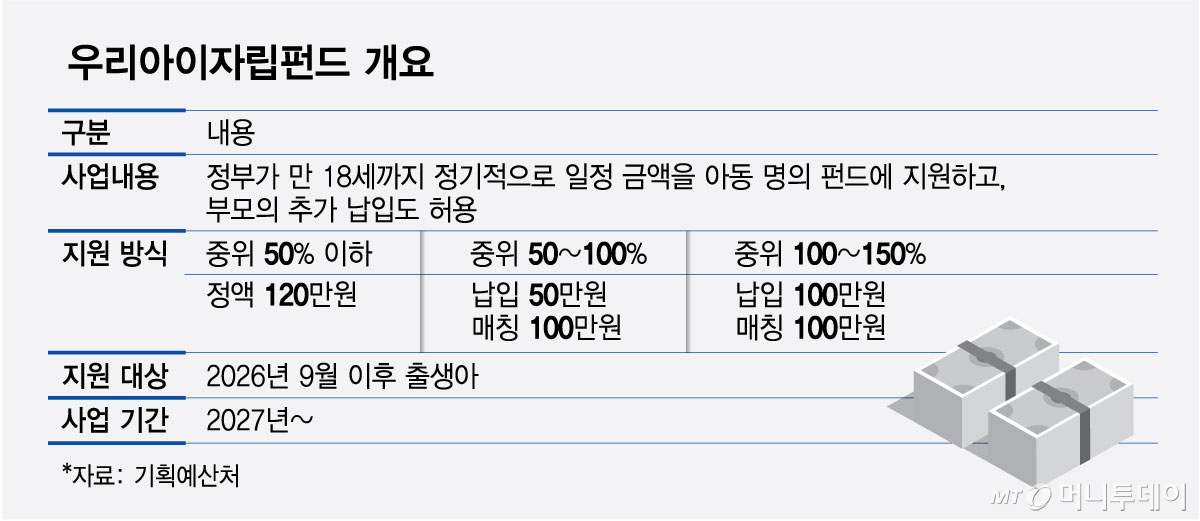
The scale of government support for the Our Child Independence Fund varies according to household income levels. For low-income households with incomes at or below 50% of the median, the government will provide an annual subsidy of 1.2 million won regardless of parental contributions.
For children in households with incomes between 50% and 100% of the median, the government will match twice the amount parents contribute annually (500,000 won). For children in households with incomes between 100% and 150% of the median, the matching ratio is 1:1. If parents contribute 0.1 billion won, the government will also provide 0.1 billion won.
The government expects that upon maturity of the Our Child Independence Fund, families will be able to accumulate a lump sum of between 60 million won and 1 million won.
For young people preparing for employment, youth opportunity funds up to 2 million won will be available as loans. Interest will be waived from the time of borrowing until the recipient secures employment or starts a business, after which repayment will occur at low interest rates of 2% to 4%. Eligible recipients are unemployed youth with annual incomes of 35 million won or less.
To support young people who have entered society in building stable savings, the Youth Future Savings Plan has been introduced, eliminating income and other enrollment requirements.
The Youth Culture and Arts Pass will expand its target beneficiaries to all young people. A "Soldier Group Accident Insurance" plan will be introduced for youth serving in the military, and a proposal is also being advanced to support out-of-pocket insurance premiums for veterans up to 18 months after discharge.

 in ECONOMY

