

The Ministry of Oceans and Fisheries has set the 2027 government budget at 8.2636 trillion won, an increase of 10.8% (805.3 billion won) from this year's 7.4583 trillion won. This is the highest growth rate since the Ministry was re-established in 2013.
The main drivers of this budget increase reflect key initiatives aimed at creating a new growth paradigm for the marine economy, including the development of the Maritime Capital Region, a shift from catch-based fisheries management to a more sustainable system, and accelerated adoption of Marine and Fisheries AI (AX).
On the 1st, the Ministry announced that it has prioritized budget allocations for 2027 to achieve tangible results in the marine and fisheries sectors: full-scale development of the Maritime Capital Region, structural innovation in the fishing industry with revitalization of coastal villages, and investment in emerging marine industries that grow alongside clean seas.
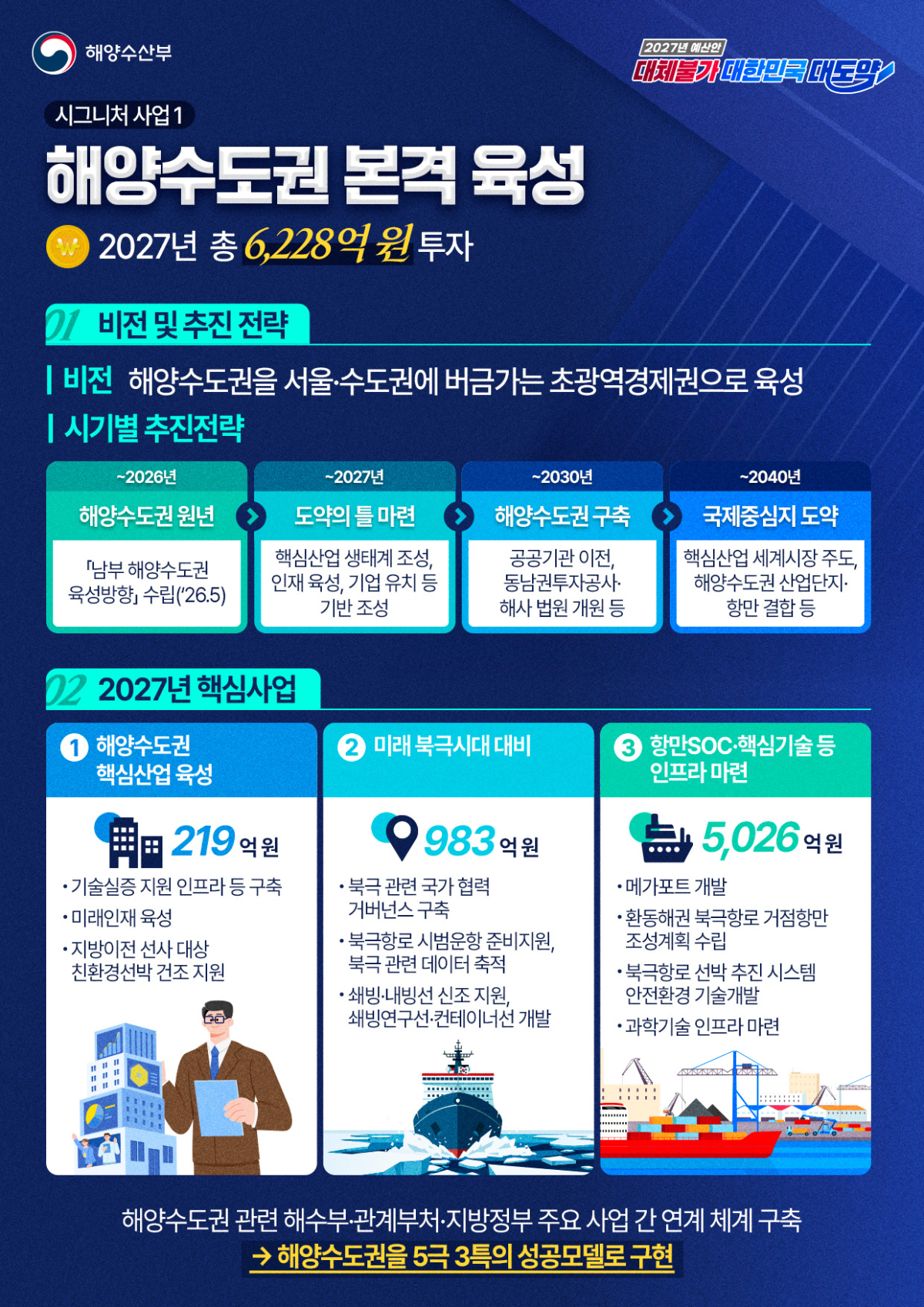
The Ministry will first fully establish the foundation for the Maritime Capital Region and expand investments to enable Korea's shipping and port industries to lead global markets.
To encourage corporate relocation to the Maritime Capital Region, a new support program for eco-friendly ship construction will be introduced for companies that have relocated from metropolitan areas (new allocation: 12.1 billion won).
Additionally, the Ministry will strengthen preparations for pilot operations on the Arctic route, including data collection and international cooperation (new allocation: 18.4 billion won), support for building polar icebreakers and inland ice-capable vessels, and development of ice-breaking container ship technologies to prepare for long-term entry into the Arctic route.
To foster an ecosystem of related industries, the Ministry will build infrastructure for technology validation and cultivate future talent to lead advanced marine industries (new allocation: 9.8 billion won). It will also accelerate port AX through pilot testing of physical AI-based cargo handling and transfer equipment (new allocation: 7.4 billion won) and development of smart port operation technologies (18 billion won).
Global competitiveness in the shipping and port industries will be further strengthened. To lead the autonomous vessel market, the Ministry will introduce autonomous navigation systems on Korean-flagged ships (new allocation: 2.9 billion won) and begin full-scale development of fully autonomous navigation technology (Level 4), increasing funding from 6.3 billion to 15.7 billion won.
Large-scale port development projects, including the new Donghae Port, Saemangeum New Port, and Gunjang Port, will proceed without delay with a budget of 1.68 trillion won to expand insufficient port infrastructure and create a smooth environment for import-export logistics.
To enhance response capabilities to supply chain crises such as the Hormuz incident, loss compensation funds for stable operation of essential national vessels will be expanded to 10 billion won. The functions of the International Logistics Investment Analysis Support Center will also be strengthened, and overseas expansion consulting for shipping and logistics companies will receive an increased allocation of 3.1 billion won.
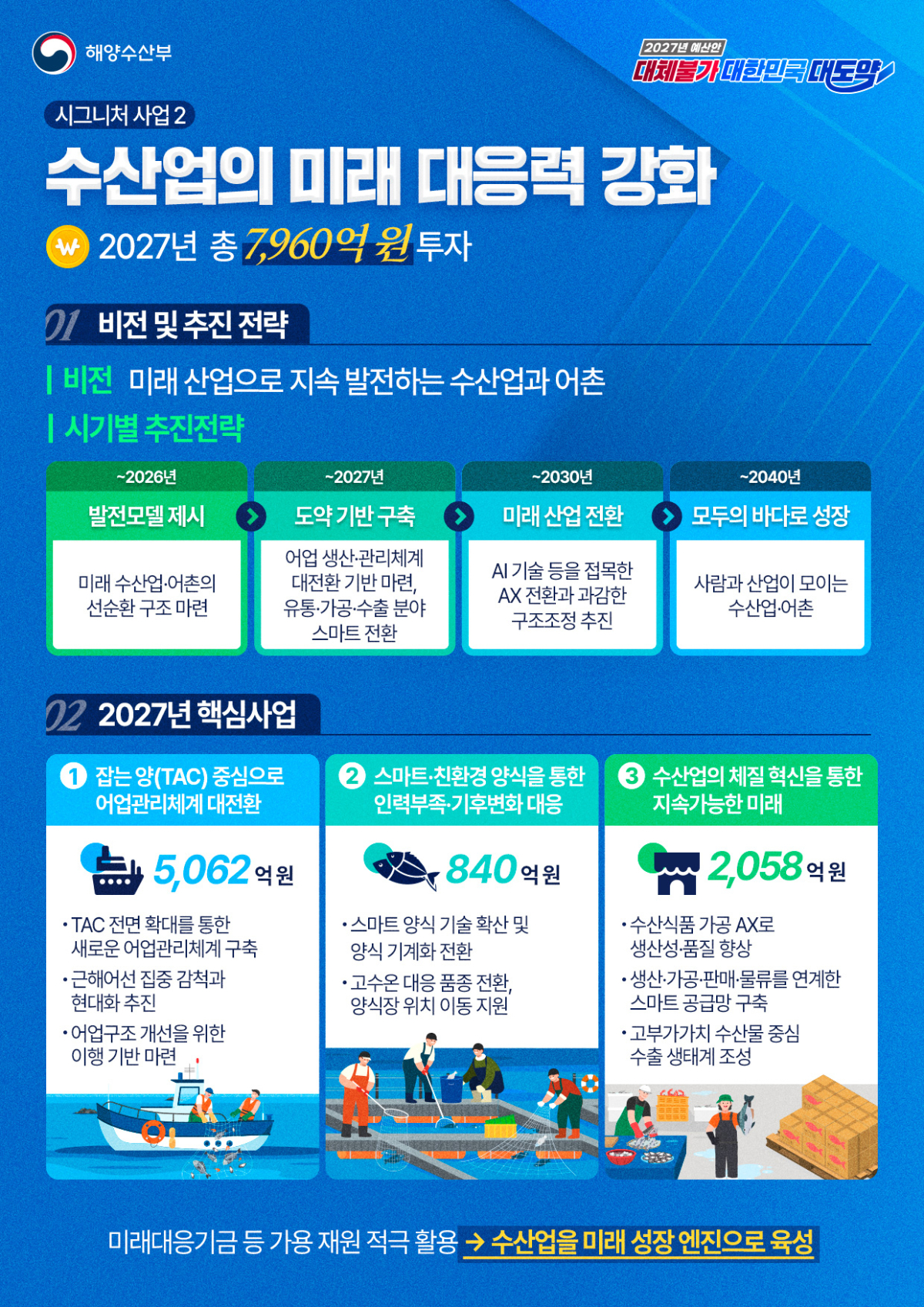
In particular, structural improvements to enhance competitiveness in the fisheries sector and support for creating vibrant coastal villages will be significantly strengthened.
To fundamentally improve the fishing industry structure, the Ministry enacted the "Sustainable Coastal Fisheries Development Act" in June this year. Next year, in line with the law's implementation, new measures including verification of catch volumes at landing stages, inspections of landing ports, operation of a fisheries information management center, and loan support for compliant fishermen will be introduced (new allocation: 105.5 billion won) to establish an enforcement framework.
Furthermore, the Ministry has allocated 6.7 billion won to conduct scientific stock assessments for the full-scale introduction of the Total Allowable Catch (TAC) system and to build a highly reliable TAC calculation framework. Fishing vessel sizes will also be adjusted in alignment with the new fisheries management system.
Looking ahead, over the next five years, the Ministry will intensively reduce coastal fishing vessels and establish a Coastal Fishing Vessel Modernization Fund (39.4 billion won) to modernize and enlarge fishing fleets.
In the export and processing sectors, support for key export items will be expanded to achieve 4 billion dollars in seafood exports by 2028. To boost high-value-added seaweed exports, a K-GIM leading zone will be designated, establishing offshore smart aquaculture farms and land-based leased aquaculture facilities to create a related industrial ecosystem (new allocation: 13.5 billion won).
Measures to address non-tariff barriers for key export items such as tuna will be strengthened through prevention of forced labor on distant-water fishing vessels (new allocation: 1.68 trillion won) and operation of an overseas market analysis center (2.4 billion won). A new dried seaweed stockpiling program will also be introduced (new allocation: 24.2 billion won) to reduce price burdens on citizens for this staple side dish.
Investments for the smart transformation of the fisheries sector will be significantly increased. Smart aquaculture will be continuously expanded through initiatives such as the Smart Fisheries Innovation Leading Zone and Smart Aquaculture Clusters (32.6 billion won), with priority given to mechanization support in labor-intensive aquaculture areas (new allocation: 6 billion won). Support for smart processing to improve productivity and quality of aquatic food products will also be substantially increased (10.2 billion won).
A new budget of 9.6 billion won has been allocated for the coastal passenger ferry public operation system, which will take effect next year, to strengthen transportation rights for island residents.
In addition, to ensure smooth implementation of the "Illegal Occupation and Use Management of Shared Waters" project—a national normalization initiative—the Ministry will begin establishing a GIS-based shared water management system (new allocation: 5.7 billion won) and introduce an immediate removal program for illegal fishing gear (new allocation: 2.1 billion won) to eradicate illegal use of Korean waters. Furthermore, outdated enforcement equipment such as high-speed patrol boats and communication facilities will be replaced with a budget of 15.8 billion won to firmly respond to illegal fishing by Chinese vessels.
Investments in managing marine waste in Jeonju will not be spared. Among Korea's vulnerable coastlines (approximately 3,824 km) where marine trash is heavily concentrated, collection zones will be expanded to more than half, enabling intensive beach cleanup (17.5 billion won). Marine trash collection robots will also be introduced at 10 locations (new allocation: 3.5 billion won).
Minister of Oceans and Fisheries Hwang Jong-woo stated, "The budget for next year focuses on investments that shift the growth paradigm in the marine and fisheries sectors through development of the Maritime Capital Region and structural innovation in fisheries, ensuring citizens can directly experience national achievements." He added, "The Ministry will do its utmost to prepare for National Assembly budget deliberations to support our economy's Daejeon transformation and great leap forward."

 in ECONOMY

