

If the Financial Services Authority and the Korea Deposit Insurance Corporation (hereinafter referred to as KDIC) proceed with raising the deposit insurance premium rate as currently planned, it is estimated that an additional annual burden of approximately 500 billion won will be imposed on the property and casualty insurance industry, and over 1 trillion won on the life insurance industry. In particular, the life insurance industry is expected to face a significantly larger actual burden as the reserve deduction effect under the target fund system disappears.
According to an internal simulation by the insurance industry on the 13th, if the rate increase proposals from the research commission conducted by KDIC are applied to the property and casualty and life insurance industries, the burden will increase substantially. The report from KDIC's research commission proposed raising the deposit insurance premium rate by 0.5% for the property and casualty industry and by 0.4% for the life insurance industry. Currently, both life and property and casualty insurers are subject to a rate of 0.15%.
In the case of 23 property and casualty insurers covered by deposit insurance, excluding the International Monetary Fund (IMF) special contribution, they paid 250 billion won in deposit insurance premiums last year (an average of 10.8 billion won per company). If the rate is raised to 0.5%, the burden for the property and casualty industry will increase by 580 billion won from the current level, reaching 830 billion won (an average of 36 billion won per company).
In particular, the life insurance industry is expected to see a sharp rise in deposit insurance premiums as the reserve deduction under the target fund system expires starting next year. The increased premium rate will be applied from 2028. The target fund system is a mechanism that sets a pre-determined target for reserves to enable the Deposit Insurance Fund to cover unexpected losses, and provides a reduction in deposit insurance premiums paid by financial institutions once the fund's reserve level reaches that target. Currently, only the life insurance industry receives this deduction among all sectors.
The 22 life insurers covered by deposit insurance also paid 280 billion won in deposit insurance premiums last year (an average of 12.7 billion won per company), excluding the IMF special contribution. However, if the rate is raised to 0.4%, this amount will increase to 1.4 trillion won (an average of 63.6 billion won per company) under identical conditions. This means an additional burden of approximately 1.12 trillion won compared to the current level. Converted to a per-company average, property and casualty insurers would need to pay an additional approximately 25.2 billion won, while life insurers would need to pay an additional approximately 50.9 billion won. However, the difference in payment amounts between large and small/mid-sized insurers is expected to be significant in practice.
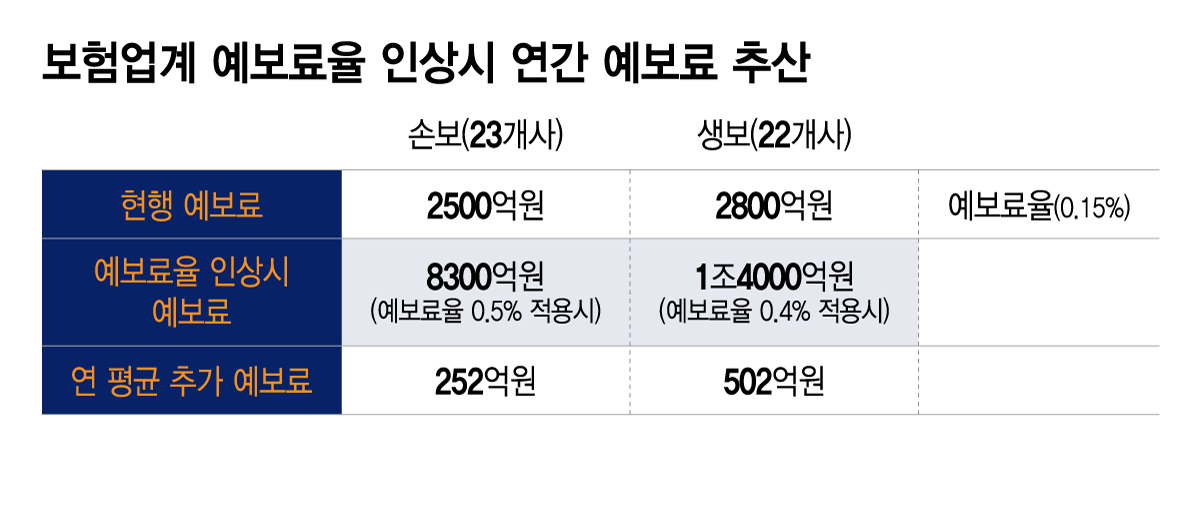
Life insurers, whose overall industry burden will increase substantially, are also taking this matter seriously. This is because the average annual deposit insurance premium for life insurers will exceed twice that of property and casualty insurers. An increase in deposit insurance premiums of around 50 billion won per year does not merely result in a cost increase but also affects CSM (Contractual Service Margin), which is a core indicator for insurers and represents future profits. It is explained that with the introduction of new accounting standards (IFRS17), if future cash outflows increase, it will inevitably impact the valuation of insurance liabilities, and under identical conditions, CSM may decrease by the amount of the increased future cash outflows.
Above all, the burden on financial soundness increases. If the valuation of insurance liabilities rises due to increased deposit insurance premiums, available capital may decrease. Under identical conditions, a decrease in available capital leads to a decline in the K-ICS (Korea Insurance Capital Standard) ratio. The insurance industry is already facing considerable burdens in managing financial soundness, but there are concerns that it may soon be forced to focus solely on financial stability rather than securing new contracts or investing in new businesses. In particular, for small and mid-sized insurers vulnerable in financial management, the immediate increase in deposit insurance premium burden itself acts as a factor pressuring profitability.
A source at an insurance company stated, "I believe that raising the deposit insurance premium will ultimately undermine medium- to long-term growth potential and capital efficiency, inevitably having a negative impact on profitability and corporate valuation."

 in FINANCE
