

[For more diverse company information on startups, you can view it on the Unicorn Factory big data platform 'Data Lab.]
"To become a product that is actually sold, it must be more comfortable, lighter, prettier, and more natural."
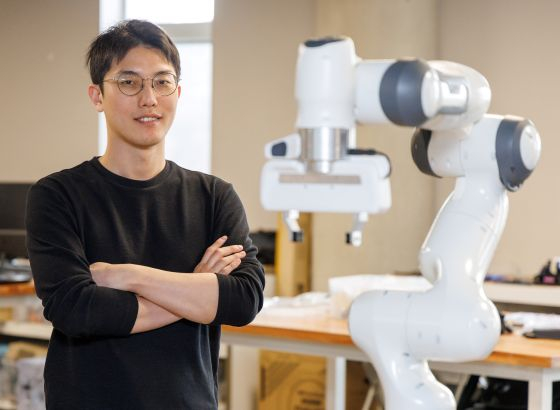
Yoon Sung-sik, CEO of Rebodis (Rebodis), responded to the question about why wearable robots have not yet been popularized in the market by saying, "It is less a problem with the function itself and more that the inconvenience users had to endure to gain that function was too great."
While existing exoskeleton-type wearable robots resembled large and heavy assistive devices for patients, Rebodis is developing 'wearable robots that can be worn invisibly or even like fashion' through a slim and lightweight clothing-form factor. The goal is to reduce the weight and sense of alienation unique to exoskeleton robots by using flexible materials and to achieve a natural and comfortable wearing experience like clothing. Yoon (CEO) emphasized, "We are developing wearable robots that consider everything from weight and comfort, storage convenience, the naturalness of putting them on and taking them off, to the psychological burden felt from others' gazes," adding that this is "a completely different approach from existing exoskeleton-type wearable robots."
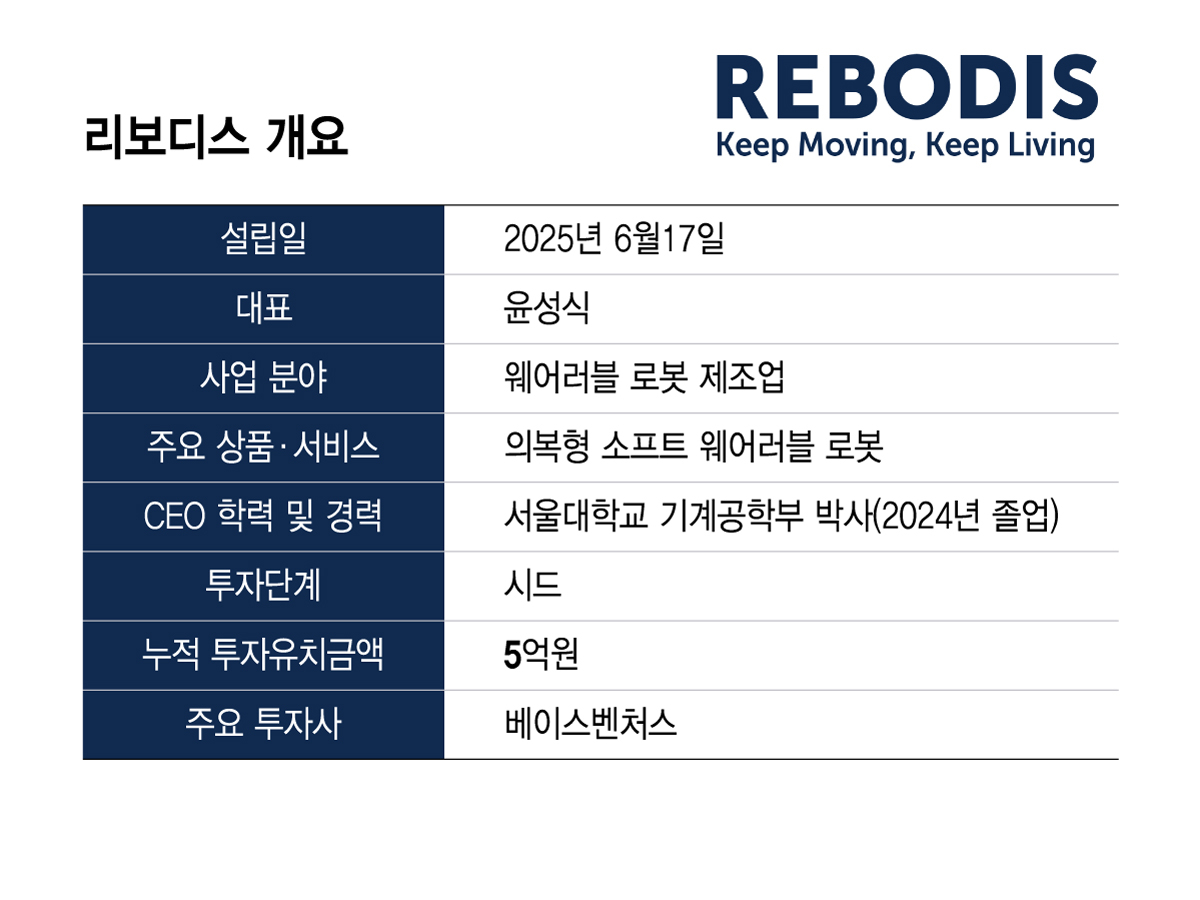
Rebodis is a startup established last year based on research achievements in soft robotics and wearable robotics accumulated at Seoul National University's Bio-Robotics Laboratory. Yoon (CEO) is an alumnus of Seoul National University Gi Gye-gong-hak (Dr.), having accumulated 10 years of research experience in the field of wearable robots and filed numerous domestic and international robotics patents.
Rebodis' differentiating factor is 'modularity.' Existing wearable robots were often designed and manufactured separately for each body part, such as hip, knee, and ankle joints. In this case, users had to purchase devices separately for each required body part, and companies also faced the burden of developing new products for each body part.
In contrast, Rebodis is designing a structure where one drive unit can be utilized across multiple body parts. The core drive and control units remain unchanged, while only the parts worn on the body are swapped out for hip, knee, or ankle versions. It is like replacing accessories on a single main body; modules can be swapped to fit the required body part. This allows users to reduce purchase cost burdens while selecting products tailored to their physical condition and intended use. For companies, it also offers the advantage of being able to expand their product lines more quickly.
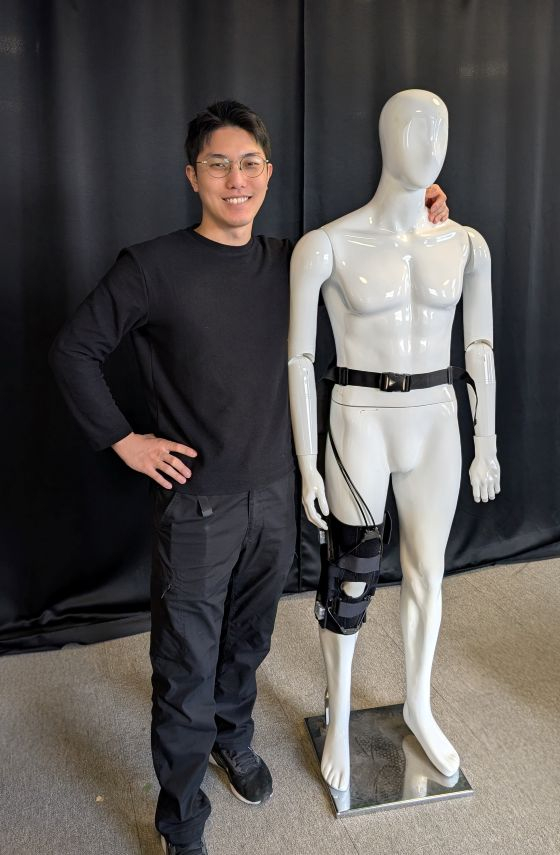
As the first step of this modular strategy, Rebodis developed a prototype 'knee-assistive strength robot' based on wire-driven motors. Currently, it is conducting usability assessments and real-world validation tests with over 70 patients in collaboration with Bundang Seoul National University Hospital. This wearable robot reduces knee joint burden during walking and assists muscle strength during actions like standing up or during rehabilitation exercises.
According to the company, the product showed effects of reducing knee load by approximately 44% when walking downhill and reducing muscle burden by about 34% during standing-up motions. In user surveys, 69% left positive evaluations, and medical staff expressed expectations such as "I want it stocked in treatment rooms" and "It can be utilized in actual treatment sites," the company reported.
Starting with this knee-assistive strength robot, Rebodis plans to expand its product line to include hip, ankle, and elbow versions to complete a modular wearable robot system. In the long term, the strategy is to obtain prescription medical device certification based on clinical data accumulated through modular wearable robots and to enter hospital and public procurement markets.
Recently, this technology and business potential were recognized, and Rebodis was selected for the 8th cohort of Samsung Electronics' external startup incubation program 'C-Lab Outside.' Yoon (CEO) stated, "When wearable robots no longer look like robots, people will start wearing them naturally in their daily lives," and added, "We will create collaboration opportunities with various partners, including clothing brands, to further accelerate our growth speed."
[MoneyToday Startup Media Platform 'Unicorn Factory']

 in FUTURE


