

[For more diverse corporate information on startups, please visit the Unicorn Factory big data platform 'Data Lab'.]
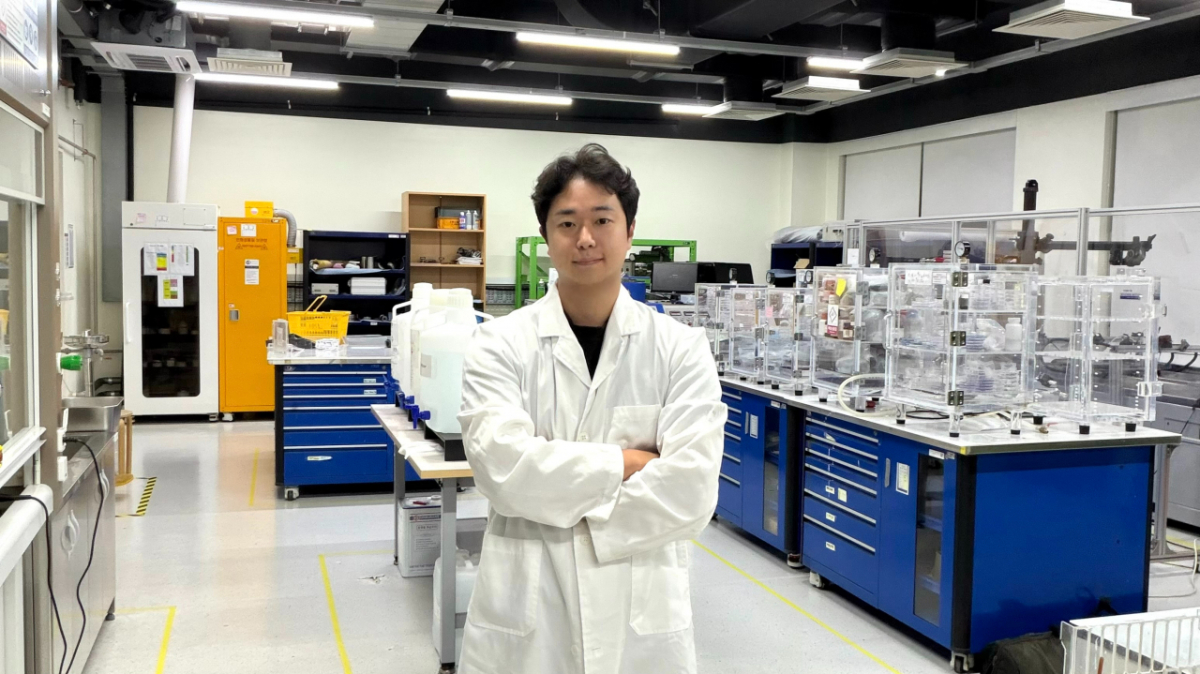
The domestic production rate of parts for the Nuri rocket exceeds 95%, but core materials such as special steels and alloys used to manufacture these parts are largely dependent on imports. Industry analysis suggests that, excluding some general-purpose materials, the import dependency for space-grade special steel is effectively 99%.
AstroMat, a student startup team from Pohang University of Science and Technology (POSTECH), aims to resolve this foreign dependence on space materials through artificial intelligence (AI) and experimental automation. The goal is to design new alloys tailored to the temperature, load, weight, and cost conditions under which rocket and satellite parts operate, and then manufacture these into actual components.
Traditional new material development has often relied on researchers' experience and intuition. This process requires repeated trial and error: altering alloy compositions, manufacturing the material, and verifying its physical properties. Material development alone can take more than five years, with commercialization sometimes requiring 10 to 20 years.
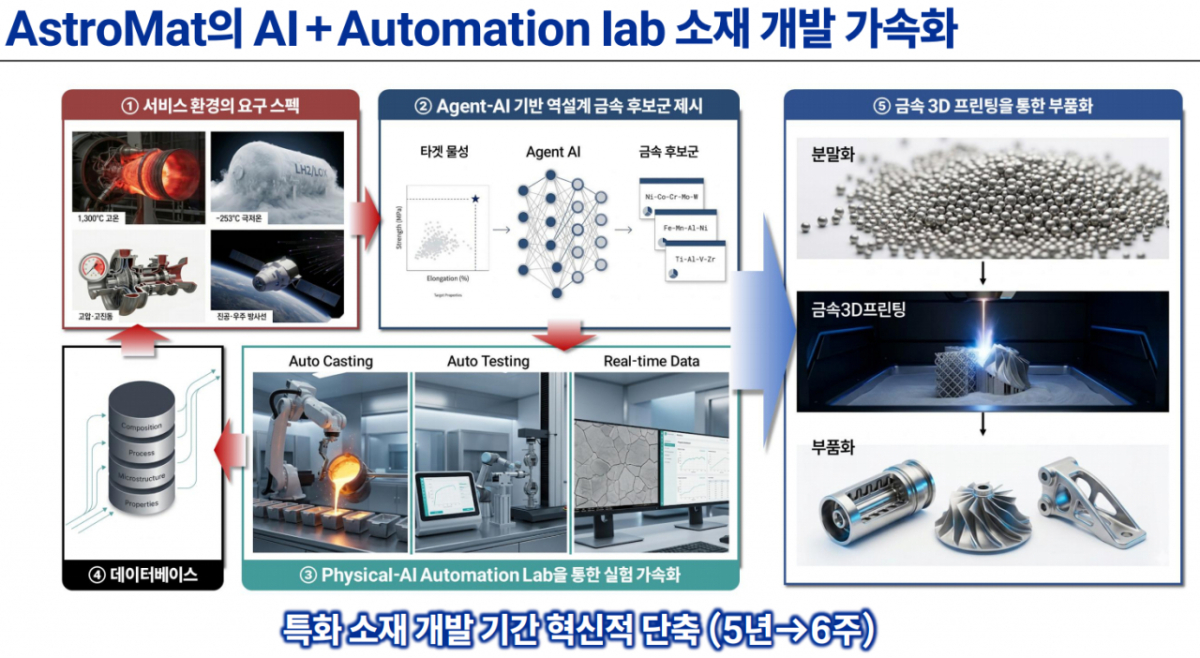
AstroMat's strategy is to combine AI-based alloy reverse design with automated experiments to shorten the period for exploring candidate materials and verifying initial performance to as little as six weeks. The starting point of material development is also shifted from alloy composition to the customer's required performance specifications.
For example, if a customer specifies conditions such as temperature, pressure, load, weight, and price required for a rocket nozzle, the AI generates candidate alloy compositions that can meet the target physical properties. Subsequently, literature and thermodynamic data are reviewed, and the physical properties and manufacturing processes for each candidate composition are predicted.
Candidates proposed by the AI are manufactured and evaluated using automated equipment. Experimental results are then accumulated as learning data and reflected in the next material design. This 'closed-loop' approach connects design, manufacturing/evaluation, and data learning into a single closed iterative structure.
The company also utilizes LPBF (Laser Powder Bed Fusion), a metal 3D printing technology. This technique selectively melts metal powder with a laser to build parts layer by layer, making it suitable for manufacturing space components with complex shapes.
Kim Rae-eon, CEO of AstroMat, stated, "We plan to pulverize the alloys found through AI, manufacture prototypes via 3D printing, and validate them in the customer's actual operating environment."
Preliminary research completed on iron-based medium-entropy alloy 'Astromat-1'
AstroMat's first preliminary material is 'Astromat-1,' an iron-based medium-entropy alloy. A design strategy was employed that applies a 'hierarchical heterogeneous structure,' combining microstructures of various sizes, to simultaneously secure strength, ductility, and high-temperature characteristics.
Nickel or cobalt are primarily used in conventional high-temperature alloys. While they maintain excellent performance at high temperatures, they have limitations regarding high cost and high density. Inconel, a representative nickel-based superalloy, offers outstanding high-temperature durability but its weight and cost act as burdens for the lightweighting and cost reduction of space launch vehicles.
In the preliminary research that served as the basis for Astromat-1, the alloy was designed centered on iron to enhance economic efficiency and lightweighting. Research results showed mechanical performance at high and room temperatures comparable to existing commercial high-temperature materials, while manufacturing costs were reduced by half and weight was achieved at a level lighter than pure iron.
The research was published in the international academic journals 'Acta Materialia' and 'Materials Science and Engineering A' in the field of materials engineering. Based on this research, AstroMat is advancing its technology to develop materials tailored to the operating conditions of space launch vehicles and satellite structures.
However, Astromat-1 is currently a preliminary material at the laboratory stage. To apply it to actual space launch vehicles, validation of physical properties in space environments such as extreme temperatures and vacuum, official certification, part manufacturing, and securing a 'space heritage' (launch history) are required.
Kim Rae-eon (CEO) stated, "We will pursue Proof of Concept (PoC) targeting domestic small launch vehicle companies and research institutional investors," adding, "We will first supply materials for prototypes and test parts, verify performance in real environments, and then review the possibility of mass production and the Yangsan process."
On the 30th, 6 Science and Technology Specialized Universities Compete at COEX; 12 Student and Faculty Startups Clash
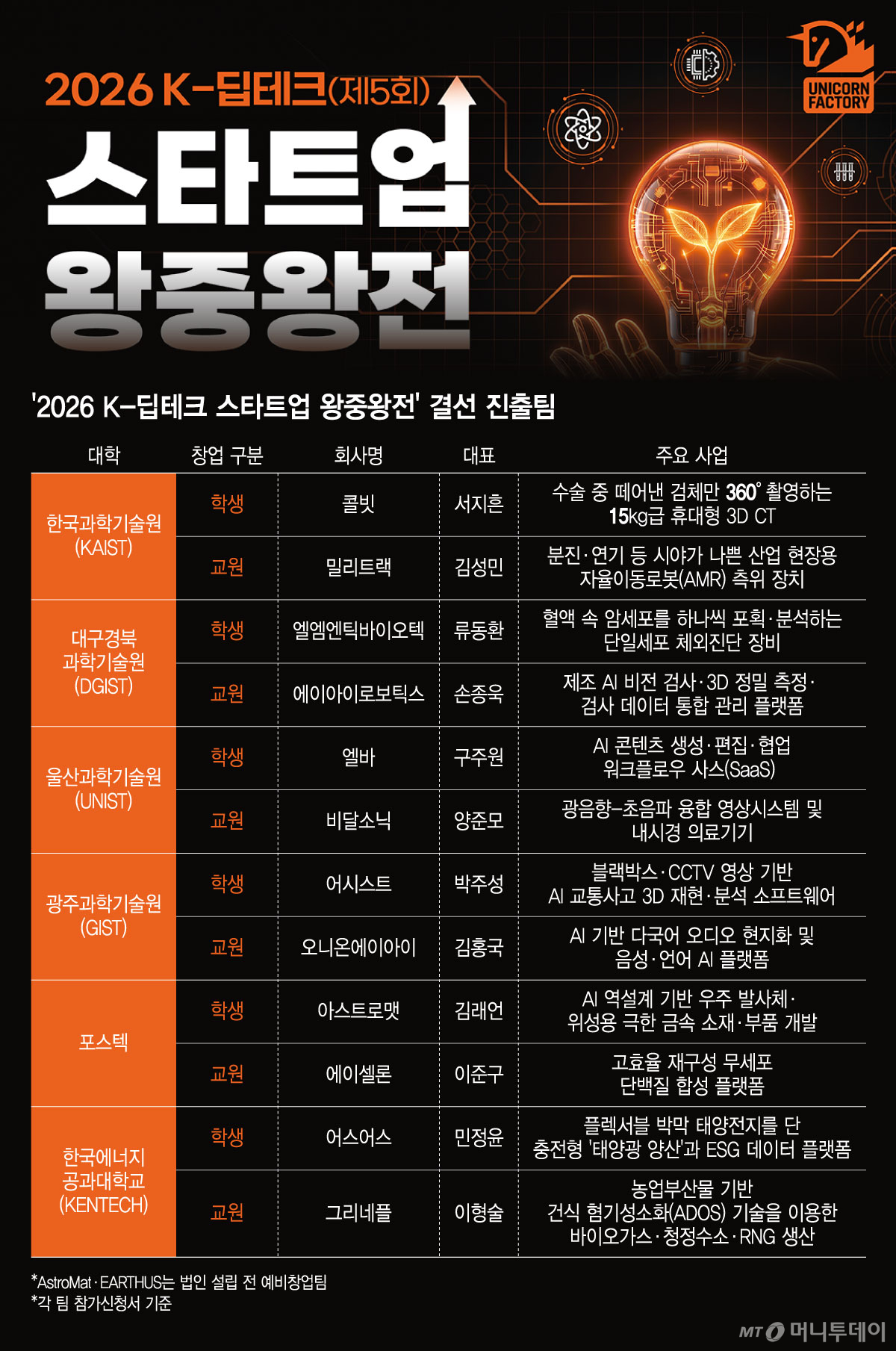
AstroMat will compete as the representative of POSTECH student startup teams in the finals of the '2026 K-Deep Tech Startup King of the Kings,' held on the 30th at Hall B Plus Stage, COEX, Gangnam-gu, Seoul (Spectator registration: https://forms.gle/McNBqdiBts8RJazVA).
Now in its fifth year, the King of the Kings is hosted by MoneyToday's startup media platform 'Unicorn Factory' and co-hosted by KAIST (Korea Advanced Institute of Science and Technology), DGIST (Daegu Gyeongbuk Institute of Science and Technology), UNIST (Ulsan National Institute of Science and Technology), GIST (Gwangju Institute of Science and Technology), POSTECH (Pohang University of Science and Technology), and KENTECH (Korea National University of Science and Technology).
The jury includes deep tech investment and commercialization experts from Samsung C-Lab Outside, GS Vents, Ecopro Partners, L&S Venture Capital, LB Investment, Blue Point Partners, Series Ventures, CNTech, Korea Technology Holding, and the R&D Special Zone Promotion Foundation.
Participants range from large corporate CVCs (corporate venture capital) to deep tech-specialized VCs, early-stage investment ACs (accelerators), and public technology commercialization institutional investors, comprehensively evaluating the commercialization potential and investment attractiveness of the technologies.
The finals feature a total of 12 teams, with six each in the faculty and student startup categories. The event follows an actual investment fundraising IR (Investor Relations) format, involving a 10-minute presentation and 10-minute Q&A for each team. Evaluation is based on a total score combining technology (30 points), marketability (20 points), business viability (40 points), and team capability (10 points).
The Grand Prize will be awarded to one team in each of the faculty and student startup categories. The two Grand Prize teams will receive the Minister's Award from the Ministry of Science and ICT, which is the Deputy Prime Minister's award, along with a prize money of 3 million won. Four Excellence Award teams will receive the R&D Special Zone Promotion Foundation Lee (President) Award and 1 million won in prize money, while six Encouragement Award teams will each receive the MoneyToday CEO Award and 500,000 won in prize money.
Winning teams will be provided with benefits such as linkage to CVC open innovation and bonus points when participating in the Global Digital Innovation Network (GDIN) overseas expansion program. Regardless of winning status, all 12 finalist teams will receive support for a one-year follow-up scale-up program, including corporate promotion, expert consulting, and networking with investment firms.
<Registration for the 5th K-Deep Tech Startup King of the Kings>
-Date: October 30 (Fri) 9:30~17:00
-Location: COEX Hall B PLUS STAGE, Seoul
-Target: Deep tech startups and investment VC reviewers
-Hosts: KAIST, DGIST, UNIST, GIST, POSTECH, KENTECH, MoneyToday Unicorn Factory
-Application: https://forms.gle/McNBqdiBts8RJazVA
[MoneyToday startup media platform 'Unicorn Factory']

 in FUTURE


