

Discarded rice straw reborn as electricity... New technology for producing biogas draws attention
Korea National University of Science and Technology (KENTECH) faculty-founded company "Greenepfl"
Development of anaerobic digestion technology to produce biogas from agricultural waste such as rice straw
Lee Hyeong-sul (CEO): “Production is four times higher than with the conventional method… We are also expanding overseas”
[For more diverse corporate information on the startups mentioned in this article, please refer to the Unicorn Factory big data platform 'Data Lab'.]
Every autumn, after the harvest is complete, agricultural waste such as rice straw, rice husks, and outer leaves and peels of vegetables floods farmland. Industry estimates suggest that annual agricultural waste generation reaches approximately 14 million tons. A significant portion is burned in fields or buried in the ground; burning contributes to wildfires and fine dust, while buried waste emits greenhouse gases as it decomposes.
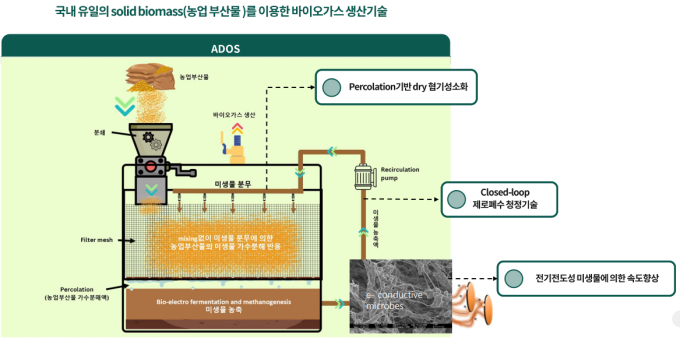
KENTECH (Korea National University of Science and Technology) spinoff company Greenep is developing a “dry anaerobic digestion (ADOS)” technology that produces biogas from dry Bususan, which can be used for electricity, heat, and hydrogen. The technology enables direct electron exchange between Misaengs that conduct electricity, thereby producing methane faster and in greater quantities.
Anaerobic digestion, a process that converts waste resources into biogas, has traditionally focused on "wet" methods that handle moisture-rich feedstocks such as food waste and livestock manure. Although the Biogas Act mandates that a certain proportion of waste resources be converted into biogas, the actual expansion of facilities has been slow due to post-processing issues such as wastewater discharge and odor. An even greater challenge has been productivity: because biogas output is limited, facility profitability remains low. The technology has been closer to waste treatment than energy production.
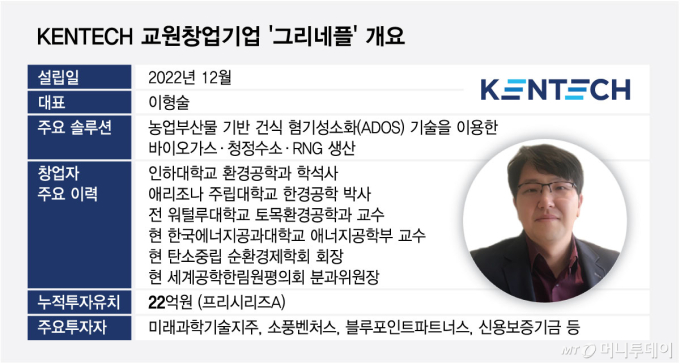
Greenepfl is boosting its energy output, shifting anaerobic digestion technology from the “waste treatment” sector to the “energy production” domain. Lee Hyeong-sool, CEO of Greenepfl, stated, “Our biogas production rate is 230 to 250 N㎥ per ton, which is four times higher in energy output than conventional wet processes,” adding that “the absence of wastewater and odor significantly reduces installation and operating costs.” He further noted, “Unlike solar and wind power, our technology can produce energy consistently without being affected by weather conditions, which is another key strength.”
Its utility as a waste treatment method is also greater than that of existing approaches. It uses agricultural Busan waste, which had previously lacked an appropriate disposal method, as the primary raw material, thereby resolving incineration and landfill issues. Additionally, livestock manure and other materials traditionally used as feedstock in existing technologies can be treated by mixing them with agricultural Busan waste.
Lee (CEO) stated, “Unlike food waste or livestock manure, agricultural Busan waste is not easily visible and therefore tends to receive relatively less attention. However, it has the potential to cause significant problems, which is why the Biogas Act also recognizes plant- and animal-based residues, including agricultural and forestry Busan waste, as eligible feedstock.”
Greenefield completed a 10 cubic meter pilot demonstration in Gangjin County, South Jeolla Province, and began construction of a 0.1MW modular demonstration plant at the KEPCO New Business Technology Research Institute in Naju in July. The company is also pursuing overseas expansion into markets such as Indonesia. As its business viability has been recognized, it has secured cumulative investment of 2.2 billion won from Future Science & Technology Holdings, Soopong Ventures, and Blue Point Partners.
“AI Handles Dubbing and Quality Control”... This Place Cuts Production Time by Up to 90%
Gwangju Institute of Science and Technology (GIST) faculty-founded startup "Onion AI"
Comprehensive analysis of emotions and context to develop dubbing technology tailored to local cultures
Kim Hong-guk (CEO): “Production time reduced by 90% and costs cut by 80% compared to manual work”

In an era where video content crosses borders, language barriers persist. Producing dubbed versions for overseas audiences requires a complex process that includes translation, voice actor recording, editing, and quality control. Although AI dubbing technology has emerged, human intervention is still needed to verify and correct emotional expression, lip-sync accuracy between mouth movements and audio, sound effects, and other elements.
Gwangju Institute of Science and Technology (GIST) faculty-founded startup AunionAI is focused on overcoming the limitations of existing AI dubbing technology. The company has developed a technology that comprehensively analyzes scenes, speakers’ emotions, context, and sound effects within videos to produce multilingual dubbing tailored to local cultures and environments.
Kim Hong-guk, CEO of Onion AI, explained that the technology's differentiator from existing AI lies in its ability to simultaneously consider the context and emotions of a scene, as well as sound effects. He added that the company has focused on enhancing the overall immersion of the video, going beyond simple translation and voice synthesis.
The company has also developed technology that automates quality inspection and error correction for AI-generated outputs. According to the company's internal verification, this approach can reduce production time by up to 90% and costs by up to 80% compared to traditional manual methods.
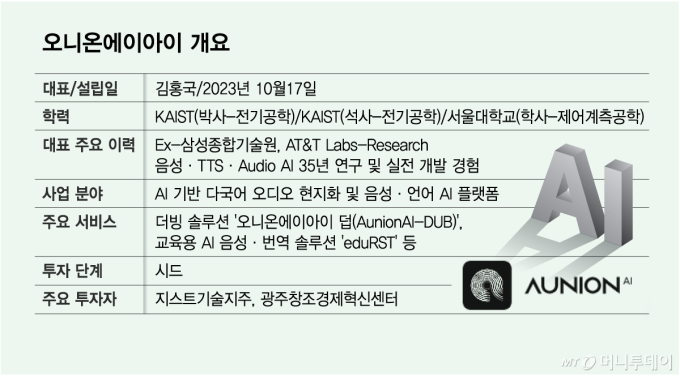
Onion AI was established in October 2023 by Kim (CEO) to commercialize the voice technology he has been researching for many years. Kim (CEO) is an expert with approximately 35 years of research and development experience in the field of voice and audio AI, having worked at Samsung Advanced Institute of Technology and AT&T Labs in the United States. He also carried out various industry-academic collaboration projects with companies while affiliated with a university.
Onion AI's flagship product is its AI-powered multilingual dubbing solution, "Onion AI DUB Plus." When a video is input, the AI analyzes dialogue, speakers, emotions, and sound effects, then generates dubbed audio in other languages through translation, voice synthesis, and speech timing adjustments. The platform currently supports more than 10 languages.
The core of the technology lies in analyzing video on a scene-by-scene basis rather than sentence by sentence. Even with identical dialogue, the pitch and speed of speech, as well as emotional expression, must differ between a tense chase sequence and a calm conversation. Onion AI has developed "scene-aware" technology that reflects these characteristics in dubbing.
The system also corrects for differences in sentence length across languages. When English dialogue is translated into Korean, the resulting sentences may become longer or shorter, causing a mismatch between lip movements and audio. To address this, the technology reconstructs the translated sentences to align with the original video’s speech timing. It has also developed techniques to generate or reconstruct sound effects and spatial audio based on object and spatial information within the video.
In particular, the company highlights its differentiating feature: an “Auto QA” technology in which AI-generated dubbing is reviewed and corrected by AI. By leveraging metrics that assess vocal naturalness and speech rhythm, as well as language-model-based analysis, the system identifies segments with subpar quality.
Kim (CEO) explained, “When an error is detected, instead of re-creating the entire video, only the problematic segment is regenerated and its quality is reassessed,” adding that this approach can reduce the burden on people who would otherwise have to manually identify and correct every error.
The company is also accelerating its technology validation and commercialization efforts. Onion AI conducted proof-of-concept (PoC) tests with the video display (VD) division of a major domestic conglomerate, evaluating its AI dubbing technology on more than 100 pieces of content. It has also carried out real-world demonstrations in the broadcasting, education, and public sectors, including with Global Gwangju Broadcasting (GGN), the Gwangju Institute of Science and Technology (GIST), the Suwon Education Support Office, and the Korea Tourism Organization, thereby broadening the potential applications of its technology. The company participated in CES, the world’s largest IT and home appliance exhibition, for two consecutive years last year and this year, and in July of this year it secured seed investment after its technological capabilities were recognized.
Robots Move Accurately Even With Eyes Covered…New Indoor Positioning Technology Draws Attention
Korea Advanced Institute of Science and Technology (KAIST) faculty-founded company "Militrack"
Indoor positioning technology developed over eight years applied to industrial sites
Kim Seong-min (CEO): “Targeting manufacturing automation and robot navigation sectors first”

"Outdoors, a location can be identified by latitude and longitude, but indoors there is no standard coordinate system that can pinpoint such coordinates. We are developing a common coordinate system capable of mapping physical space, with the aim of creating an environment in which robots can collaborate organically with people and move around."
Kim Seong-min (CEO), who leads Miltrack, a faculty-founded startup at the Korea Advanced Institute of Science and Technology (KAIST), is developing technology to establish precise coordinate systems in indoor spaces. The goal is to enable various types of robots and humans to determine their locations and move based on the same coordinate system.
Autonomous mobile robots (AMRs) that operate in factories typically use LiDAR and cameras to read their surroundings and determine their own position. However, in environments with heavy dust or steam, visibility is obscured, and strong sunlight can also interfere with sensor perception. If a robot fails to accurately determine its location, it can lead to disruptions in both movement and operations.
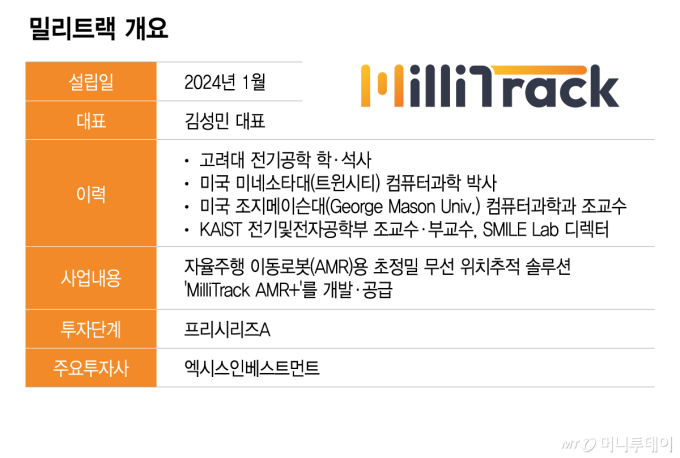
Kim (CEO), a professor in the Department of Electrical Engineering at KAIST, founded Millitrack in January 2024 to apply indoor positioning technology he had researched for eight years to industrial settings. The decision to start the company was also driven by the recognition of the technology’s potential, as it received awards in academic circles. Kim (CEO) stated, “In a situation where current positioning technologies all rely on foreign core technologies, I wanted to prove the excellence of the domestically developed core technology created at KAIST.”
The company's technological capabilities were first recognized by the academic community. It won the Best Paper Award twice at ACM MobiSys, an international conference on mobile computing, and has filed and registered 22 patents both domestically and abroad. Kim (CEO) explained the background of the startup, stating, "In a situation where all current location recognition technologies rely on foreign core technologies, I wanted to prove the excellence of the domestic core technology developed at KAIST."
Militrack products are currently in operation on production lines at major domestic steel mills and shipyards. At the steel mills, the products were attached to vehicles transporting molten iron at approximately 1,500 degrees Celsius (°C) to verify their stable performance even in high-temperature environments. The products are manufactured with an IP65 rating, which provides protection against dust and water.
Militrack's system consists of a "tracker" attached to moving objects and "tags" installed on walls, pillars, and other structures. By measuring the distance and angle between the two devices using radio waves, it achieves location accuracy at the level of 3 centimeters over distances of up to 30 meters. The company explained that, unlike light-based methods, the system can measure location even in environments with heavy dust or steam.
The installation and maintenance methods also serve as differentiators. Existing indoor real-time location systems (RTLS) often require surveying equipment to measure the position each time a reference point is installed. Millitrack applies a method in which devices measure each other's positions to align coordinates. The tags can be used for up to 20 years on a single battery, reducing the burden of separate power wiring.
Militrack also developed a service called "AMR+," which uses its own coordinate system to supplement robot localization. Under this approach, robots move using conventional methods under normal conditions but switch to the Militrack system to determine their position when they enter sections with limited visibility. The system is designed so that it can be implemented without replacing existing robots or overhauling the entire process.
Kim (CEO) stated, “A precise common coordinate system is essential for effectively operating multiple heterogeneous AMRs,” adding that its importance will grow even greater as robots become more widespread in the future.
Militrack plans to expand its supply of the technology to manufacturing sites both domestically and internationally. It is also in the process of obtaining radio frequency certifications required for overseas expansion, including those in South Korea, the United States, and Europe. The company expects to generate revenue through equipment sales and software license agreements tied to adoption.
Miltrack, which has completed the Pre-Series A round, is planning to raise follow-on investment in 2027. The funds will be used for its product Yangsan and overseas expansion. Kim (CEO) said, "Our priority is to create products that customers can use conveniently and to gain their trust," adding, "We aim to have our products be the first consideration in the fields of domestic and international manufacturing automation and robot navigation."
Six major science and technology universities' deep tech startups clash at COEX on the 30th
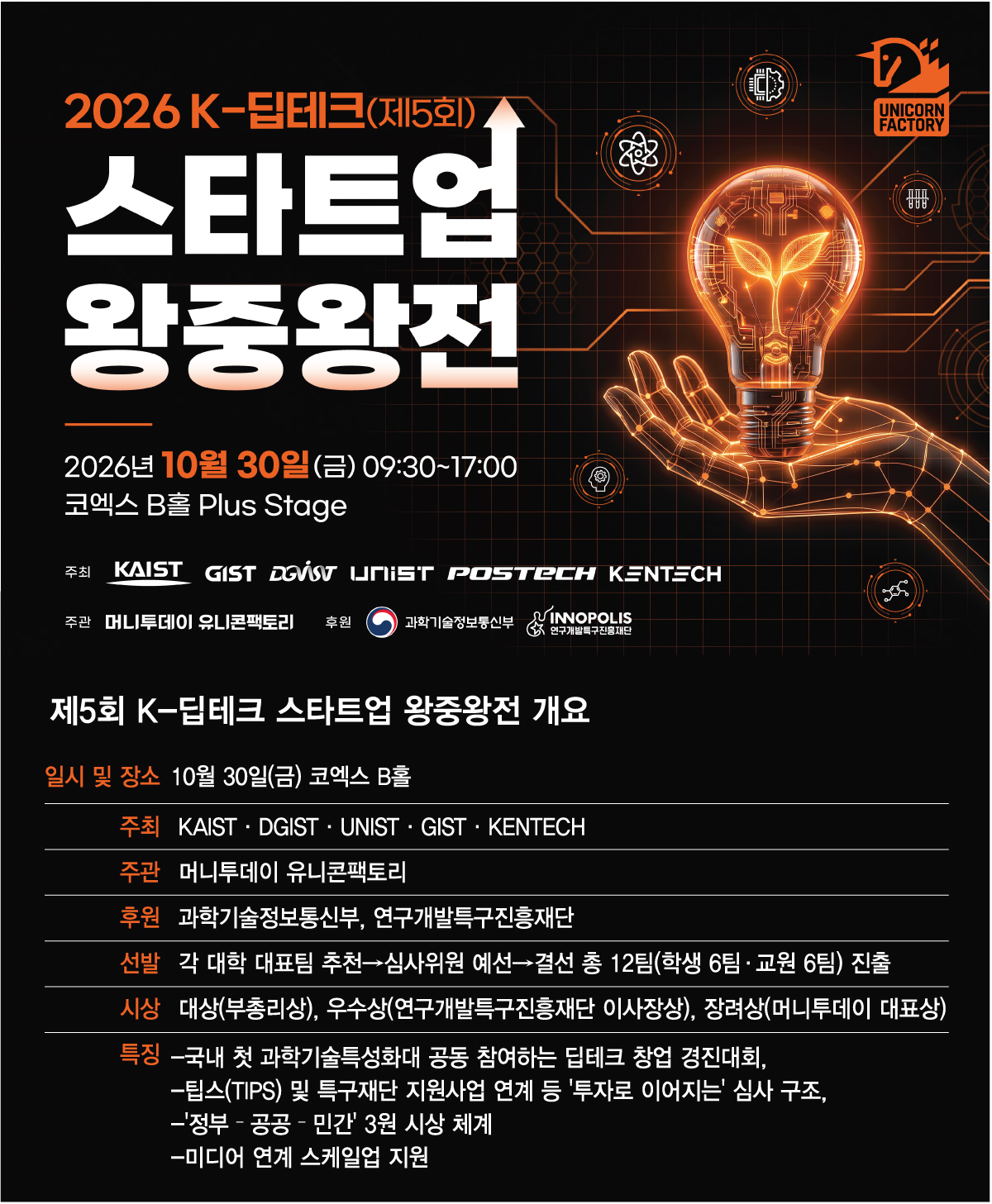
Meanwhile, Greenepple, Onion AI, and Millitrack will compete in the finals of the "2026 K-Deep Tech Startup Championship" to be held on the 30th at the Plus Stage in Hall B of COEX in Samseong-dong, Seoul (Observer Registration: https://forms.gle/McNBqdiBts8RJazVA).
The fifth King of Kings competition is a deep tech startup contest organized by MoneyToday’s startup media platform, Unicorn Factory, and co-hosted by six national science and technology-focused universities (KAIST, DGIST, UNIST, GIST, POSTECH, and KENTECH).
The judging panel for this competition includes Samsung C-Lab Outside, GS Ventures, Ecopro Partners, L&S Venture Capital, LB Investment, Blue Point Partners, Series Ventures, CNTech, Korea Technology Holdings, and the R&D Special Zone Promotion Foundation.
Experts from large corporate CVCs (corporate venture capital) to deep-tech-focused venture capital (VC) firms, early-stage investment accelerators (AC), and public technology commercialization institutional investors gather to assess the commercial viability of technologies and their investment appeal.
A total of 12 teams advanced to the finals, with six each from the faculty startup and student startup categories. The evaluation will follow the same format as an actual investment pitch session (IR), consisting of a 10-minute presentation and a 10-minute Q&A for each team. The scoring criteria are: technical merit (30 points), marketability (20 points), business viability (40 points), and team capability (10 points).
The two teams with the highest scores in each category (one faculty team and one student team) will be awarded the Minister of Science and ICT, who also serves as Deputy Prime Minister, prize along with a cash award of 3 million won. The four teams receiving the Excellence Award will each receive the Lee (President) Prize from the Research & Development Special Zone Promotion Foundation and a cash award of 1 million won, while the six teams receiving the Encouragement Award will each be given the MoneyToday CEO Prize and a cash award of 500,000 won.
Winning teams will be provided with preferential treatment when participating in the Global Digital Innovation Network (GDIN) overseas expansion program and corporate CVC open innovation collaboration. In addition, all 12 teams that advanced to the finals, regardless of whether they won, will receive support for a one-year follow-up scale-up program, including corporate promotion, expert consulting, and networking with investment firms.
<Application to Attend the 5th K-Deep Tech Startup King of Kings Tournament>
Date and time: October 30 (Fri), 9:30 a.m. to 5:00 p.m.
-Location: Hall B, COEX in Seoul, PLUS STAGE
Target: Deep tech startups and investment VC reviewers
Hosted by: KAIST, DGIST, UNIST, GIST, POSTECH, KENTEC, Money Today Unicorn Factory
-Application: https://forms.gle/McNBqdiBts8RJazVA
[Money Today Startup Media Platform Unicorn Factory]

 in FUTURE


