

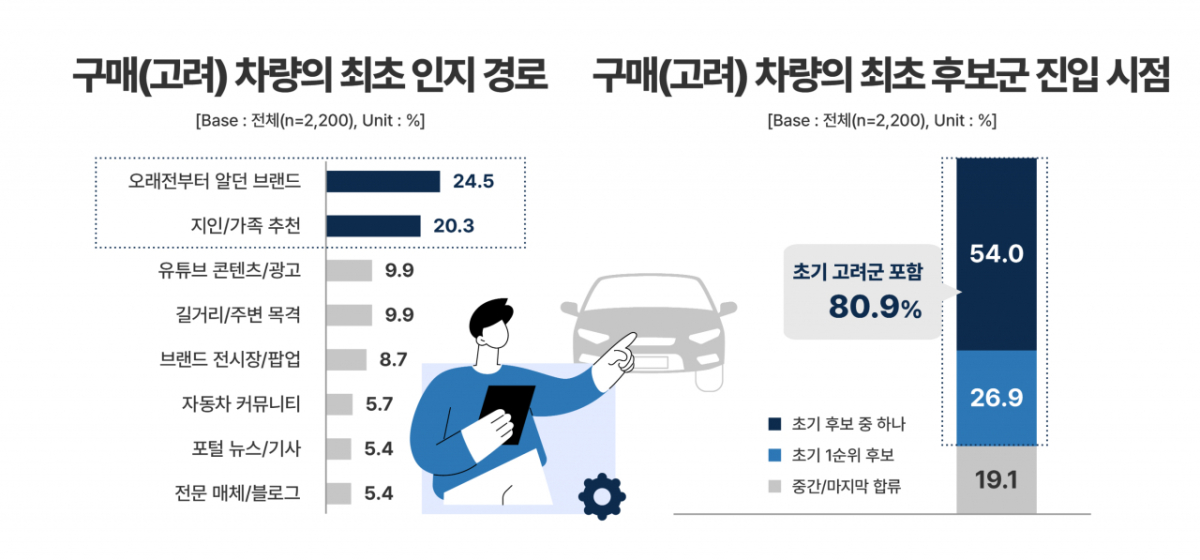
Imported car consumers were found to purchase vehicles by first narrowing down their candidates to two or three brands and models they are already familiar with, then verifying them through test drives and online information. Only about one in five consumers used artificial intelligence (AI) to search for information.
The Korea Automobile Importers Association (KAIDA) announced on the 15th the results of its "Imported Car Purchase Journey Exploration Survey," conducted among 2,200 consumers aged 25 to 59 who had purchased or considered purchasing an imported car within the past three years.
KAIDA categorized the imported car purchase journey into six stages: awareness, AI search, exploration through online, social media, and acquaintances, showroom visits and test drives, financial and quote comparisons, and purchase contracts and delivery. The survey found that consumers experienced an average of 2.06 out of the four stages excluding awareness and purchase.
Consumers tended to consider whether to purchase after selecting two or three candidates from brands and models they were already familiar with, taking into account budget, vehicle class, body type, and specifications. It was found that 80.9% of the vehicles under final purchase consideration were included in the initial candidate pool.
The experience rate by stage, based on multiple responses, was highest for showroom visits and test drives at 78.1%. Exploration through online, social media, and acquaintances accounted for 63%, financial and quote comparisons for 45.1%, and AI search for 19.5%.
In online information exploration, YouTube had the highest utilization rate. The YouTube usage rate was 63.1%, with an active engagement level of 79.8%. Consumers primarily referred to reviews and test drive reports (78.7%) and actual owners' feedback and long-term usage experiences (53.1%). In terms of active engagement, recommendations from acquaintances and family followed at 71.8%, and brand-specific cafes and communities at 69.5%.
The experience rate for information exploration using AI was 19.5%. AI was mainly used to compare vehicle performance, specifications, and competing models. Consumers evaluated AI as useful not so much as a means of finding new information, but for summarizing and organizing existing information. A tendency was also observed where consumers used AI for candidate exploration in the early stages of purchase and for final verification in later stages.
Some consumers purchased with a higher budget or vehicle grade than originally planned. 26% responded that their actual purchase amount was higher than planned. 44% responded that they chose a higher vehicle class or trim, or a different brand or model, than initially planned.
The most common reason for upgrading the purchase was "buying with better specifications because it is a car to keep for a long time," at 46%. "A design and specification I liked more" accounted for 44.3%, and "need for higher options after test drive and physical inspection" for 35.5%.
Jung Yoon-young, Vice Chairman of KAIDA, stated, "Through this survey, we were able to specifically confirm the characteristics of consumers' purchase journeys and their information exploration methods," adding, "We will enhance our understanding of the market and consumers through continuous surveys and analysis."

 in INDUSTRY
