

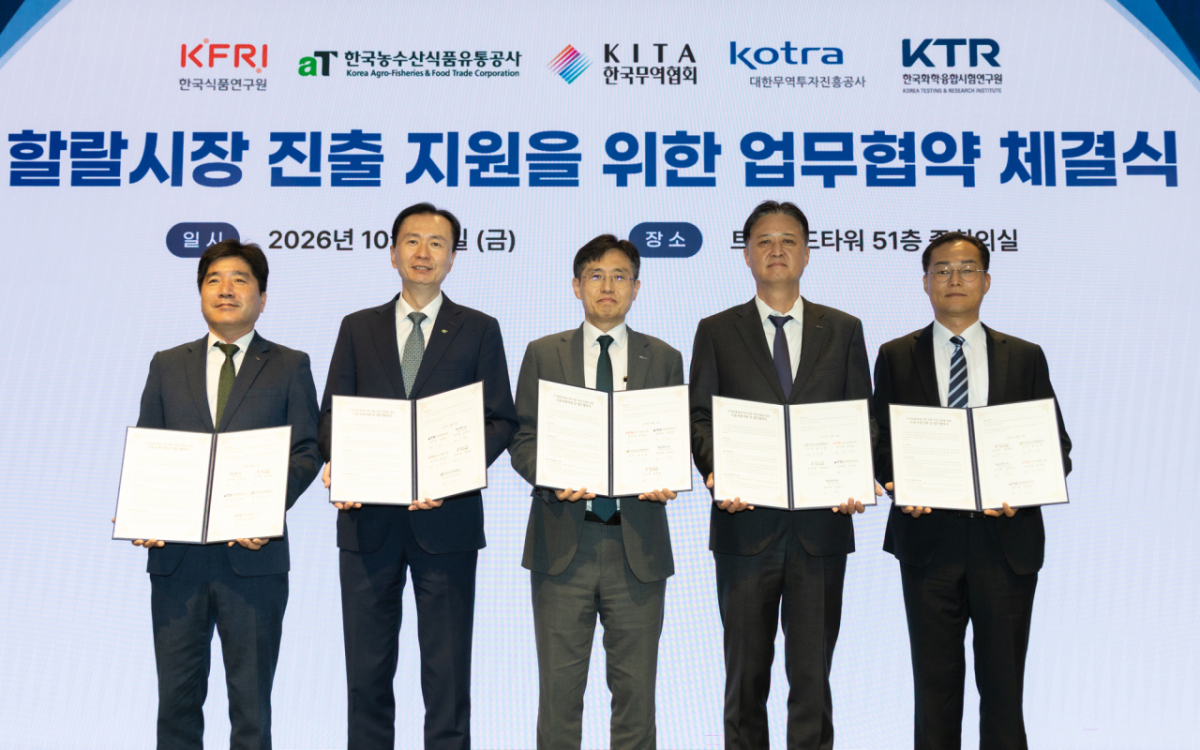
The Korea International Trade Association (KITA) said Friday that it had signed a multilateral memorandum of understanding (MOU) with the Korea Trade-Investment Promotion Agency (KOTRA), the Korea Agro-Fisheries and Food Trade Corp. (aT), the Korea Testing and Research Institute (KTR) and the Korea Food Research Institute (KFRI) to strengthen support for exporters seeking to enter halal markets.
The signing ceremony was held at Trade Tower in Samseong-dong, Gangnam-gu, Seoul. Attendees included Jung Hee-cheol, head of KITA's Trade Promotion Division; Kim Kwan-mook, head of KOTRA's Economic Security and Trade Cooperation Division; Jeon Gi-chan, executive director for food exports at aT; Shin Jung-ha, head of KTR's Global Division; and Kim Young-chan, head of KFRI's Food Industry Research Division.
The agreement was established to respond to the trend of major countries, including Indonesia, mandating halal certification and strengthening regulations amid the rapid growth of the global halal market.
The purpose is to pool the support capabilities of each institutional investor so that export companies can proceed without hindrance from grasping information on certification and regulations all the way to actual market entry. "Halal" is an Arabic term meaning "permissible," referring to products that Muslims can consume and use in accordance with Islamic law.
The institutional investors involved in the agreement agreed to link the halal-related information and support programs they have individually provided thus far.
Based on this, they plan to build a comprehensive cooperation framework that allows companies to grasp and utilize specialized services from each institutional investor—such as testing and analysis, certification response, overseas market information, and marketing—all at once.
Specifically, they will pursue: △ exchange of information on halal policies, regulations, certification systems, and market trends by country; △ linked provision of information and support programs by each institutional investor utilizing the "Halal Comprehensive Information Platform"; △ joint identification of challenges faced by export companies in halal certification and market entry; and △ linked support for specialized services such as testing and analysis, certification consultation and consulting, and overseas marketing.
An official from KITA said, "Through this agreement, we will advance the support system for entering the halal market through continuous information exchange and joint project development with the institutional investors involved in the agreement, and work to lower the barriers to entry into the halal market for export companies."

 in INDUSTRY
