

Although domestic stock markets rebounded just one day after the sharp decline, securities firms view it as premature to declare a trend reversal. With limited recovery in foreign investor supply and demand, analysts advise waiting until next week's big tech earnings releases to confirm grounds for the rebound before taking action.
On the 16th, the KOSPI index closed at 5,668.05, up 113.83 points (2.05%) from the previous day. The KOSDAQ index ended trading at 794.78, rising 33.96 points (4.46%), and an intraday buy-side sidecar (futures market circuit breaker) was triggered.
This marks a rebound for the KOSPI after eight trading days and for the KOSDAQ after seven trading days. However, among the semiconductor leaders, Samsung Electronics rose by only about 2%, while SK Hynix remained nearly flat, proving insufficient to recover recent losses.
The rebound on this day appears to have been triggered by the overnight recovery of the New York stock market, which had fallen sharply due to concerns over the debt burden of AI (artificial intelligence) companies. As U.S. Treasury yields declined and Jensen Huang, CEO of NVIDIA, positively assessed CoreWeave's financial soundness, investment sentiment in AI and semiconductors improved somewhat.
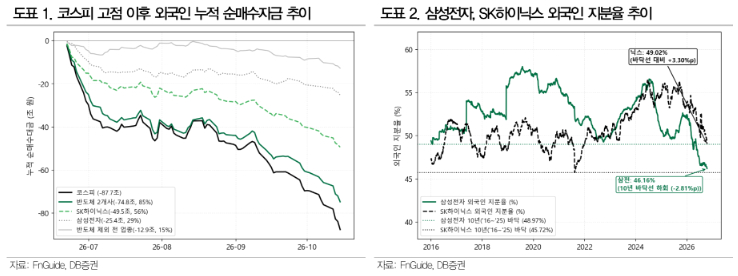
The variable most closely watched by securities firms is foreign investor supply and demand. Im Jeong-eun, a researcher at KB Securities, stated, "While foreign buying emerged in the KOSPI, cumulative net purchases amounted to only 310 billion won as of market close, and foreigners responded with net selling in the KOSDAQ, which had risen more sharply than the KOSPI."
She added, "Earnings releases from major domestic and international companies are scheduled for next week, including Hyundai Rotem (on the 19th), LS ELECTRIC (on the 21st), Meta Platforms and Tesla (on the 22nd), so company-specific momentum is expected to stand out."
Analysts argue that both domestic and external conditions must support a full return of foreign investors. Seol Tae-hyun, a researcher at DB Securities, said, "We assess the slump in AI semiconductor ETFs (exchange-traded funds) as an undershooting phase resulting from strong foreign net selling combined with the macro environment."
He continued, "Reconfirming the sustainability of AI capital expenditure through big tech earnings releases, restoring confidence in earnings based on HBM (High Bandwidth Memory) supply visibility in memory semiconductor earnings comments, easing concerns over additional tightening by the Federal Reserve, and stabilizing the won/dollar exchange rate—these macro environmental stabilizations will be the critical turning point determining a shift to foreign net buying."
Analysis also suggests that confirming support lines is a priority in the short term. Hwang San-hae, a researcher at LS Securities, stated, "Next week is expected to test support near July's lows and find grounds for a rebound in earnings."
The possibility of further rebounds was also left open. Researcher Hwang added, "Just as there was a sharp rebound following the plunge at the end of last July, big tech earnings that could serve as material are on deck." He noted, "There is a possibility that perceptions may emerge that short-term declines have been excessive, depending on investment scale, returns on investment, and the funding environment."

 in STOCK
