

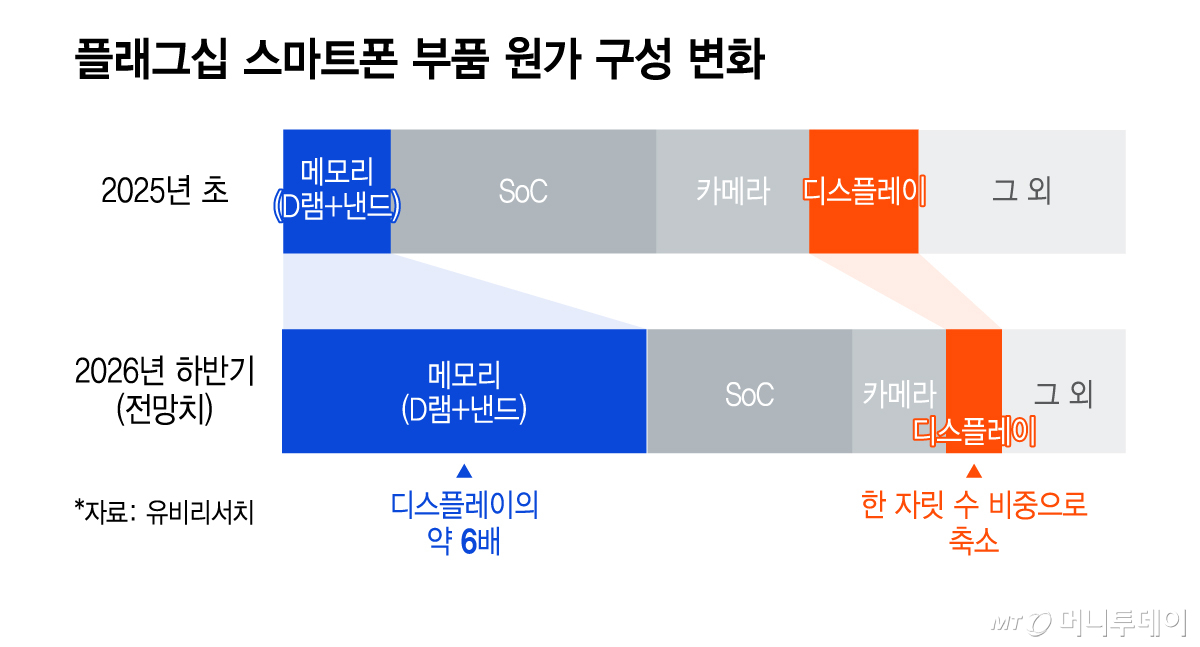
The sharp surge in memory semiconductor (hereinafter "memory") prices has intensified pressure on the display industry to reduce panel prices. As memory now accounts for nearly six times the share of display costs in the manufacturing cost of flagship (top-tier) smartphones, some manufacturers have begun moving to lower display specifications. Analysts say that domestic display companies such as Samsung Display and LG Display have relatively greater room to respond to price-cutting pressure, based on their competitiveness secured in the premium OLED (organic light-emitting diode) market.
According to market research firm Ubi Research on the 18th, memory's share of the manufacturing cost of flagship smartphones rose to the 40th percent range in the second half of this year, while the display share fell to single digits. The cost shares of the two components, which were at similar levels until early last year, have diverged by nearly six times in just over a year. Memory has overtaken the AP (application processor) and camera to become the component with the largest share of flagship smartphone manufacturing costs.
The aftermath of rising memory prices has translated into pressure to cut display panel prices. Ubi Research stated, "Memory supply is tight, leaving set (finished product) manufacturers with almost no room to negotiate prices, whereas OLED panels are seeing increased production capacity, making it easier to demand unit price reductions." It is known that the price of general-purpose 6.7-inch flexible OLEDs has fallen to half the level of 2023.
Some smartphone manufacturers have moved to cut costs by lowering display specifications. This involves replacing LTPO (low-temperature polycrystalline oxide) OLED, previously applied in high-end models, with the relatively cheaper LTPS (low-temperature polysilicon) OLED. The adoption range of expensive LTPO panels has narrowed, centered on top-tier models.
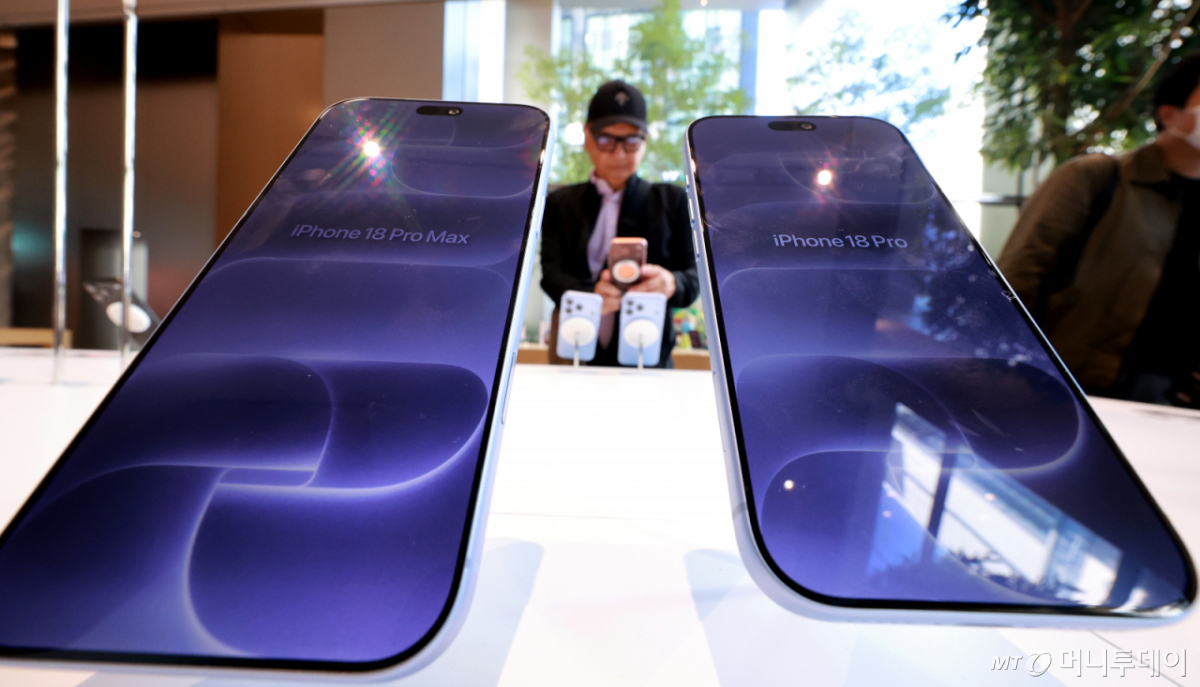
The decline in smartphone shipments is also a factor increasing the burden on the display industry. According to market research firm Counterpoint Research, global smartphone shipments in the third quarter of this year fell 20 percent year-on-year, recording the lowest quarterly level since 2012. If panel supply volumes decrease due to slowing smartphone demand, a double blow from falling prices and reduced shipments is inevitable.
However, domestic display companies are offsetting price-cutting pressure based on their technological competitiveness secured in the premium OLED market. According to market research firm Omdia, the OLED adoption rate in the global smartphone market this year was 60.5 percent, significantly ahead of LCD (liquid crystal display), which recorded 39.5 percent. During the same period, Samsung Display and LG Display combined for a 57.3 percent share of the global smartphone OLED market on a shipment basis.
The premiumization of the smartphone market is also seen as an opportunity for domestic firms. As rising memory prices increase cost burdens for mid- to low-priced smartphones, manufacturers are likely to focus on high-value-added products. In particular, Chinese display companies such as BOE are struggling to secure the technological capability and yield for LTPO OLED applied in top-tier smartphones. This is the background that allows domestic firms, which lead in related technology, to occupy a relatively advantageous position.
Diversifying supply product lines into OLED for foldables and tablets is also cited as a strength. Because they can negotiate by linking supply conditions for multiple products with customers, there is room to respond to price-cutting demands for smartphone panels. Nam Sang-wook, Gyeong Je-hak-gwa (Prof.) at Korea National Open University, analyzed, "The display industry has already been under significant pressure to cut prices," adding, "Domestic firms can utilize a 'bundling' strategy that negotiates by grouping various OLED product lines, so they are not in a situation where they are unilaterally dragged along by customers' price-cutting demands."

 in INDUSTRY

