

![[Seoul=NEWSIS] Reporter Jeong Byung-hyuk = Foreign tourists visit the Lotte Mart Seoul Station branch in Jung-gu, Seoul on the 3rd to check out K-food items such as snacks, instant noodles, and seaweed. April 3, 2026. jhope@newsis.com /Photo=Jeong Byung-hyuk](https://thumb.mt.co.kr/cdn-cgi/image/f=avif/21/2026/10/2026101511584592963_1.jpg)
Major domestic food companies are expected to continue their earnings improvement trend in the third quarter of this year, driven by global popularity for K-food. In particular, Samyang Foods, Orion, and Nongshim, which have a high proportion of overseas business, are projected to lead revenue growth. However, the impact of a stronger won on the profitability of export companies is also cited as a variable amid continued domestic sluggishness and raw material burdens.
According to consensus estimates (earnings forecasts) from financial information provider FnGuide and other securities firms on the 18th, operating profit for six out of eight major food companies is expected to increase year-on-year in the third quarter. Samyang Foods is projected to see revenue rise by 29.6% to 819 billion won and operating profit increase by 42.9% to 187.1 billion won, driven by the popularity of its Buldak brand. Nongshim, led by Shin Ramyun, is also expected to see revenue grow by 6.7% to 929.4 billion won and operating profit rise by 14.5% to 62.2 billion won. Binggrae and Lotte Wellfood are also expected to see their operating profits increase by 30% and 24.4%, respectively, compared to the same period last year. Earnings announcements from major food companies are expected in early November.
On the other hand, CJ CheilJedang is projected to see revenue excluding CJ Logistics decrease by 10.2% to 4.2 trillion won, and operating profit drop by 4% to 194.1 billion won. Securities firms forecast that the operating profit margin in the food division will decline due to factors such as slowing domestic consumption. Lotte Chilsung Beverage is also expected to see revenue increase by 2.2%, but operating profit is projected to fall by 8.4% to 84.1 billion won, owing to reduced demand from domestic consumer stagnation and rising costs of raw materials and components.
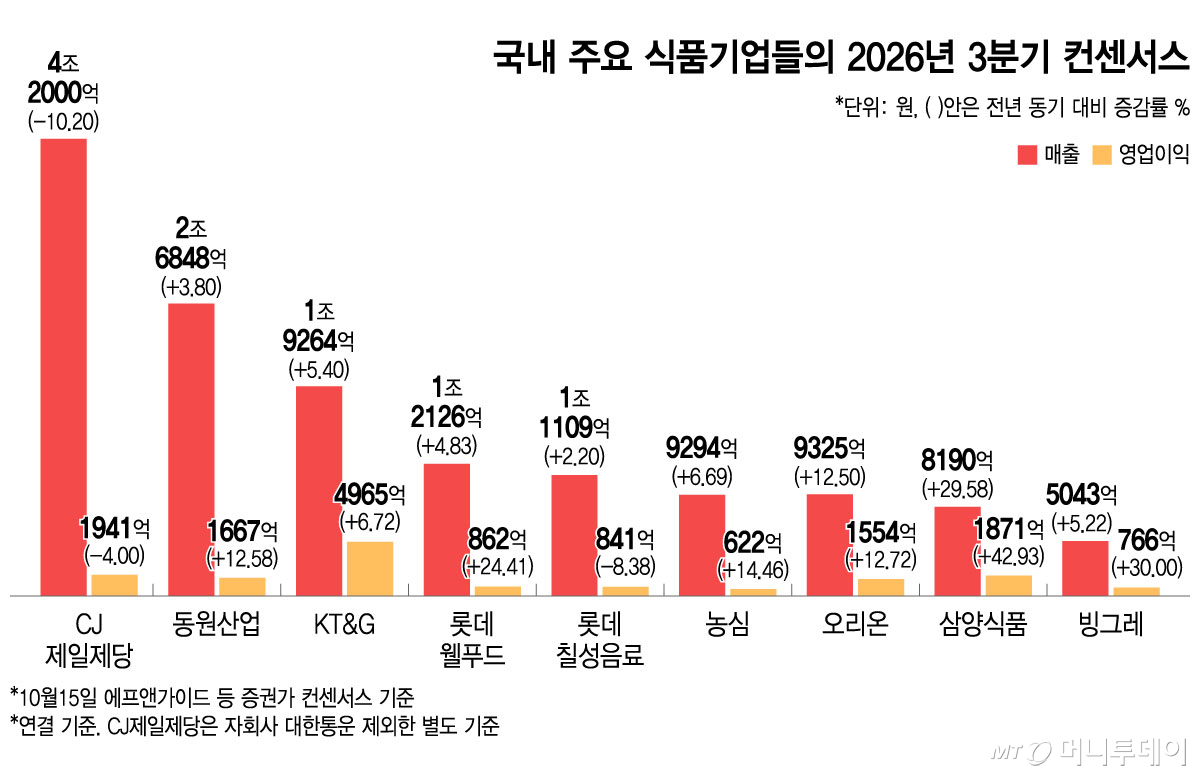
The overseas market has been the pillar supporting the earnings of major companies. According to the Korea Agro-Fisheries & Food Trade Corporation (aT), agricultural and fishery food exports surpassed $10 billion in 253 days, setting a record for the shortest time ever. During this period, instant noodle exports reached $1.376 billion (approximately 1.76 trillion won), a 27.2% increase year-on-year. Samyang Foods generated 82.9% of its first-half revenue from overseas markets.
Recovering domestic demand and easing cost burdens remain challenges. In the Korea Agro-Fisheries & Food Trade Corporation’s (aT) “2026 Food Industry Business Climate Survey,” the overall business climate index for the third quarter was 99.5, up 6.2 points from the previous quarter, but still below the baseline of 100. Among responses to questions about why companies view the economy as deteriorating, 42.8% cited decreased consumption and sluggish domestic demand, making it the most common answer. Additionally, while the raw material purchase price index fell by 12.9 points from the previous quarter to 121.0, more respondents indicated that prices had risen. During the same period, the export sales index exceeded the baseline at 100.8.
Forecasts also suggest that the domestic industry will improve in the fourth quarter, driven by seasonal factors such as Christmas and year-end holidays. According to the report, the food industry’s overall business climate outlook index was 102.0, and the export sales outlook index was 105.2, both exceeding the baseline of 100.
Recent exchange rates may also act as a variable for individual companies. According to the Bank of Korea, the monthly average won/dollar exchange rate fell from 1,497.43 won in July to 1,406.30 won in August and 1,359.00 won in September, and the exchange rate on the 15th of this month is also maintaining a level around 1,350 won. A stronger won has the effect of reducing imported raw material costs, but it can be a burden when converting overseas revenue into won. A food industry official said, “The impact of the won-dollar exchange rate is not negligible, but if we further increase overseas sales and adjust various costs, it is at a level that can be defended.”

 in LIVING

