

As companies accelerate the adoption of AI (artificial intelligence), concerns are deepening over the rapidly growing 'AX (AI transformation) bill.' Samsung Electronics recently instructed its frontline departments to review their AI token usage and formulate optimization plans. 'Tokenomics,' which involves boosting work productivity through AI while efficiently managing costs, has emerged as a new challenge.
According to the electronics industry on the 18th, Samsung Electronics recently directed its frontline departments to report on optimization measures related to AI token usage. It was reported that the company asked them to explain token usage volumes and primary purposes, and to devise plans for efficient future utilization. This is interpreted as a measure to review the surge in token usage driven by expanded AI adoption and to manage costs.
A token is the basic unit used when an AI processes sentences or data. Enterprise AI (AI for businesses) primarily applies pay-as-you-go models where costs are charged based on actual token usage. In particular, as AI evolves from simply answering questions to performing multiple tasks autonomously as an AI agent, token consumption has increased significantly. In complex software development tasks, AI consumes large amounts of tokens by repeatedly writing code and fixing errors. It is said that the phrase 'tokens are melting' has emerged among developers.
Samsung Electronics is actively pushing AX, which shifts work methods to be AI-centric. Since last June, employees in the DX (Device eXperience) division have been allowed to use external generative AIs such as ChatGPT, Gemini, and Claude within the company. AX performance has also been reflected as a key evaluation criterion in executive assessments.
AI utilization is actually leading to improved work efficiency. By leveraging AI and HPC (High-Performance Computing), Samsung Electronics shortened the TV drop verification period from the previous 15 days to 2 days, and reduced the washing machine drop verification period from 15 days to 5 days. The time required for some semiconductor design tasks has also been cut in half. Another advantage of AI utilization is that automating repetitive tasks allows employees to focus on more complex research and development and decision-making.
However, as AI usage increases, the importance of cost management is also growing. It was reported that Samsung Electronics divided its employees into four tiers during the AI adoption process and differentiated the amount of AI tokens available based on tier. General employees were primarily assigned to Tiers 1-2, while development roles were basically applied Tier 3. Employees in the highest Tier 4 are known to be granted a monthly token usage limit of approximately $500.
Major domestic conglomerates such as SK, Hyundai Motor, and LG have either adopted or are considering adopting generative AI. According to OpenAI Korea, as of the end of last August, the scale of ChatGPT Enterprise adoption by domestic companies and institutional investors expanded by approximately 28 times compared to the same period last year, based on the number of users.
"Used up annual tokens in the first half".. Companies in 'emergency' over AI cost burden
The problem is costs increasing faster than expected. A senior executive at a major conglomerate stated, "While work efficiency has improved with the full-scale adoption of AI, related costs have become a significant burden," adding, "We had already consumed most of our projected annual token usage by the first half of the year."
Voices are also emerging from frontline development departments stating that allocated tokens are insufficient. An employee in a development role at a major conglomerate said, "As AI usage increases, there are cases where allocated tokens are completely exhausted by the end of the month, effectively halting related work," and added, "There are times when one must explain the reason for use if tokens are consumed excessively."
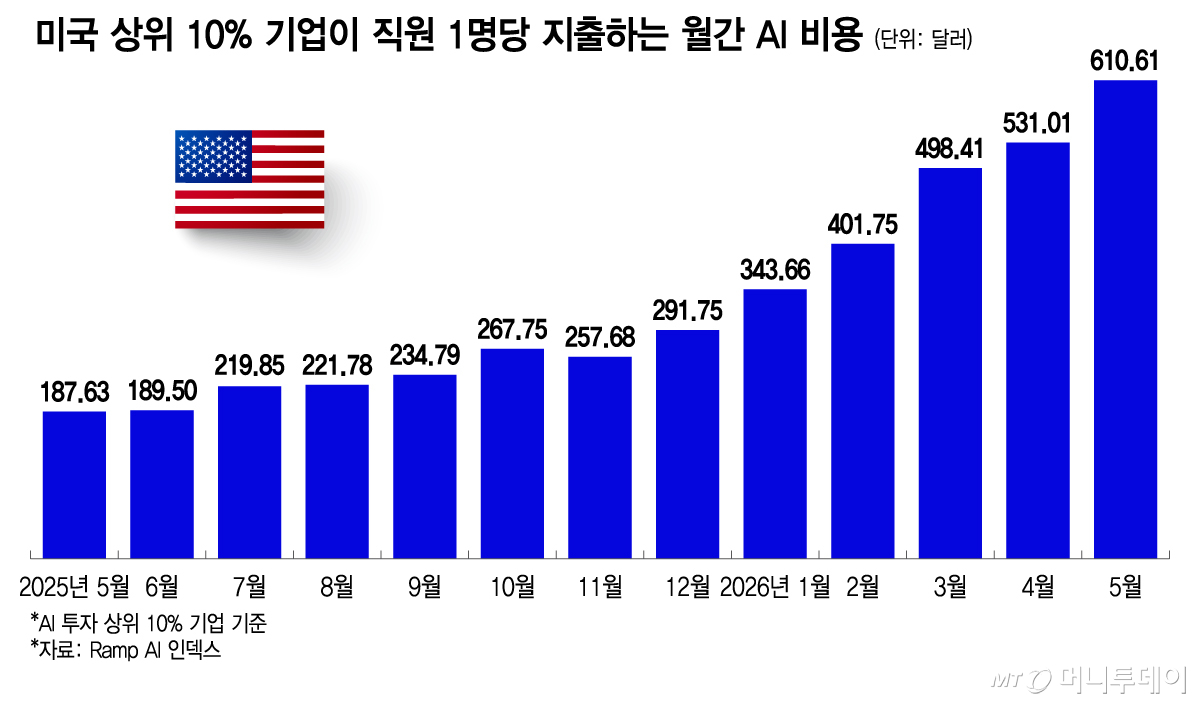
In reality, the AI cost burden on companies is snowballing. According to the Ramp AI Index, which tracks AI adoption and spending at US companies, the average monthly AI cost per employee at top 10% surveyed companies was approximately $611 (about 810,000 won) as of last May, a 3.3-fold increase from one year ago. For a company with 1,000 employees, this amounts to annual AI costs of roughly 8.1 billion won.
The monthly AI expenditure per employee at top 1% companies reached $7,450 (about 10 million won). While some companies are adopting cheaper Chinese AIs, the situation is already one where increased usage is outpacing cost-saving effects. Another factor increasing the cost burden is using multiple AIs simultaneously rather than just one.
Consequently, the importance of 'Tokenomics,' which comprehensively manages AI token usage, costs, and productivity effects, is being highlighted. Companies are working to maximize efficiency relative to cost by selecting AI models according to the performance required for work and reducing unnecessary token usage. How much high productivity can be secured with the same cost is becoming a new competitive advantage for companies.
An industry official said, "As employees become accustomed to using external generative AIs and learn how to save tokens, they are utilizing AI more efficiently than in the early stages of adoption," adding, "However, as the scope of AI utilization and absolute usage volumes continue to grow, the cost burden related to tokens is increasing."


 in INDUSTRY


