

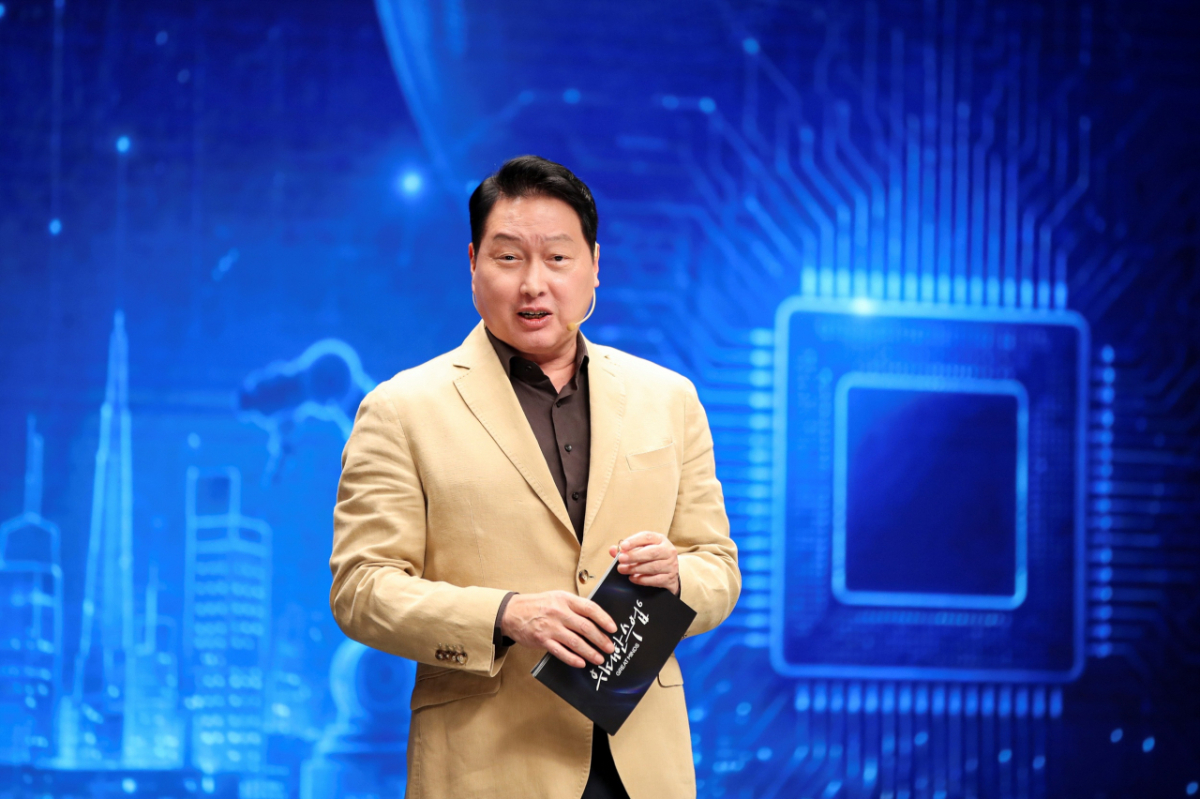
"If I could go back to my 20s, I would start a business without hesitation. I want to tackle the most difficult challenges facing South Korea and humanity."
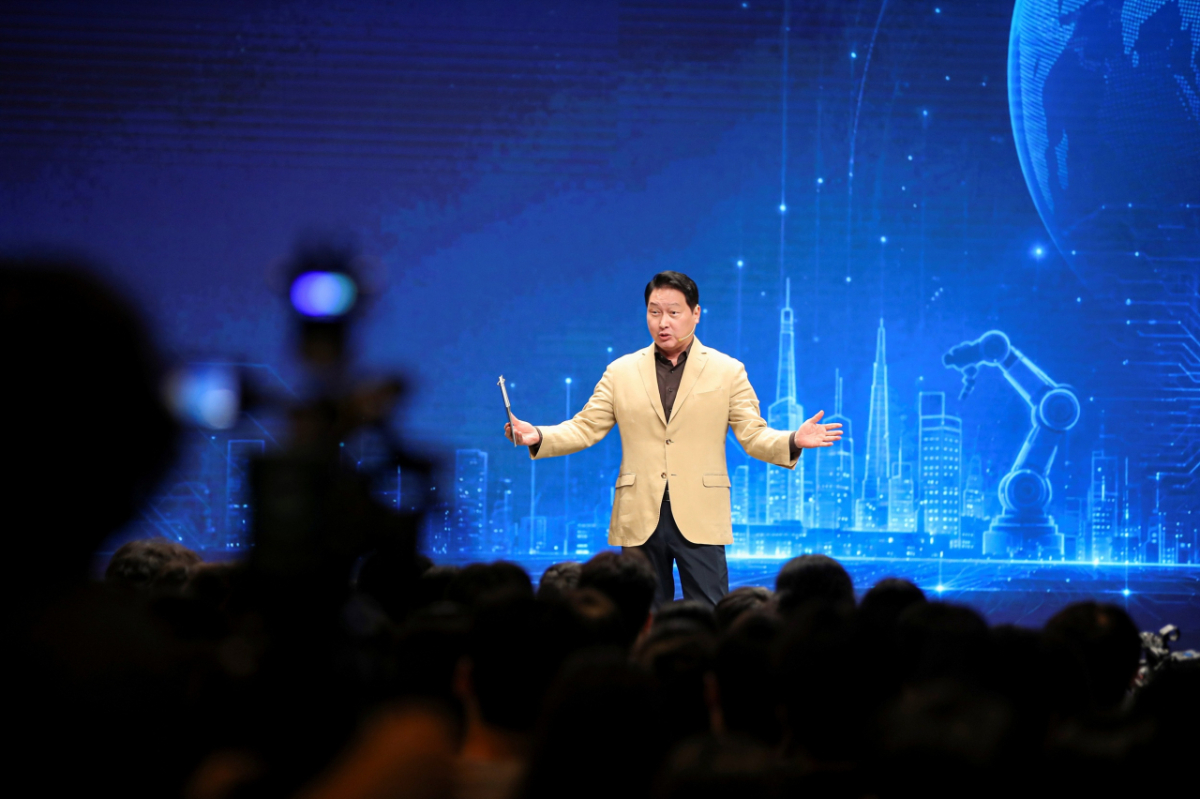
Choi Tae-won, Chairman of SK Group and President of the Korea Chamber of Commerce and Industry Gong Hoe-ui-so (Chairman), shared his thoughts with young people on the future and growth of South Korea, as well as work and life in the era of artificial intelligence (AI). Choi (Chairman) appeared on Season 6 of EBS's "The Great Lecture, Great Minds," which aired over five days from the 12th to the 16th, delivering a lecture titled "AI, New Capitalism, and Youth." This marks the first time a Korean business leader has appeared on the program.
In the final broadcast, Choi (Chairman) answered the question, "If you could go back to your 20s, what would you want to challenge yourself with in the AI era?" by saying, "I would start a business without hesitation." Choi (Chairman) added, "It would not be a startup in semiconductors like today," stating, "I would deploy all means and methods to solve the most difficult problems facing South Korea or humanity, or issues that cause great suffering to many people." Specifically, he cited environmental issues such as water scarcity and carbon emissions, as well as food shortages.
He advised young people to start by solving small problems they are interested in, rather than setting grand goals. Choi (Chairman) said, "There are countless problems in society, including the environment, care, low birth rates, and financial vulnerabilities," adding, "Start by solving small problems within your reach, and as experience accumulates, you can develop larger solutions." He continued, "If asked what problem to solve, I would simply say to do whatever is in your heart."
Regarding job changes in the AI era, he predicted that choices regarding labor will change. Until now, working for a set amount of time at a specific company or in a particular occupation was considered a career, but he explained that AI could alter this concept. If AI is used to complete work that previously took eight hours in just one to two hours, the remaining time can be used freely or to choose different work.
He pointed out that future education must move beyond knowledge transmission and test-centric approaches. Choi (Chairman) stated, "What is more important than the college degree itself is experience in solving real problems," explaining, "The ability to define problems and ask questions, thinking power and empathy, and an attitude that does not fear failure will become even more important."
On the role of leaders in the AI era, he said they must do what AI cannot. Choi (Chairman) noted, "AI is a tool that enhances intelligence, but intelligence is not wisdom," adding, "To solve problems, ultimately, one must understand and move people."
He presented four competencies that young people should cultivate: thinking power, empathy, the muscle of adaptation, and body skills. Choi (Chairman) warned, "If you wait until all safety measures are in place to avoid failure, you may fall behind the pace at which AI evolves," emphasizing the importance of resilience.
In his lecture, Choi (Chairman) also outlined plans for sustainable growth in Korea. He proposed an economic ecosystem that measures and rewards outcomes in solving social problems. Citing the Social Performance Incentive (SPC), which SK has promoted for over 10 years, as an example, he explained, "Companies that paid incentives produced at least three times more social performance than those that did not."
He cited speed, scale, and safety—the "3S"—as key requirements for national competitiveness in the AI era. He also emphasized the importance of applications that utilize AI in daily life and industry, calling for a transition to an "AI-native society" where citizens directly use AI agents. As a growth strategy to address low birth rates and aging populations, he proposed economic cooperation between Korea and Japan.

 in INDUSTRY

