

Spent batteries, which contain large quantities of core metals such as lithium, nickel, cobalt, and manganese, are 'resources' in their own right. Competition among companies is intensifying to secure a foothold in the future resource market in preparation for the massive influx of spent batteries as electric vehicle battery replacement cycles come due.
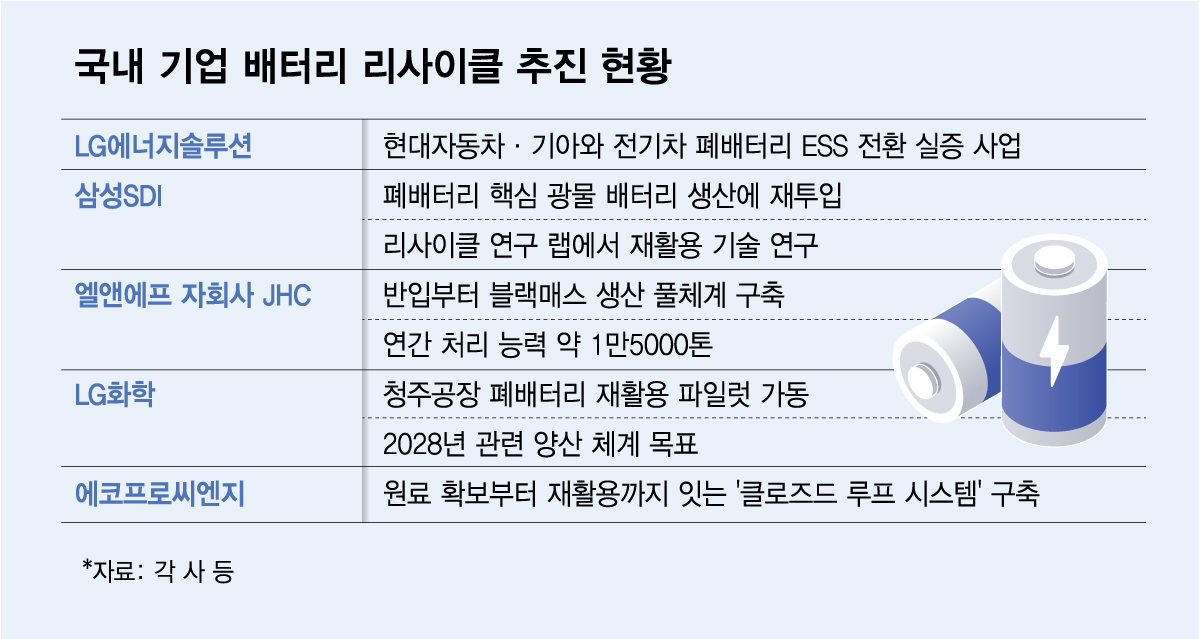
According to industry sources on the 19th, Samsung SDI is building a circular system that recovers core minerals from spent batteries and reinvests them in battery production. Centered on its 'Lisa Cycle Research Lab,' it is working to increase material recovery rates and develop eco-friendly recovery technologies.
LG Energy Solution recently launched a demonstration project with Hyundai Motor and Kia to repurpose electric vehicle spent batteries as energy storage systems (ESS). Hyundai Motor and Kia are developing reuse technologies and business models, while LG Energy Solution will manufacture UBESS (Used-Battery-based ESS) using these batteries to verify performance and safety.
The materials industry has moved to build a value chain covering everything from securing spent batteries to producing core materials. JHC, a subsidiary of L&F, obtained comprehensive recycling permits for waste batteries last year and set up a pretreatment line, followed by adding discharge and disassembly lines this year. This covers the entire process from receiving spent batteries to producing black mass, a key intermediate material, with an annual processing capacity reaching 15,000 tons.
LG Chem completed and began operating a spent battery recycling pilot facility at its Cheongju plant in Chungcheongbuk-do province in the first half of this year, with plans to establish a Yangsan system by around 2028. EcoPro is also building a 'closed-loop system' that links raw material procurement to precursor and cathode material production and recycling, led by its affiliate EcoPro CNG.
However, there are limits to growing the market simply because companies are rushing to secure technologies and facilities. It is not easy to stably secure spent batteries for recycling. According to data submitted by the Ministry of Climate, Environment and Energy to Democratic Party of Korea lawmaker Park Jeong, the recovery rate of mandatory return electric vehicle spent batteries from 2021 through the end of August this year was only 65.9%.
In particular, industry voices are pointing out that black mass (black powder containing core minerals such as lithium, nickel, cobalt, and manganese) generated domestically must be prevented from flowing overseas to countries like China. China accounts for more than two-thirds of the world's black mass production and consumption capacity. The United States also restricted black mass exports for one year in response to China's weaponization of resources. There are also opinions that regulations on overseas raw material procurement should be eased. Industry sources explain that importing black mass from Europe into Korea requires an import permit under the Basel Convention, which is a heavy burden because its validity period is only one year.
As the importance of spent battery recycling grows globally, the government is also stepping up to refine regulations. A representative example is pushing for regulatory sandbox measures and revisions to related notices to allow spent batteries to be easily recognized as circular resources.
The Ministry of Climate has signed a memorandum of understanding with EcoPro CNG, Seongil Hitech, and others on a 'Battery Regenerated Raw Material Production Certification System Pilot Project' and is currently conducting demonstrations.
An industry official stated, "From the perspective of creating an ecosystem for the domestic Lisa Cycle industry and resource security, virtuous circulation of resources within the country is paramount," adding, "It is necessary to strengthen policy and institutional foundations so that battery resources can be reinvested into the domestic industry."

 in INDUSTRY

