

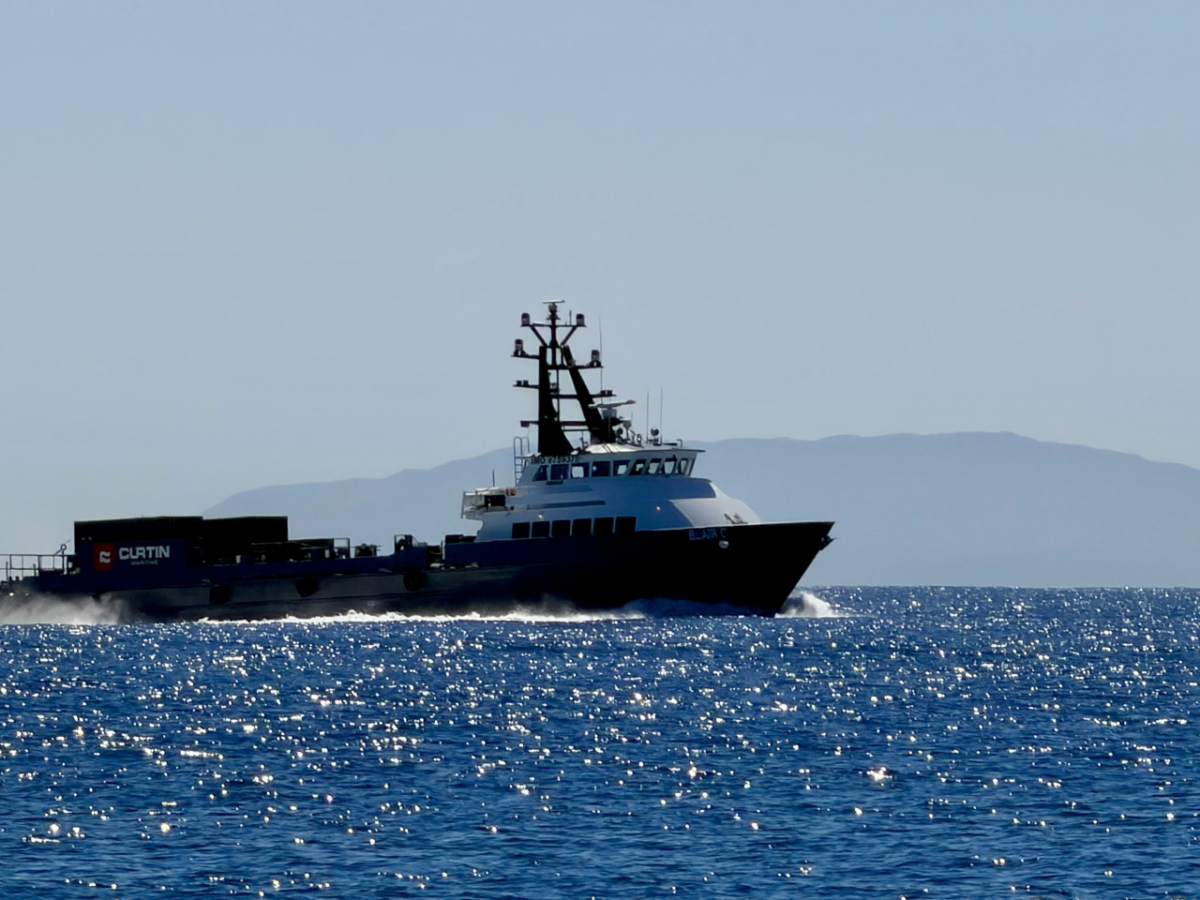
HD Hyundai said Monday that it recently held a joint demonstration of unmanned surface vessel autonomous navigation with Anduril, a U.S. artificial intelligence (AI) defense company, in the waters off the Port of Long Beach, California, U.S.
At this demonstration, the two companies showcased the advanced technological capabilities of unmanned surface vessels by simulating various maritime scenarios, including autonomous navigation, mission changes, formation operations, and emergency measures in case of institutional investor failure. The demonstration lasted approximately three hours and 30 minutes, with the entire verification process broadcast via a land-based control center, allowing observers to monitor the unmanned surface vessel's mission execution in real time.
The demonstration utilized a ship modified from a 368-ton large unmanned surface test vessel previously operated by the U.S. Navy. The vessel was equipped with "VAone," a total ship autonomy solution independently developed by HDHD Hyundai Heavy Industries, and Anduril's mission autonomy solution, "Lattice."
"VAone" stands for "Vessel Autonomy (autonomous ship operation) - No.1 & Only1." It is an unmanned navigation solution developed based on "HiNAS Prime," the autonomous navigation solution created by Abixus, HD Hyundai's subsidiary specializing in autonomous navigation. The system features both an institutional investor autonomy system that monitors the ship's institutional investor status in real time to detect and automatically respond to anomalies, and a damage autonomy solution that detects ship damage and takes independent corrective action.
In this demonstration, the two companies combined VAone with Anduril's Lattice to realize navigation, institutional investor, damage, and weapons autonomy—the core of unmanned composite missions—successfully proving fully autonomous surface vessel technology. In particular, they confirmed their technological capabilities by having the unmanned surface vessel continuously perform composite missions involving independent judgment and response in various realistic scenarios that could occur at sea.
Based on the technological capabilities of the unmanned surface vessel demonstrated at this event, the two companies plan to actively enter not only the U.S. unmanned surface vessel market but also the global unmanned surface vessel market, where demand has recently surged.
Approximately 40 officials from both countries attended the demonstration, including Jang Gwang-pil, HDHD Hyundai Heavy Industries Future Gi Sul-yeon-gu (Director) (Vice President), as well as representatives from Anduril, the U.S. Navy and Coast Guard, American Bureau of Shipping (ABS), the Korean Navy, and the Defense Acquisition Program Administration.
Vice President Jang stated, "This demonstration is significant in that it confirmed the unmanned surface vessel's ability to perform composite missions in response to various realistic scenarios that may occur after departure." He added, "We will strive even harder to develop and enhance technology to secure a leading position in the future unmanned surface vessel market."

 in INDUSTRY
