

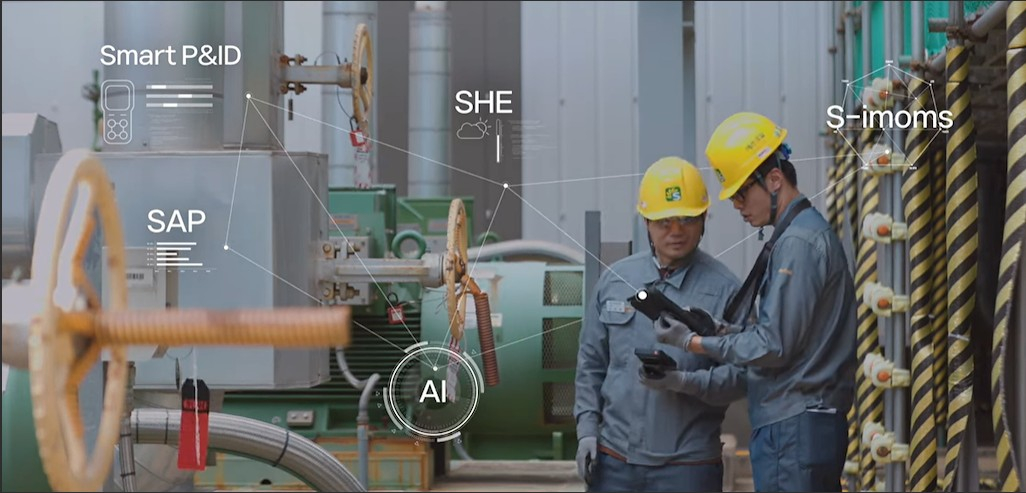
S-OIL announced on the 22nd that it has completed the advancement of its integrated manufacturing operations management system, "S-imoms (S-OIL Integrated Manufacturing Operations Management System)," and expanded its application scope to the Shaheen plant.
S-imoms is S-OIL's digital transformation project that connects systems and data scattered across overall plant operations—including production, equipment, maintenance, inspection, and safety—into a single platform. It aims to build an integrated manufacturing operating system capable of assessing plant conditions and making decisions based on field data.
In this "Phase-2" advancement, data integration among key solutions was strengthened, including Manufacturing Master Data Management (mMDM), Lifecycle Reliability and Integrity System (LRIS), and On-site Operation and Maintenance Inspection (ORS). By integrating equipment operation and performance information that had been dispersed across separate systems, the company enabled rapid assessment of plant operating conditions and improved equipment reliability and operational efficiency.
Digital technology has also been expanded to safety management. Eight modules, including change management, incident management, and Korea Fair Trade Commission risk assessment, were added to the Process Safety and Operational Risk Management Solution (PSORMS).
Generative artificial intelligence (AI) is also being utilized for on-site safety management. A generative AI function was applied to the Job Safety Analysis (JSA) module, which learns from and utilizes safety data such as approximately 2,800 standard job hazard assessment records, past accident cases, and injury/fatality risk factors. The plan is to enhance accident prevention capabilities by using AI to identify potential risk factors for each task and review corresponding response measures.
S-OIL has also completed the "Phase-3" deployment, which expands the application of S-imoms to the Shaheen project. This allows the Shaheen plant, which is approaching commercial operation, to utilize standardized equipment and operational data from the outset. The concept involves applying operational data and digital transformation experience accumulated at existing plants to new facilities to enhance initial operating stability and maintenance efficiency.
For refining and petrochemical plants, where stable equipment operation and accident prevention are directly linked to productivity, the capability to leverage manufacturing data combined with AI is emerging as a factor determining plant competitiveness.
Shim Hwan-seung, head of S-OIL's Plant Innovation and Adjustment Division, said, "Going forward, we will actively utilize data and AI to enhance on-site safety and operational efficiency, creating an intelligent workplace where employees can work more safely and efficiently."

 in INDUSTRY
