

Hyundai Motor's European subsidiary has suffered a sharp deterioration in its financial position, posting a large net loss amid an intensifying push by Chinese automakers. Its vehicle sales declined even as the European market continued to grow, while its capital impairment expanded nearly tenfold in just one year.
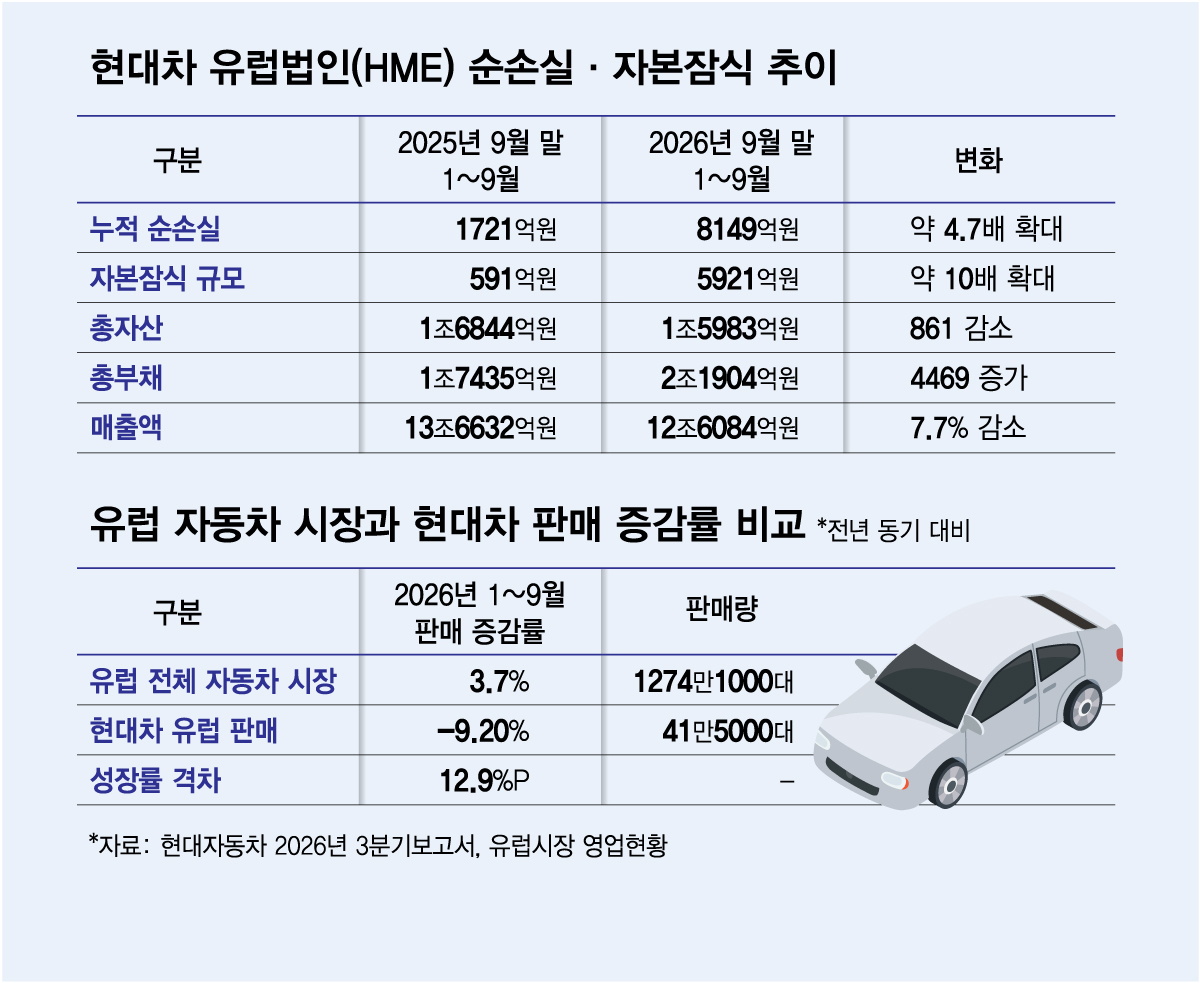
According to Hyundai Motor's third-quarter report submitted on Monday, the net loss for Hyundai Motor Europe (HME), its European sales subsidiary, on a consolidated basis from January to September this year was 814.9 billion won. This represents an increase of approximately 4.7 times compared to the net loss of 172.1 billion won recorded during the same period last year.
In particular, losses were concentrated in the third quarter. HME's cumulative net loss for the first half of this year was 314.2 billion won, but an additional net loss of approximately 500.7 billion won occurred solely in the third quarter. The net loss generated over three months exceeded the cumulative loss of the preceding six months.
The financial structure also deteriorated. As of the end of September, HME's consolidated total assets were 1 trillion 598.3 billion won, while total liabilities stood at 2 trillion 190.4 billion won.
With liabilities exceeding assets by approximately 592.1 billion won, the company is in a state of capital impairment. Considering that the scale of capital impairment was approximately 59.1 billion won as of the end of September last year, it has expanded to about 10 times its size over the past year.
Weak local sales are cited as a primary background factor. In the European auto market from January to September this year, 12.741 million vehicles were sold, a 3.7% increase year-on-year. Demand for electrified vehicles improved, allowing the overall market to maintain its growth trend.
In contrast, Hyundai's sales volume in Europe was 415,000 units during the same period, a 9.2% decrease year-on-year. The gap between the market growth rate and Hyundai's sales growth rate reached 12.9 percentage points (p). While overall market sales increased, Hyundai's sales actually declined.
This was reflected in the local subsidiary's revenue as well. HME's revenue from January to September this year was 12 trillion 608.4 billion won, a 7.7% decrease compared to 13 trillion 663.2 billion won during the same period last year.
With both sales volume and revenue declining simultaneously, and net losses expanding, restoring profitability in the European business has emerged as a key challenge.
A Hyundai Motor official explained, "Competition has intensified, centered on battery electric vehicles (BEVs), due to the expanded entry of Chinese automakers into the European market, coupled with sluggish sales of existing key models."
Although electrification demand is recovering, it is not translating into sales performance for Hyundai as competitors' market entry expands.
Hyundai's weak sales in Europe are not an issue limited to this year. Annual sales volume, which was 621,000 units in 2023, fell to 606,000 units in 2024 and 604,000 units last year, marking two consecutive years of decline. Last year, sluggish sales of internal combustion engine vehicles were a major contributing factor.
Recently, the competitive landscape in the European auto market is shifting rapidly, centered on electric vehicles.
Hyundai faces a situation where it must recover sales of its existing key models while enhancing competitiveness in the electrification market. With the confirmation of large-scale losses and expanded capital impairment at the local subsidiary, there are indications that improving financial structure is as urgent as reversing sales trends.

 in INDUSTRY
