


With less than two months remaining until the implementation of "telemedicine," which allows patients to receive medical care from doctors via screen without visiting hospitals or clinics, difficulties are expected as doctors, pharmacists, and industry groups push back against the exception rules regarding prescription days for initial telemedicine patients and the criteria defining initial patients.
According to industry sources on the 20th, the Ministry of Health and Welfare announced a revised draft of the Enforcement Decree of the Medical Service Act and the Administrative Sanctions Rules for Medical Affairs, which detail specific matters concerning the scope, prescriptions, delivery of pharmaceuticals, systems, and intermediary media for telemedicine.
The revised draft limits the prescription days for initial telemedicine patients to "within 7 days" as a general rule. For example, even patients who have been prescribed long-term medication for conditions such as diabetes or hypertension can only receive up to 7 days' worth of medication via telemedicine if they do not have a history of in-person treatment for the same condition at that clinic within the past six months. However, if a history of consultation and prescription for the relevant condition is confirmed and medical professionals determine it necessary to continue existing treatment, prescriptions may be issued for "within 30 days" on a one-time basis.
However, medical associations have raised objections to the revised draft, which leaves the door open for "prescriptions within 30 days." The Korean Medical Association (KMA) stated, "The revised draft announced by the Ministry of Health and Welfare directly overturns the principle of 'strictly limiting telemedicine as a supplementary means to in-person treatment' in subordinate regulations," adding, "The Ministry of Health and Welfare has itself undermined the restrictions on initial prescriptions."
It further argued, "(Prescribing) a month's worth of medication without checking the patient's condition even once during the 30th days after prescription nullifies the '7-day principle' and turns initial telemedicine into a channel for long-term prescriptions and future expansion of allowances," demanding, "The clause allowing 30-day prescriptions for initial visits should be deleted, and if exceptions are necessary, they must be strictly limited to 'within 14 days.'" This means that "conditional" exceptional prescriptions should be reduced from a maximum of 30 days to 14 days.
The Korean Association of Private Practitioners has decided to recommend its members not to issue "30-day prescriptions" for initial telemedicine visits. Park Geun-tae, president of the Korean Association of Private Practitioners, stated, "Even in the government's analysis of the pilot project, 73% of initial prescriptions were 'within 7 days,'" criticizing, "Prescribing a month's worth of medication to a patient seen for the first time, even just once in a lifetime, amounts to neglecting the risks of drug side effects and delayed diagnosis for 30 days."
Pharmacists also hold the position that exceptional prescription days should be limited to 14 days rather than a maximum of 30 days. In a statement on the 19th, the Korean Pharmacists Association noted, "If telemedicine records are included in the scope of history verification for (exceptional prescriptions), it becomes possible to receive an additional 30-day prescription via telemedicine immediately after receiving a 7-day prescription for an initial telemedicine visit, effectively allowing a 37-day prescription solely through initial telemedicine," and opined, "The number of days for exceptional prescriptions should be narrowed to the level of 14 days, not 30."
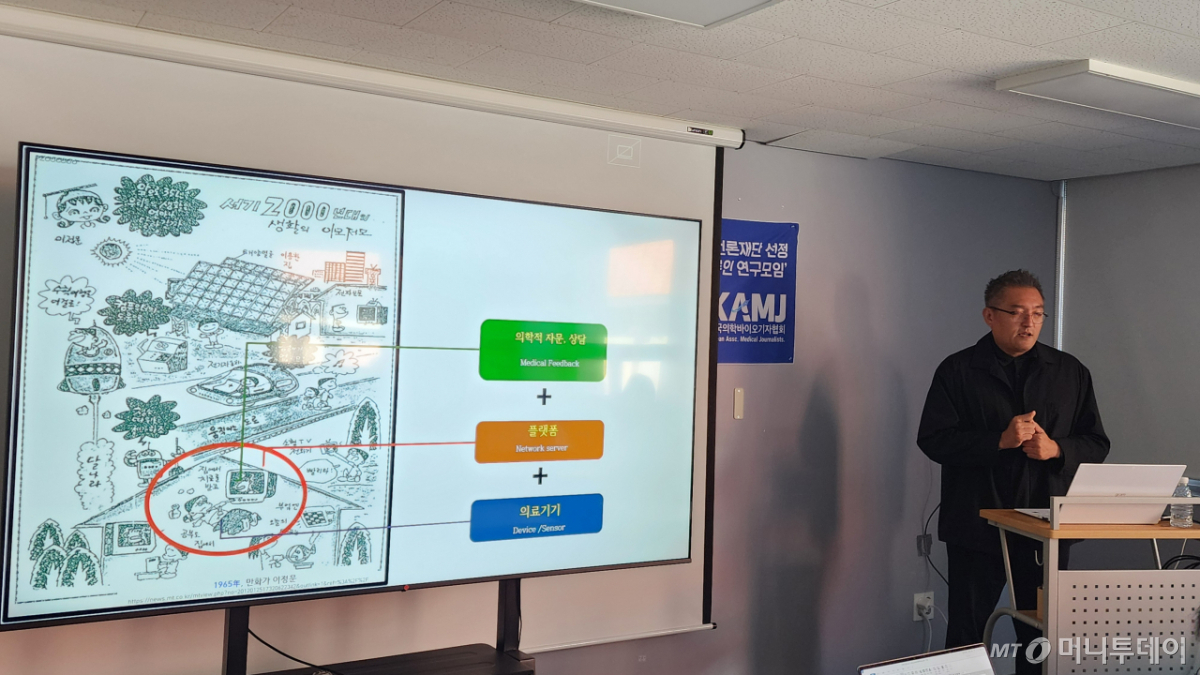
Arguments were also made that telemedicine should be used as a supplementary mechanism to fill the gaps between in-person visits, rather than as a "means to reduce the frequency of in-person visits." Kim Heon-seong, vice president of the Korean Telemedicine Society (Professor of Endocrinology at Seoul St. Mary's Hospital), argued during a media academy session hosted by the Korea Medical and Bio Journalists Association on the 20th in an undisclosed location in Jung-gu, Seoul, that "limiting prescription days is meaningless. It is appropriate to leave it to doctors' autonomy to decide prescription days for telemedicine themselves, while also having them bear the corresponding responsibility."
According to the revised draft, a person who has never received in-person treatment at Clinic A will be classified as an "initial patient" even if they receive multiple telemedicine consultations for the same condition, and can only receive up to 7 days' worth of medication.
In response, the telemedicine industry pushed back, stating, "(The revised draft) is no different from effectively banning telemedicine." Lee Seul, co-chair of the Telemedicine Industry Council, criticized, "If a patient who takes the same medication every day has to undergo five telemedicine consultations to receive a 30-day prescription, it is tantamount to telling them not to use telemedicine at all."
Meanwhile, the Ministry of Health and Welfare plans to finalize the revised draft after gathering opinions from the public and relevant institutional investors until the 9th of next month. The Ministry of Health and Welfare announced, "Opinions on the revised draft can be submitted by November 9 through the Ministry of Health and Welfare's Medical Information Policy Division (for matters related to pharmaceutical delivery, the Pharmaceutical Affairs Policy Division) or the National Participation Legislation Center."

 in THEBIO

