

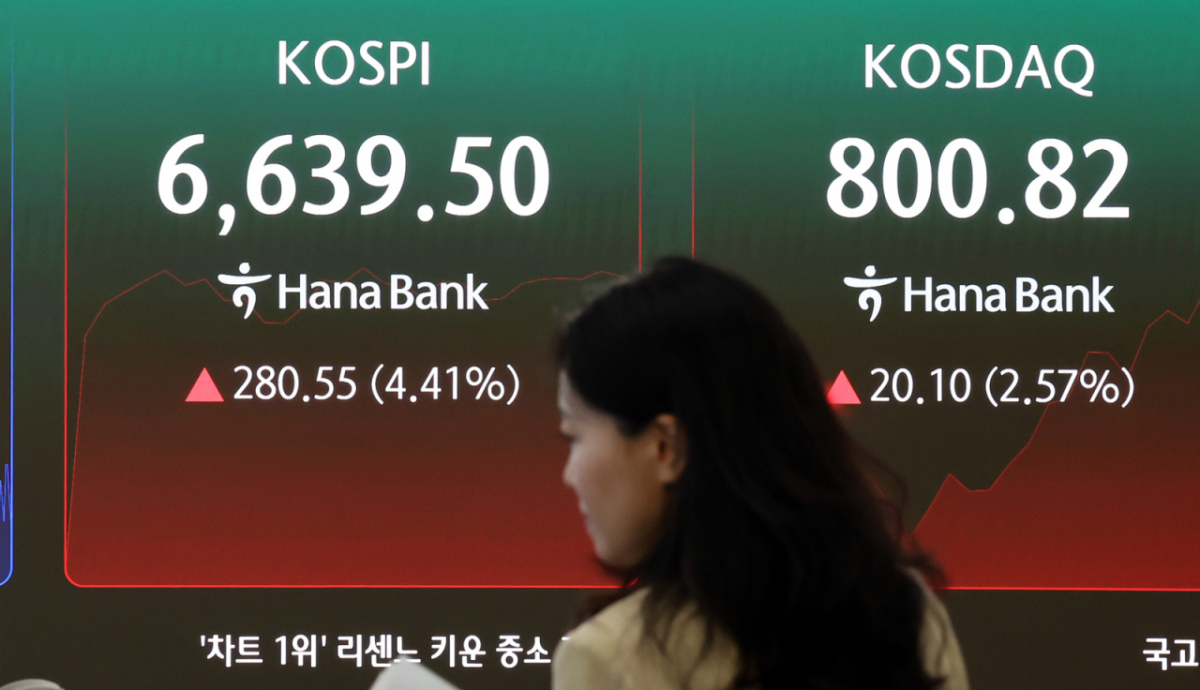
On the 5th, both the KOSPI and KOSDAQ markets rose together, bringing warmth to both major markets for the first time in a while. In the KOSPI market, foreign investors who regained confidence in AI (artificial intelligence) investments made net purchases, while in the KOSDAQ market, retail investors drove up the index with net buying. Experts recommended a strategy of diversifying portfolios by allocating between large-cap semiconductor stocks and growth stocks on the KOSDAQ.
As of 1:59 p.m., the KOSPI closed at 6,638.21 points, up 279.26 points (4.39%) from the previous trading day. The KOSPI opened the day at 6,603.48 points, up 244.53 points (3.85%), and after rising for two consecutive days, its gain expanded to over 4%.
At 9:25 a.m., a buy-side sidecar (futures market circuit breaker) was activated, suspending the validity of program trading orders for five minutes. This marked the 45th time since the beginning of the year that a sidecar (futures market circuit breaker) was triggered in the KOSPI market, with 22 instances occurring on the buy-side.
The rise in the KOSPI was driven by gains in Samsung Electronics and SK Hynix, which together account for half of the market capitalization. Both stocks had shown strength since pre-market trading; as of 11:01 a.m., they were up over 3% and over 7%, respectively. Samsung Electric (over 13%), Samsung C&T and SK Square (over 7%), and Doosan Enerbility rose by over 5%, showing strong performance.
In the KOSPI, construction stocks rose by over 6%, while electrical & electronics and machinery & equipment sectors gained over 5%. Manufacturing and distribution sectors rose by over 4%, and financials increased by more than 3%, indicating a broad-based upward trend rather than concentration in large-cap stocks.
Foreign investors and institutional investors made net purchases, driving up the KOSPI index. Retail investors sold off 1.2075 trillion won in net sales, while foreign investors bought 1.1095 trillion won and institutional investors purchased 97.9 billion won in net terms. Kim Seok-hwan, a researcher at Mirae Asset Securities, stated, "Semiconductor stocks, including SK Hynix ADRs (American Depositary Receipts), surged alongside the U.S. stock market yesterday, lifting SK Hynix's share price," and added, "Risk-on sentiment has expanded from the U.S. to Korea."
As of 1:59 p.m., foreign investors held Samsung Electronics, Korean Ocean Shipping, Kumho Tire, and Korean Air among their holdings. Institutional investors made net purchases in construction, solar power, and telecommunications stocks, including GS Construction, Hanwha Solutions, Doosan Enerbility, Daewoo E&C, and SK Telecom.
The KOSDAQ market continued to experience favorable momentum for four consecutive days. At the same time, the KOSDAQ rose 17.22 points (2.21%) from the previous trading day to close at 797.94 points. It opened at 794.93 points, up 14.21 points (1.82%), and briefly reclaimed the 800th-point level during trading.
In the KOSDAQ market, retail investors made net purchases of 376.3 billion won, supporting the index despite net selling by foreign investors and institutional investors. Large-cap stocks in biotechnology and semiconductors all rose. Alteozen gained over 3%, Juseong Engineering rose over 4%, and IOTech surged over 7%, showing strong performance.
Analysts suggest that while non-semiconductor stocks were undergoing rotation, a sharp rise in semiconductor stocks on the U.S. market pushed all sectors into a broad upward trend. Kang Jin-hyuk, a researcher at Shinhan Investment Corp., noted, "With stabilization in oil prices and interest rates, strong optimism around AI has flowed in, triggering a buy-side sidecar (futures market circuit breaker) in the KOSPI. Meanwhile, the KOSDAQ has continued to show strength for three consecutive days after a sidecar (futures market circuit breaker), driven by positive developments in biotech." He added, "Credit balances have decreased by 27% compared to June's peak, indicating reduced volatility."
Another outlook suggests that since the single-stock leverage ETF deposit requirement was raised to 30 million won on July 31, concentration risks have eased, supporting continued KOSPI gains. Lee Kyung-min, a researcher at Daishin Securities, stated, "Before the launch of single-stock leverage ETFs, Samsung Electronics and SK Hynix accounted for 50.2% to 58.9% of market capitalization, but as of the close on the 4th, their combined share dropped to 50.3%. With semiconductor selling pressure absorbed and concentration risks easing, an upward trend is expected to resume."
Analysts also predict a broad rotation following the second-quarter earnings season, driven by strong exports and improved performance in non-semiconductor sectors. The researcher explained, "The leading PER (price-to-earnings ratio) of the KOSDAQ has fallen to 17 times, easing valuation concerns and enhancing the price appeal of growth stocks." He added, "Policy impacts such as the KOSDAQ victory system have also contributed to its strong performance."
During periods of index recovery, experts advised maintaining a portfolio with 70–80% in KOSPI and 10–20% in KOSDAQ. Han Ji-young, a researcher at Kiwoom Securities, said, "This is not a market for switching positions but one for adding to holdings." She recommended that a buy strategy focused on core sectors like biotechnology and materials, components, and equipment (MCE) on the KOSDAQ remains valid, while maintaining a neutral or higher allocation to large-cap stocks such as semiconductors within the KOSPI is advisable.

 in STOCK
