

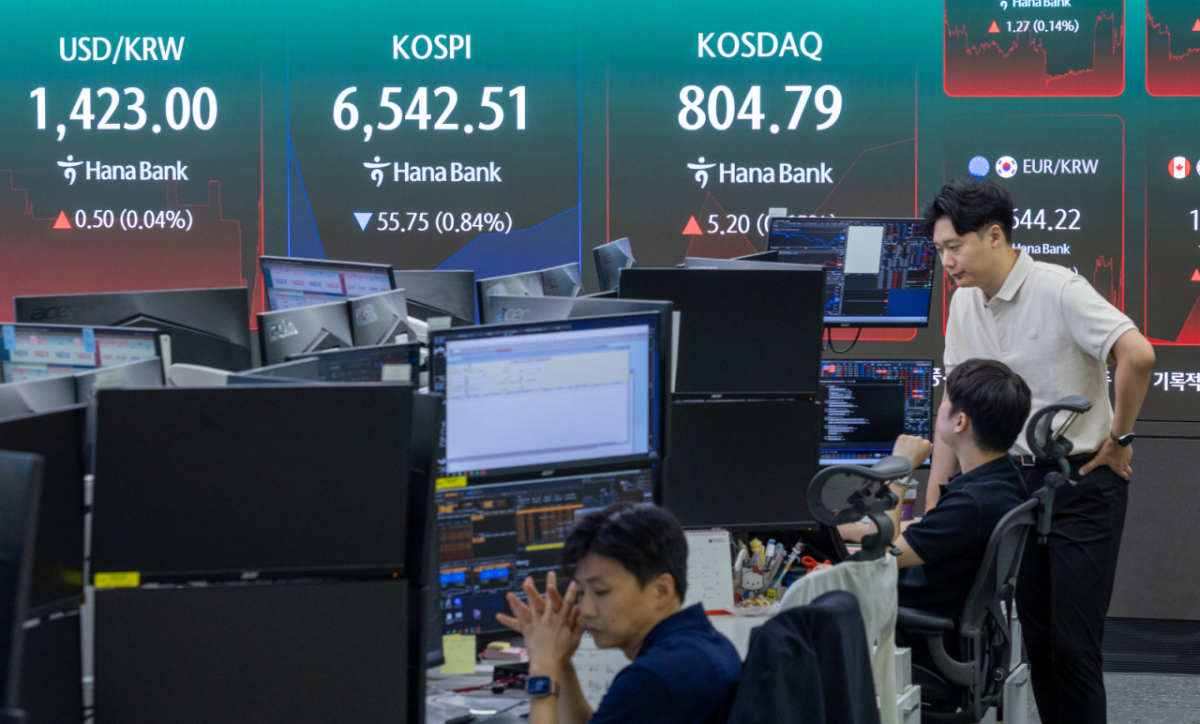
The KOSPI and KOSDAQ markets both turned red on the 6th, influenced by a decline in semiconductor stocks in the U.S. market that eroded investment sentiment toward "AI (artificial intelligence) semiconductors." Foreign investors, who had led the KOSPI's upward trend the previous day, sold off net in both major markets, shifting the market to a downward trajectory.
As of 11:22 a.m. on this day, the KOSPI stood at 6,324.85, down 271.49 points (4.11%) from the previous trading day. At the same time, the KOSDAQ recorded 790.88, down 8.71 points (1.09%).
The rebound momentum of the KOSPI, which had started and closed higher for two consecutive recent trading days, has stalled. The KOSPI opened at 6,478.75, down 119.51 points (1.81%), widened its losses during the session, and was pushed as low as the 6,200 level at one point.
In the KOSPI, where a buy-side sidecar (futures market circuit breaker) had been triggered the previous day, a sell-side sidecar (futures market circuit breaker) was activated at 10:30 a.m. today, suspending program trading orders for five minutes. This marks the 46th activation this year and the 24th time for a sell-side trigger.
Foreign investors, who had net purchased over 1 trillion won the previous day, turned to net selling, causing leading semiconductor stocks to weaken. Today, foreign investors sold off 1.9308 trillion won in the KOSPI, while institutional investors sold 39 billion won. Retail investors, who engaged in profit-taking the previous day, are now net purchasing 1.8823 trillion won today.
Leading semiconductor stocks are particularly weak. Samsung Electronics fell by over 5%, and SK Hynix dropped by over 8%. SK Square declined by over 10%, and Samsung Electro-Mechanics fell by over 8%, reversing the previous day's gains. Hanwha Aerospace is showing a gain of over 4% among the top market capitalization stocks.
Kim Seok-hwan, a researcher at Mirae Asset Securities, stated, "The market has declined centered on technology stocks, with the KOSPI showing weakness around 4% and the KOSDAQ around 1%." He analyzed, "If risk-on sentiment toward Korean assets had continued from the U.S. to Korea yesterday, today it has shifted back to risk-off sentiment."
This diagnosis indicates that the weakness in semiconductor stocks in the U.S. market led to eroded investment sentiment. Overnight, the Philadelphia Semiconductor Index fell 1.4% on the New York Stock Exchange. AMD dropped 7.04%, and SanDisk also showed weakness, falling 5% in after-hours trading as its expected revenue failed to meet market expectations. Han Ji-young, a researcher at Kiwoom Securities, explained, "Despite NVIDIA's rise of over 3% driven by expectations for the normalization of the Strait of Hormuz and improved server demand, weak stock performance from AMD and SpaceX led other AI semiconductor stocks into profit-taking."
The KOSDAQ also fell by around 1% as a procession of selling by foreign investors and institutional investors continued. The KOSDAQ opened at 797.44, down 2.15 points (0.27%), recovered the 800th level during the session, but then turned back to a downward trend.
While retail investors net purchased 239.9 billion won in the KOSDAQ, supporting the index, foreign investors sold off 220.6 billion won and institutional investors sold 19.7 billion won.
Kang Jin-hyeok, a researcher at Shinhan Investment Corp., analyzed, "The KOSDAQ appears to have entered a period of consolidation after rising for four consecutive days." He added, "Selling pressure emerged in major sectors such as biotechnology and robotics, while K-beauty stocks and Simtek, which gained momentum from earnings, showed strength."

 in STOCK
