

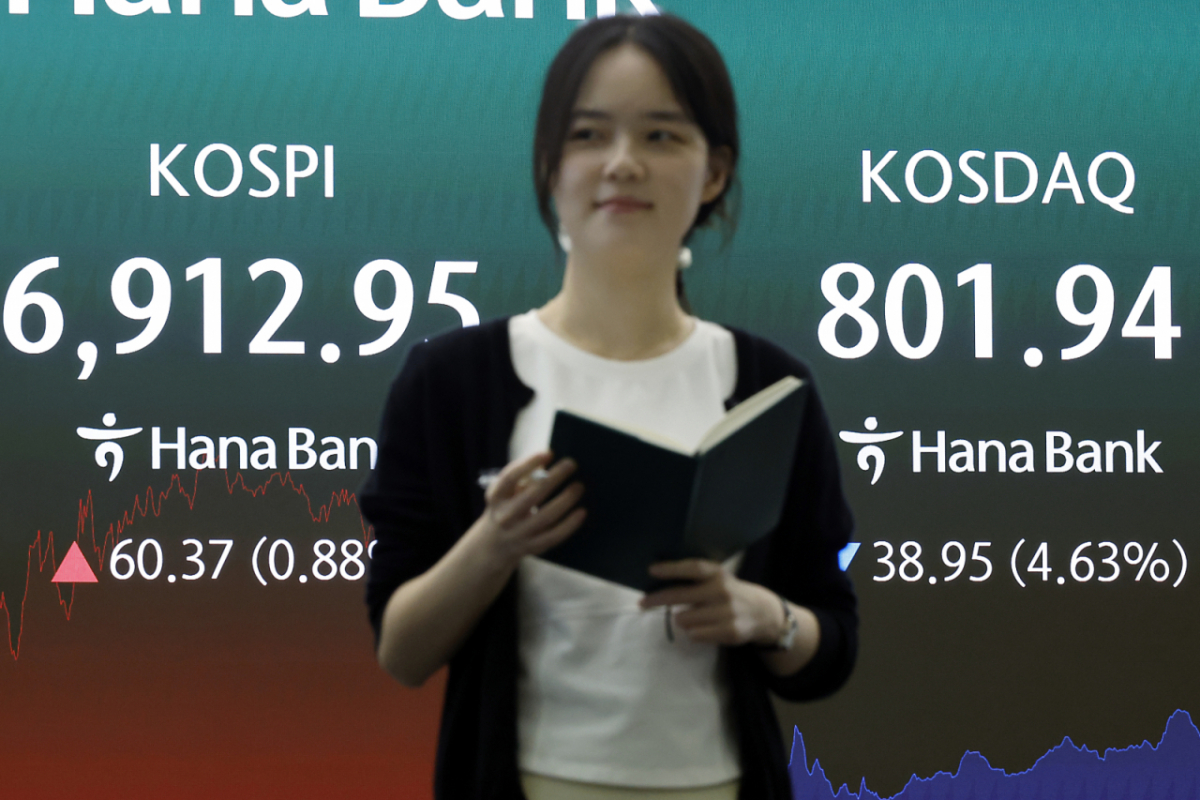
The KOSPI index rose on the 21st, recovering above the 6900th level. Amid concerns over a rebound in U.S.-driven market interest rates limiting supply and demand, expectations for shareholder returns surrounding Korea's two major semiconductor stocks pushed the market higher.
On this day, the KOSPI closed up 60.37 points (0.88%) from the previous trading session at 6912.95. The intraday high-low range was 211.68 points.
Across Korea Exchange and Next Trading, other corporations purchased a net total of 1.0863 trillion won, institutional investors bought a net 207.9 billion won, while individuals sold a net 862.4 billion won and foreign investors sold a net 423 billion won.
Among the top market capitalization stocks, Samsung Life Insurance rose over 10%, Samsung C&T gained over 5%, Samsung Electronics advanced over 3%, and SK Hynix and KB Financial Group closed up over 2%.
In contrast, Samsung Electro-Mechanics fell over 5%, LG Energy Solution dropped over 4%, Samsung Biologics declined over 1%, Hyundai Motor ended nearly flat, and SK Square closed unchanged.
Lee Kyung-min, a researcher at Daishin Securities, stated, "Amid a supply gap from foreign investors and institutional investors, net purchases by other corporations expanded, leading to a pattern of weakness early in the session followed by strength." He added, "The net purchase by other corporations targeting SK Hynix reflects the impact of share buyback volumes."
Regarding Samsung Electronics, he noted, "Reports that a new shareholder return package would be announced expanded shareholder return momentum, exerting upward pressure on Samsung Electronics and its affiliated companies."
By sector, KOSPI insurance rose over 6%, telecommunications over 3%, retail over 2%, and electrical appliances & electronics and finance over 1%. Manufacturing, transportation warehousing, and textiles & clothing showed a weakly flat trend.
Medical precision and construction fell over 5%, metals over 4%, machinery equipment and transport equipment over 3%, securities, entertainment/culture, and general services over 2%, while chemicals, IT services, and pharmaceuticals declined over 1%. Real estate, paper/wood, food/beverage/tobacco, electricity/gas, and non-ferrous metals showed a weakly flat trend.
The KOSDAQ index closed down 38.95 points (4.63%) from the previous trading session at 801.94. Individuals purchased a net 728.5 billion won, while foreign investors sold a net 370.3 billion won and institutional investors sold a net 363.7 billion won.
As the spot-futures decline continued throughout the session, a program sell order temporary suspension (sell sidecar (futures market circuit breaker)) was triggered in the KOSDAQ market at 10:05 a.m. This marks the 32nd sidecar (futures market circuit breaker) of the year.
All top 10 stocks by market capitalization fell. AVL Bio rose over 8%, EcoPro BM and EcoPro over 7%, Altogen, Rino Industrial, and Wonik IPS over 5%, Juseong Engineering over 4%, Rainbow Robotics and HLB over 3%, and IOTech declined over 2%.
Selling pressure spread across all sectors. KOSDAQ general services, electrical appliances & electronics, finance, and medical precision fell over 5%; manufacturing, transport equipment, pharmaceuticals, machinery equipment, and metals over 4%; chemicals, construction, and non-ferrous metals over 3%; retail, entertainment/culture, other manufacturing, and IT services over 2%; food/beverage/tobacco, publishing/media, and paper/wood declined over 1%. Transportation warehousing ended nearly flat, and textiles & clothing closed unchanged.
The won/dollar exchange rate settled at 1386.5 won, down 6.1 won from the previous day, concluding the weekly trading on the Seoul foreign exchange market.

 in STOCK
