

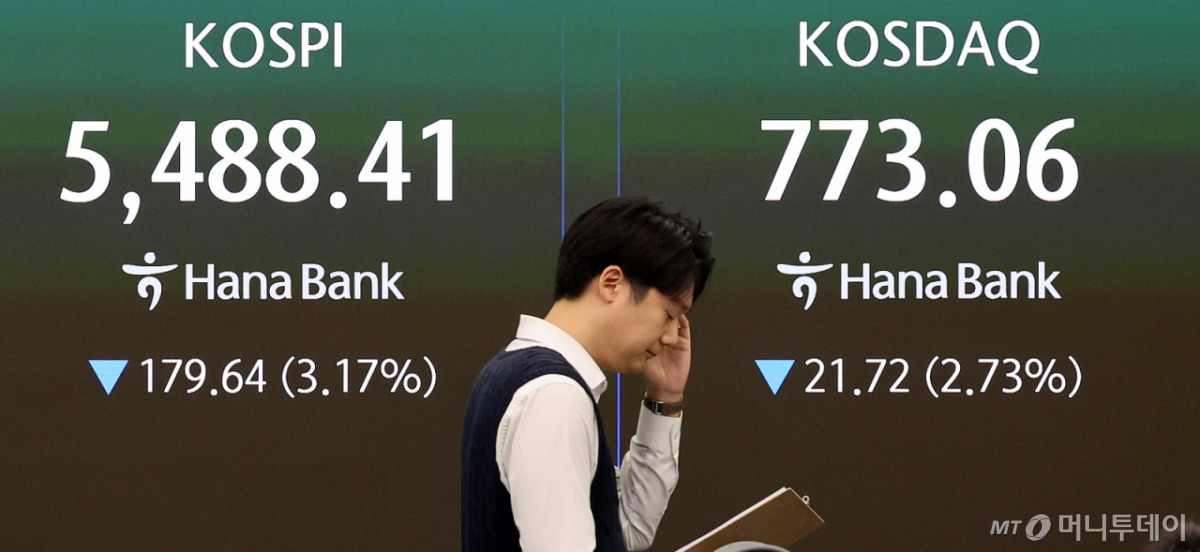
As volatility in the stock market has intensified, with the KOSPI, which hovered around the 7,000 mark earlier this month, falling to the mid-5,000 range, voices are emerging arguing that the Stock Market Stabilization Fund should be activated. While maintaining buy investment recommendations for companies, the securities industry is lowering target prices one after another to reflect the divergence between current stock prices and forecasts. Amid analyses suggesting that the stock market has historically found a bottom whenever the stabilization fund was mentioned, attention is turning to whether the market can rebound.
According to Korea Exchange on the 19th, the KOSPI 200 Volatility Index (V-KOSPI) rose by 10.47 from the previous day to 55.38 on the 15th. This marked the first time the index surpassed 50 in approximately 50 days since August 28 (50.08). The volatility index was slightly lower than the previous trading day at 48.74. Samsung Electronics and SK Hynix, which account for more than half of the KOSPI market capitalization, plunged on the 15th but showed a relatively stable trend on the 19th. However, compared to their June highs, Samsung Electronics and SK Hynix have fallen by 43% and 58%, respectively, with no clear rebound in sight.
The securities industry is successively lowering target prices. Among reports published over the three trading days from the 15th to the 19th, 128 lowered their target prices, nearly five times the number of reports that raised them (26).
The stocks with lowered target prices were diverse, including automakers (Kia, Hyundai Motor), game companies (Krafton, Netmarble), electrical equipment manufacturers (LS ELECTRIC, HD Hyundai Electric), and defense firms (Hanwha Systems, LIG Nex1). Securities firms consistently maintained the stance that while there are positive factors and earnings momentum in the second half for these companies, they were lowering target prices to reflect the divergence between stock value and targets. This has led to a vicious cycle where such reports further dampen investor sentiment.
In the market, voices are rising that the stabilization fund should be introduced if the current state persists. The Stock Market Stabilization Fund is a fund designed to supply liquidity to the market during downturns to stabilize investor sentiment. It is jointly funded by financial companies and policy finance institutions, having been established with a total scale of 10.76 trillion won through crises including the 2003 credit card loan default crisis, the 2008 Lehman Brothers-led financial crisis, the 2020 COVID-19 pandemic, and the 2022 global tightening-induced recession.
Calls for utilizing the stabilization fund have also grown louder in political circles. Lee Seong-gwon, a member of the People Power Party who had proposed establishing the stabilization fund when stock prices plummeted due to the aftermath of leveraged ETFs (Exchange-Traded Funds), stated, "Samsung and SK Hynix established treasury share funds that effectively served as a stabilization fund, but since stock price crashes continue, it is now time for the government to step in and activate the Stock Market Stabilization Fund to restore confidence and seek stability in the stock market."
The government has not ruled out the possibility of utilizing the stabilization fund. Lee Hyung-il, who serves as both the Minister of Strategy and Finance and the Minister of Economy and Finance, said at a press conference held on the 16th at the Queen Sirikit National Convention Center in Bangkok, Thailand, in response to questions about whether measures such as deploying the stabilization fund or temporarily suspending short selling could be activated if market volatility increases further, "We are preparing to take market stability measures we have at our disposal if necessary while constantly monitoring the market," adding, "What measures will be taken depends on the situation."
The Stock Market Stabilization Fund is also drawing attention among investors. According to a market official, during the COVID-19 pandemic, when the fund was established on a large scale and reached the verge of activation, the stock market stabilized in conjunction with short-selling bans. Consequently, there are analyses viewing the timing of the fund's activation as a government-guaranteed floor for the stock market.
Analyses also suggest that the market is approaching a valuation low. This view considers the KOSPI 5,100 line as the bottom range based on a forward PBR (Price-to-Book Ratio) of 1.0 times. Han Ji-young, a researcher at Kiwoom Securities, stated, "While a PBR of 1.0 times may not be an absolute support line, and if rising U.S. long-term interest rates lead to expanded cost of equity or if the medium- to long-term ROE (Return on Equity) decline of domestic companies materializes, further discounts may be necessary," she added, "At the KOSPI 5,100 level, weight should be placed on recovering recent sharp declines by confirming the restoration of earnings reliability through Q3 results and whether AI stock anxiety is alleviated, rather than betting on downside risk."
However, some question whether now is the time to activate the stabilization fund, given that the KOSPI has fallen more than 40% from just below the 10,000 mark. A financial investment industry official said, "The fund size is only about 0.23% of the domestic stock market's market capitalization," adding, "Since the KOSPI rose significantly and then fell, it is difficult to objectively assess the current level, making it hard to hastily activate the Stock Market Stabilization Fund."

 in STOCK
