

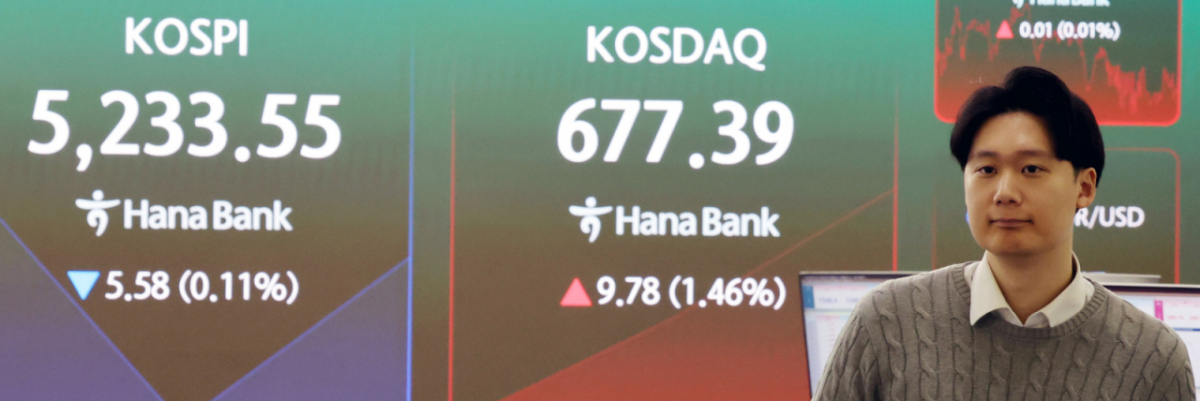
The KOSDAQ market expanded its intraday index gain to the 4% range on the 11th, continuing its sharp rally for two consecutive trading days. This stands in clear contrast to the KOSPI market, where the pace of additional gains slowed following the previous day's surge.
At 11 a.m. on Wednesday, the KOSDAQ index stood at 695.16, up 27.55 points (4.13%) from the previous close. Based on cumulative data from Korea Exchange and NextTrade, institutional investors made net purchases worth 81.4 billion won, while retail investors sold a net amount of 79.5 billion won and foreign investors sold a net amount of 5.1 billion won.
Upward bets continued in the index futures market as well. At the same time, KOSDAQ150 futures recorded 1309.79, up 64.09 points (5.14%).
Among top market capitalization stocks, strength was notable in semiconductor materials, components and equipment and secondary batteries. Jusung Engineering traded at 170,000 won, up 17,700 won (11.62%), while Ecopro BM traded at 91,000 won, up 8,500 won (10.30%).
While Ecopro surged in the 8% range, Iotech in the 7% range, and Simtech in the 6% range, Rainbow Robotics continued to show strength in the 4% range, Rino Industrial and Samchundang Pharmaceuticals in the 3% range, and Alteogen in the 1% range. Among the top 10 stocks, only HLB was slightly down.
Large-cap stocks expanded their gains to the 5% range, mid-cap stocks to the 3% range, and small-cap stocks to the 1% range. By sector, KOSDAQ non-metals surged in the 7% range, machinery and equipment in the 6% range, electrical electronics and finance in the 5% range, and manufacturing, transportation equipment, and chemicals in the 4% range.
Market attention is focused on whether the index will recover the 700th line by riding the momentum of the sharp rebound. The KOSDAQ index, which had continued its sluggishness in the second half, closed at 638.97 on the 9th, setting a new year-to-date low, prompting successive comments that selling pressure was excessive relative to listed companies' earnings.
At this time, the KOSPI index stood at 5280.42, up 41.29 points (0.79%) from the previous close. After repeatedly reversing between gains and losses in the early trading session, the index slightly widened its gain alongside the two major semiconductor stocks.
In terms of supply and demand, retail investors made net sales worth 97.5 billion won and foreign investors sold a net amount of 93.1 billion won, while other corporations made net purchases worth 175.9 billion won and institutional investors bought a net amount of 12 billion won. The main buyer among other corporations is estimated to be SK hynix, which had announced plans for on-market treasury stock purchases.
Samsung Electronics traded at 200,750 won, up 1,850 won (0.93%), and SK hynix traded at 1,238,000 won, up 26,000 won (2.15%). Among top market capitalization stocks, Celltrion showed strength in the 4% range, while Hyundai Motor and Samsung Biologics Logic entered a slight decline in the 1% range.
Amid mixed outlooks for the stock market, some analysts suggest that the time has come to attempt split purchases from a quantitative perspective.
"Extreme values were observed across seven indicators as of the previous day: KOSPI price-to-book ratio (PBR), dividend yield, foreign net purchase intensity, trading value relative to market capitalization, maximum drawdown (MDD), price-to-earnings ratio (PER), and volatility," said Lee Kyung-soo, a researcher at Hana Securities. "In the past, gradual rebounds were clearly evident after these indicators touched extreme values."
The won/dollar exchange rate was recorded at 1,337.6 won in the Seoul foreign exchange market at 11 a.m., down 6.9 won from the previous close. The decline widened by 4.4 won compared to two hours earlier.

 in STOCK
