

AMD unveiled the performance of its memory expansion software, which leverages artificial intelligence (AI) to reduce server DRAM usage by up to 75%, along with plans to expand its internal deployment. As changes in server memory configurations are anticipated, attention is turning to the potential impact on Samsung Electronics and SK hynix.
On the 11th, AMD announced that it presented the performance and application cases of its memory expansion software, "MEXT," at the "AMD In Depth 2026" event held in Las Vegas, United States. MEXT is a technology developed by a startup acquired by AMD.
The backdrop for this development is rising memory prices. According to Counterpoint Research, global DRAM sales in the third quarter of this year increased by 369% year-on-year. While shipment volume growth was limited to 4%, price hikes drove revenue up. TrendForce forecasted that contract prices for general-purpose DRAM in the fourth quarter will rise by 10% to 15% compared to the previous quarter.
What AMD focused on was DRAM utilization rates. Server operators install more DRAM than average to prepare for surges in usage, but a portion of the capacity often goes unused under normal conditions. Citing research from Meta and Microsoft, AMD explained that 50% to 80% of memory data becomes rarely used over time.
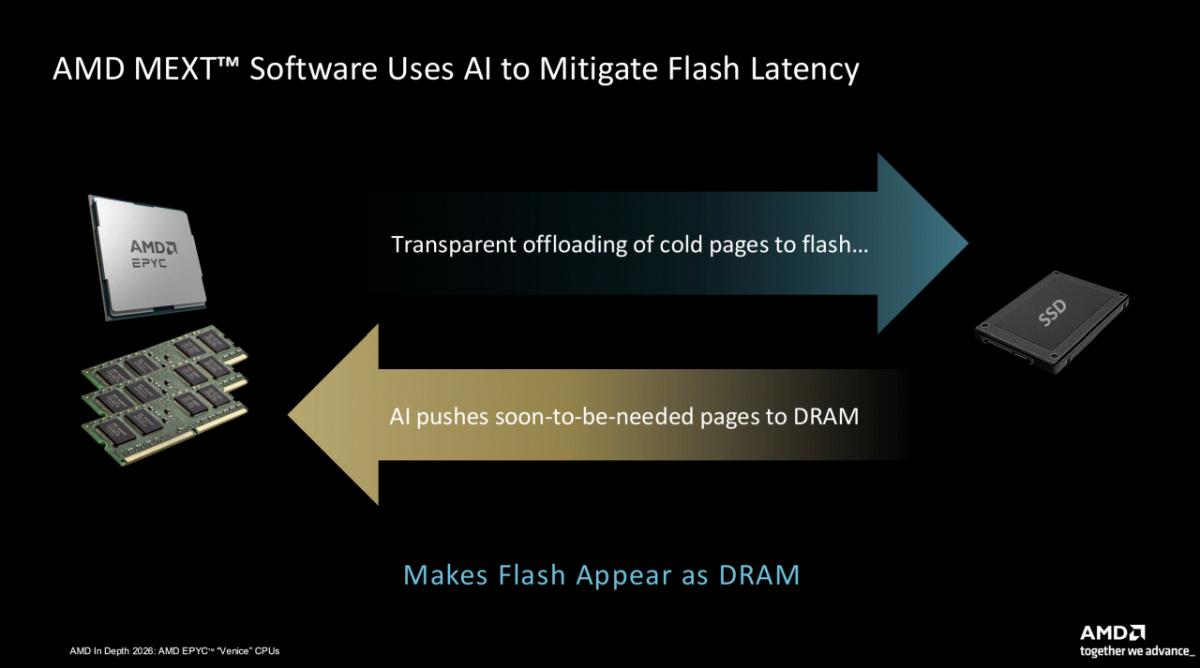
MEXT uses AI to analyze data usage patterns, moving infrequently accessed data to SSDs while pre-loading data that will be needed soon into DRAM. This approach reduces the performance degradation caused by the slow access speeds of SSDs while lowering the amount of installed DRAM.
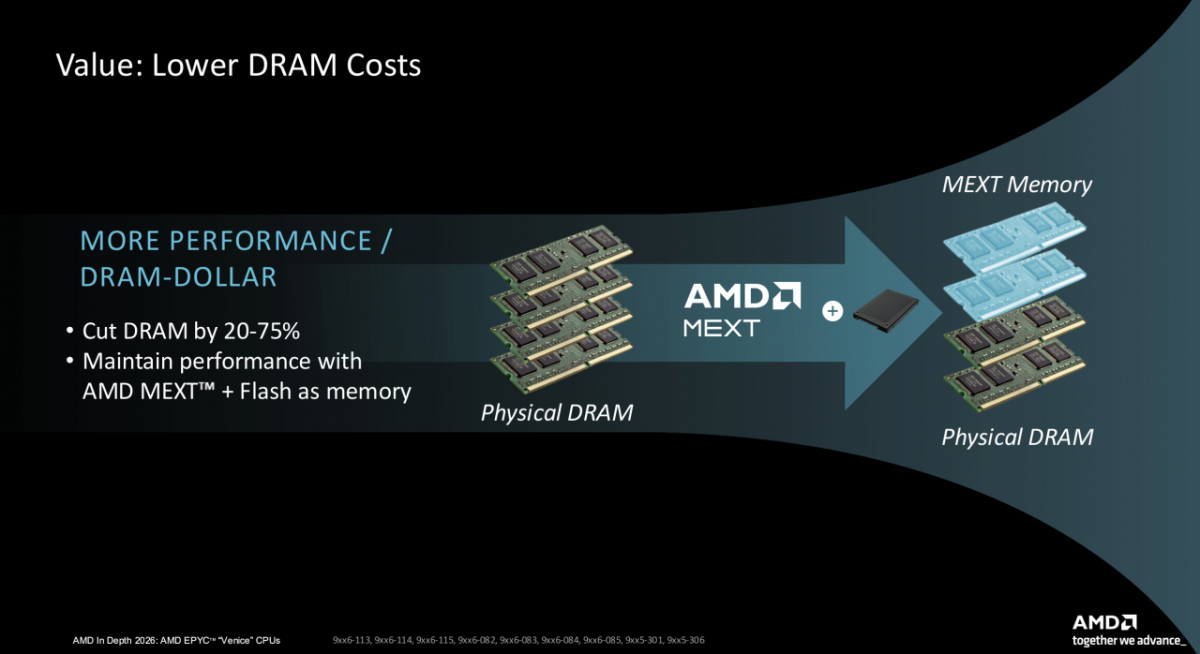
According to AMD, DRAM usage can be reduced by 20% to 75% depending on the workload. In a test running five AI agents simultaneously, maintaining 99% of the original performance was achieved even with DRAM capacity cut in half. In a configuration where DRAM was reduced by 75%, performance dropped to 85%, but performance per unit of DRAM cost increased by 3.4 times.
AMD stated that it applied MEXT to 145 of its own servers, achieving an 83% cost reduction compared to a method of expanding total memory using only DRAM. The savings amounted to approximately $4.9 million. The company plans to expand the deployment to 2,000 servers by 2027. In tests of Synopsys' semiconductor design verification software, "PrimeTime," performance was maintained at 95% when DRAM was reduced from 512GB to 256GB and the remainder was configured with MEXT.
However, SSDs cannot completely replace DRAM. Performance degradation may occur depending on the workload, and the savings are results measured in specific environments. Rising SSD prices are also a variable. TrendForce predicted that enterprise SSD contract prices will increase by 23% to 28% in the fourth quarter.
This is expected to be a point of interest for domestic memory makers such as Samsung Electronics and SK hynix. While the amount of DRAM installed per server may decrease, both companies produce NAND flash and enterprise SSDs, meaning that expanded SSD utilization could lead to new demand.

 in TECH

