

As the possibility has emerged that changes will occur in the bidding competition and market-making activities of government bond primary dealers (PDs) following the Fair Trade Commission's large-scale sanction related to government bond bids, attention is turning to the impact on government bond issuance yields and liquidity in the secondary market. Given that government bond yields serve as a benchmark for the domestic bond market, it is pointed out that retail investors also need to monitor market changes.
"Expectations of boosted bid competition" vs. "Concerns over weakened market making"
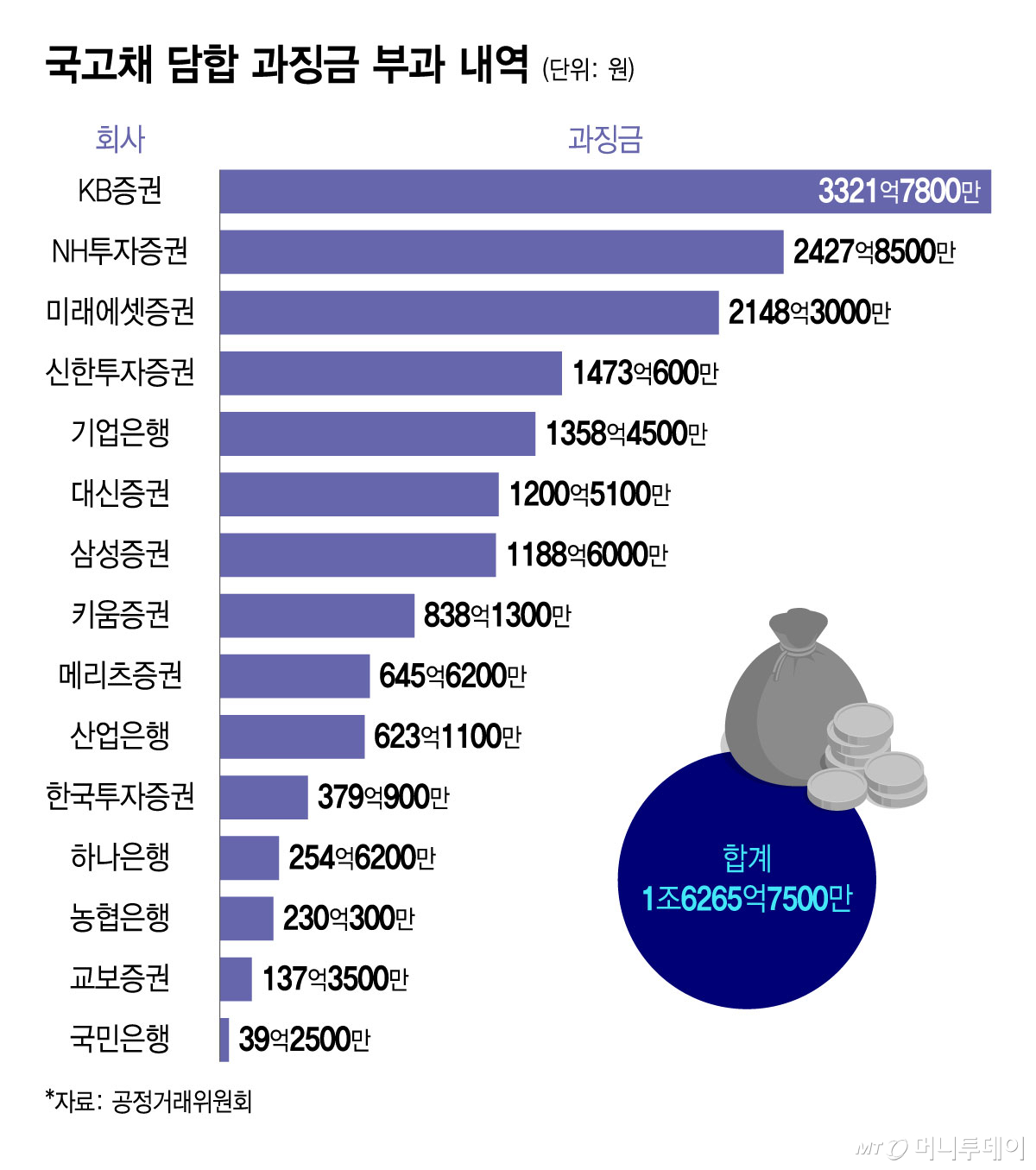
According to the Fair Trade Commission and the financial investment industry on the 11th, the Korea Fair Trade Commission imposed a total surcharge of 1,626.5 billion won on 10 securities firms and 5 banks that it determined had shared or agreed in advance on interest rates and volumes during the government bond bidding process from January 2020 to June 2023. Of this amount, the surcharges for securities firms totaled 1,376 billion won. The Korea Fair Trade Commission determined that information exchange or bid-rigging occurred in 150 of the total 345 government bond bids.
PDs are financial institutions that underwrite government bonds issued by the government through competitive bidding and ensure smooth trading in the secondary market. Currently, PDs bear the obligation to underwrite a certain percentage (8%) of the government bond competitive issuance volume and the obligation to distribute and hold government bonds, in exchange for benefits such as non-competitive underwriting rights and financial support.
The Korea Fair Trade Commission expects that this sanction will promote competition in government bond bids, thereby reducing the government's funding costs. On the other hand, the financial investment industry is concerned that PDs may become passive in underwriting and distributing government bonds due to increased capital burdens and strengthened risk management resulting from the surcharges. Even if bid competition intensifies, if the actual underwriting demand of PDs is insufficient or aggressive bidding decreases, there is a possibility that winning yields for government bonds will rise.
Government bond underwriting is the business in which financial institutions purchase bonds at a fixed price and supply them to the market. After underwriting government bonds, PDs bear profit-and-loss risks from interest rate fluctuations during the process of selling them in the secondary market or holding them themselves. If government bond yields rise, the price of held bonds falls, potentially resulting in losses. Analysis suggests that financial institutions with increased surcharge burdens may reduce underwriting beyond mandatory volumes or decrease their holdings to mitigate such risks.
In particular, if financial institutions do not compete actively in the government bond issuance market, the government may have to pay higher interest rates to secure the desired volume of funding. In the secondary market as well, if PD trading decreases, investors looking to buy or sell bonds may find it difficult to find a counterparty or may be forced to accept unfavorable prices. There are concerns that changes in liquidity in the government bond market could also affect trading conditions for other bonds.
A financial investment industry official expressed concern, stating, "We must consider not only the capital soundness of the industry but also the impact on the government bond issuance market," and adding, "If market participation by government bond PDs is restricted, it could hinder not only government bond issuance but also the government's budget procurement and execution."
The Ministry of Economy and Finance also attended the Korea Fair Trade Commission's deliberation as a reference witness and conveyed an opinion requesting that the impact on the national debt market be taken into consideration. The Korea Fair Trade Commission explained that it calculated the surcharges by comprehensively considering factors such as the financial condition of financial institutions and the specific characteristics of the government bond market.
However, this imposition of surcharges does not immediately lead to restrictions on PD bid participation. Whether to suspend or revoke PD qualifications is a matter for the Ministry of Economy and Finance to determine separately. PDs will continue to bear underwriting and distribution obligations, and they can also maintain additional benefits such as extra underwriting rights and funding advantages gained from participating in the government bond market. Therefore, it remains to be seen how much actual market-making functions will shrink, which can only be judged by observing future bid participation by financial institutions and trading trends in the secondary market.
Long-term bond and bond ETF investors should monitor yields and liquidity together
What is important for bond investors are changes in government bond yields and liquidity. If government bond yields rise, the price of previously issued bonds falls. Conversely, if yields fall, bond prices rise. Generally, the longer the maturity and the higher the duration (price sensitivity to interest rate changes), the more significantly the price moves even with the same magnitude of yield change.
Therefore, those who have invested in long-term government bonds or long-term bond exchange-traded funds (ETFs) should examine the risk of valuation losses due to rising yields. Bond ETFs are traded in real time like stocks, but profits and losses occur according to price changes in the underlying bonds. Even if dividends are received, if the ETF price drops significantly due to rising yields, the total investment return rate including dividends could turn negative.
Liquidity should also be watched carefully. If PD trading in the government bond secondary market shrinks, the spread between bid and ask prices may widen. Selling bonds with low trading volume or wide spreads urgently may result in selling at a price lower than expected. Bond ETF investors should check trading volume, the spread between bid and ask prices, and the divergence rate between market price and net asset value. In particular, for ETFs that are not actively traded, limit orders (specifying a desired price) rather than market orders can help avoid unfavorable executions.
However, it cannot be definitively stated that this sanction will immediately lead to rising government bond yields or falling bond prices. For investors, it is important to confirm actual supply-demand changes through future government bond bid response rates and winning yields, as well as secondary market trading volumes, rather than focusing on the sanction itself. When investing in bonds, one should examine maturity, duration (price sensitivity to interest rate changes), and the spread between bid and ask prices together.
Meanwhile, improving the PD evaluation system is also mentioned as a follow-up task. Under the current system, bid volumes that meet certain conditions are recognized as underwriting performance even if actual government bonds are not underwritten. The Korea Fair Trade Commission's investigation revealed circumstances in which PDs shared competitors' bid yields related to this method of recognizing performance. There are also calls to examine the relationship between the system that recognizes non-underwritten bid volumes as performance and the exchange of bidding information.
However, it is pointed out that reducing the performance recognition system could place a burden on PDs by requiring them to actually underwrite more government bonds. The task mentioned is to restructure the evaluation and incentive system so that while blocking the exchange of bidding information, participation in government bond underwriting by financial institutions can be maintained.

 in STOCK
