

"If you're working as a primary dealer, I think this level of information sharing is unavoidable. For it to constitute collusion, there should be a party that suffered losses or one that gained an advantage. But in primary dealer operations, there was virtually no harm or benefit to any particular institution."
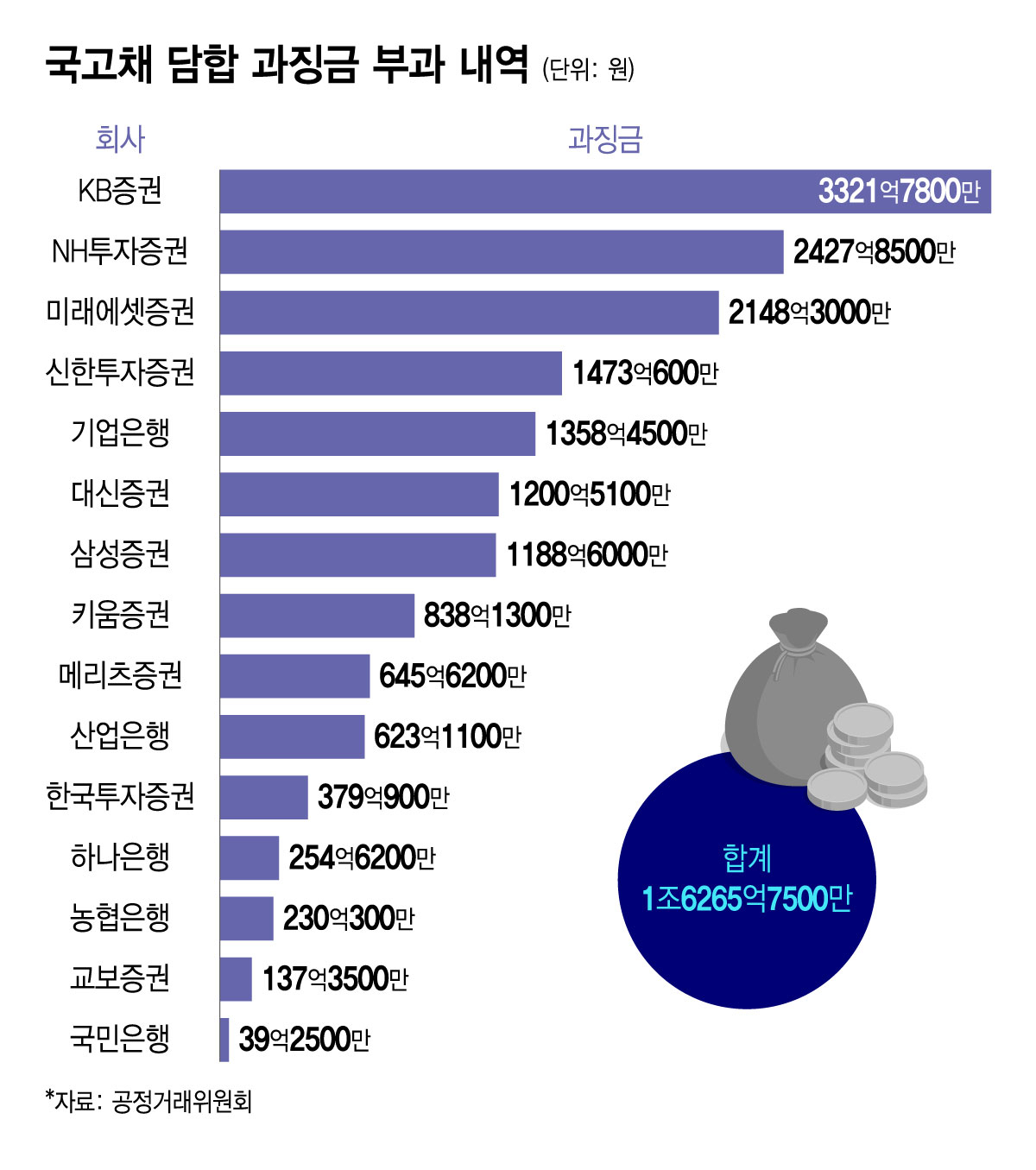
A senior official at a major securities firm made the remarks after the Fair Trade Commission (FTC) imposed fines totaling more than 1.6 trillion won on 15 primary dealers (PDs) in government bonds on Nov. 11 over alleged bid rigging.
PDs say they feel unfairly treated, arguing that routine information exchanges conducted as part of their work have been classified as serious collusion. Most are preparing to file administrative lawsuits, raising the prospect that the dispute between market participants and the government will move to the courtroom.
The Korea Fair Trade Commission issued corrective orders on the day and imposed penalties totaling 1.6266 trillion won on the 15 PDs, and decided to refer seven firms—Mirae Asset Securities, NH Investment & Securities, KB Securities, Kiwoom Securities, Korea Investment & Securities, IBK Industrial Bank of Korea, and KDB Industrial Bank—to the Serious Crime Investigation Office.
The commission determined that from January 2020 to June 2023, the PDs exchanged bidding interest rate information or agreed on bidding rates and volumes in 150 Treasury bond auctions, and that in 145 of these cases, there was even a meeting of minds regarding specific interest rates or volumes.
Reactions from the securities industry converge on the view that it was "merely information sharing."
An official from a major securities firm said, "We view this as an act of information sharing and consider it a matter to be determined in court." The argument is that exchanging market information among PDs before bidding is an unavoidable exchange given the nature of the work, and since there is no clear victimized party or party gaining unfair profit, sanctioning it as a cartel is unreasonable.
There is also significant dissatisfaction over being sanctioned while performing a role entrusted by the government.
Another official from a major securities firm said, "It is an industry-wide issue, so everyone will feel wronged. The government asked us to take on the role of market makers, and we are participating as market makers."
PDs are financial companies designated by the Ministry of Economy and Finance; in exchange for receiving the right to participate in Treasury bond auctions, they bear the obligation to quote prices in the secondary market.
The financial investment industry has expressed to the government the view that PDs are essentially intermediaries who distribute acquired Treasury bonds over a short period, making it difficult to generate profit through sales, and that some PDs have been conducting their business while absorbing losses.
It is also reported that they submitted an opinion based on their own economic analysis stating that information exchange actually lowered the winning bid interest rates.
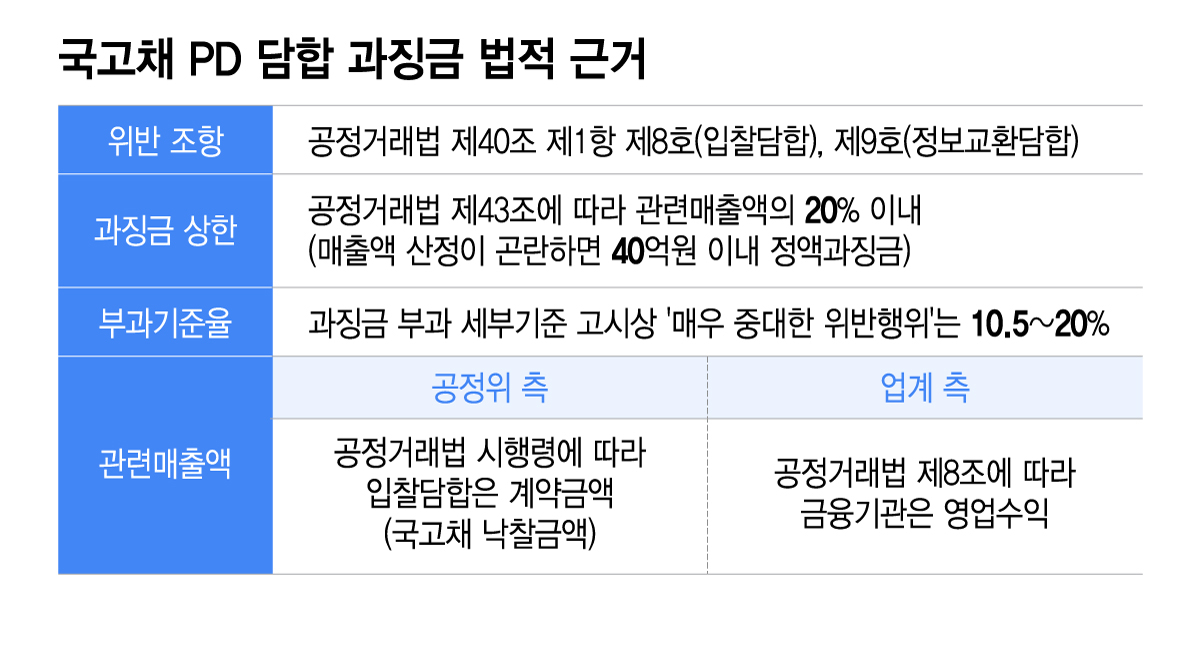
Complaints are also emerging over the method for calculating the penalties. A PD firm official said, "It is problematic to impose penalties based on the winning bid amount when it involves information exchange by a small number of participants."
The argument is that while only a few bidding staff exchanged information, the penalty was assessed based on the value of Treasury bonds won by the company, violating the principle of proportionality. The industry has long argued that penalties should be calculated based on operating revenue.
Korea Fair Trade Commission examiners initially viewed the PDs' actions as "very serious violations" and set the relevant sales amount at 76.2 trillion won based on the winning bid amount.
In the financial sector, there were even predictions that penalties could reach the 15th trillion won range if the maximum penalty rate of 20% was applied.
The FTC maintained the winning bid amount basis but reduced the relevant sales amount to approximately 54 trillion won and applied a penalty rate of 4.5%. A 30% reduction was also applied to all 15 firms.
The bidding scene examined by the FTC differs from industry explanations. In messenger conversations disclosed by the commission, a PD firm employee exchanged interest rate information with an employee from another PD firm, saying, "Now we don't even ask how you are; we go straight to the point."
When one employee said on the phone, "I'll use 70," the other replied, "Yes," and it took only five seconds to align on a bidding interest rate of 3.70%. There were also companies that handed over contact information for competitors' personnel to successors and created manuals detailing communication methods by bidding time slot.
The FTC judged this not as customary communication, but as specific and frequent agreements on bidding rates and information exchange. It also stated that the PDs failed to prove that information exchange had the effect of increasing bidding volumes or lowering winning bid interest rates.
The ball is likely to be passed to the courts. According to the financial investment industry, Mirae Asset Securities, NH Investment & Securities, KB Securities, Kiwoom Securities, and Korea Investment & Securities are considering legal action.
A financial investment industry official said, "Most companies will go to administrative litigation." The possibility of a joint response, such as a protest statement at the level of the Korea Financial Investment Association, is also being discussed.
The official expressed concern, saying, "If PDs are sanctioned, they cannot participate in bidding under the Act on Contracts with the State (State Contract Law)," and added, "If the number of participating PDs decreases, bidding demand could also shrink."
Whether information exchange can be viewed as an unfair joint action, and whether the penalty calculation based on the winning bid amount is lawful, are expected to become key points of contention in the court battle.

 in STOCK

