

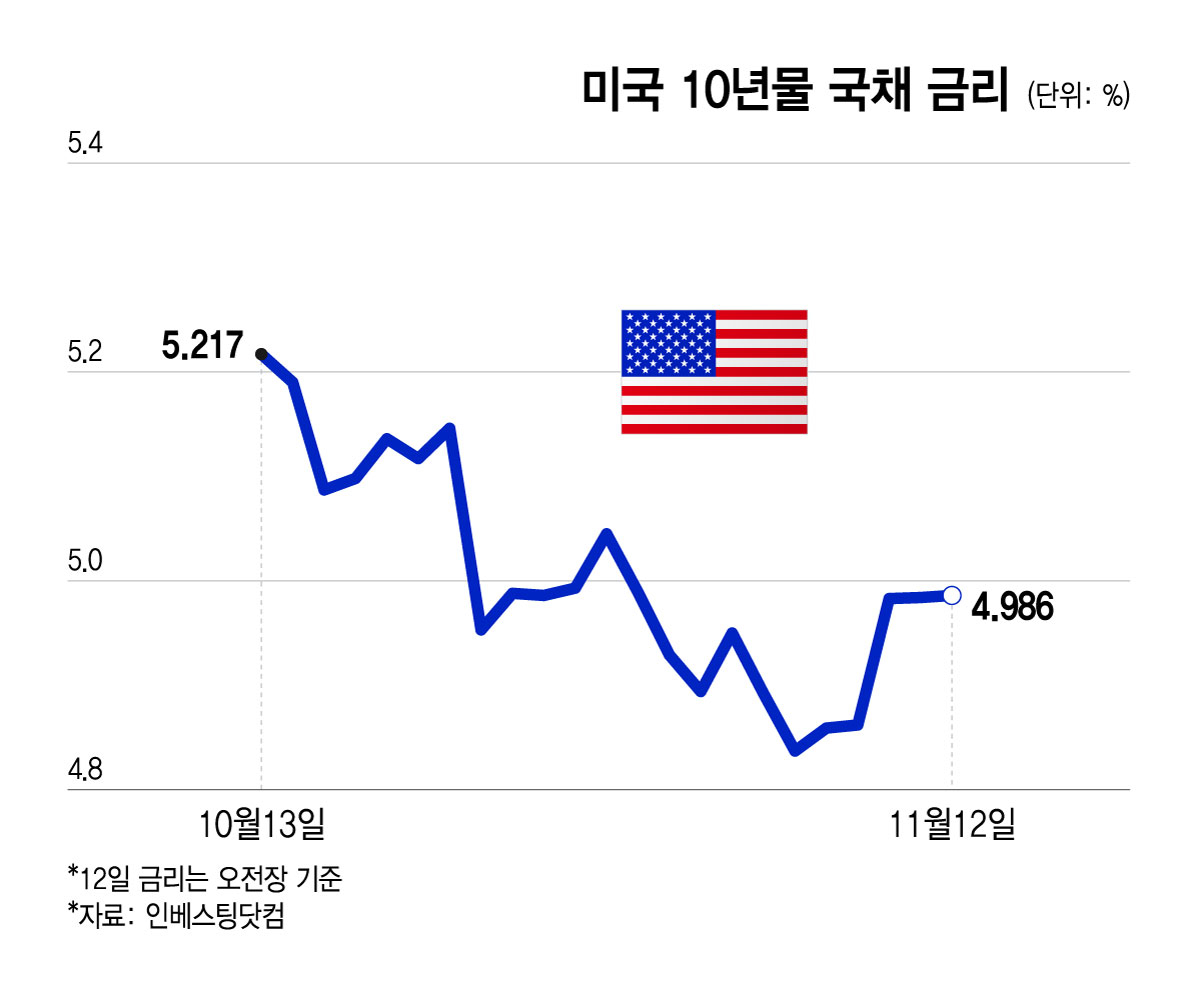
As market speculation grows that the Federal Reserve System may raise its base rate by 0.5 percentage points in a single move, known as a big step (50bp rate hike), in December, domestic market interest rates are also facing upward pressure.
According to financial information site Investing.com on Thursday, the U.S. 10-year Treasury yield stood at 4.986% annually in the global trading market that morning.
This followed a slight additional increase after closing at 4.983% annually on the 10th (local time) in the New York bond market, up 12.1bp (1bp = 0.01 percentage points) from the previous session. The New York bond market was closed the following day for Veterans Day.
That morning, the yield on 3-year government bonds fell by 1.6bp to 3.713% annually, while the 10th-year yield dropped by 2.1bp to 3.929%. However, the decline in the 3rd-year yield was only one-sixth of the 9.6bp increase on the 11th, and the drop in the 10th-year yield was merely one-fifth of the previous day's 10bp rise.
The previous day's surge in government bond yields marked the largest increase since the start of the fourth quarter this year. The 10-year yield had remained below 4% since the 3rd of this month but is now approaching the 4% mark again.
The rise in domestic and foreign interest rates, which had been stabilizing downward, is interpreted as being influenced by Federal Reserve Governor Christopher Waller's presentation of conditions for considering a big step in December at a conference held in London, UK, on the 10th (local time).
Governor Waller stated that if the U.S. core consumer price index (CPI) inflation rate for October is around 0.3% or higher month-on-month, the Federal Open Market Committee (FOMC) should consider a 50bp hike in December. The subsequently released core CPI rose by 0.3% from the previous month.
The securities industry views the upward pressure on market interest rates as dominant until year-end, given that a base rate hike at the December FOMC is considered a foregone conclusion. With the Federal Reserve likely to repeatedly express its stance on the big step, the upward pressure appears set to intensify.
SK Securities forecasted that the Federal Reserve would raise rates by 0.25 percentage points in December, with a minority opinion advocating for a 0.5 percentage point increase.
It also cited as a rising factor the possibility that foreign supply and demand for government bond futures, which had recently driven strength in domestic bonds, could shift due to surging overseas interest rates.
Hana Securities predicted that the Federal Reserve would implement additional hikes in March of next year following December, bringing the base rate to an upper bound of 4.50%. Consequently, it is expected that the peak for U.S. 10-year Treasury yields will be formed between next month and early the first quarter of 2027.
As market interest rates rise, financing costs are expected to increase for companies planning to issue corporate bonds around year-end and the start of the new year.
Even if a company secures a rate lower than the average private bond rating (Minpyeong) rate due to strong demand in book-building runs, the interest burden can still grow if the benchmark Minpyeong rate itself rises.
Acquisition financing is where rising interest rate pressure has a representative impact in the investment banking (IB) industry. It is known that LSA Holdings (the holding company of LS Automotive) and LS Automotive refinanced their acquisition financing for LS Automotive in August 2023, during a period of rising domestic and foreign market interest rates, resulting in rates increasing to between 7.68% and 10.5% annually.
This level represents an increase of 230 to 502bp compared to the initial financing in 2018. LSA Holdings is the acquisition special purpose vehicle for LS Automotive, in which LS Mtron and U.S. private equity firm KKR have invested.
A PEF (private equity fund) industry official said, "While conditions may fluctuate depending on factors such as corporate fundamentals, rising market interest rates ultimately increase the likelihood that acquisition financing rates will also rise, so rising U.S. interest rates are not a positive signal."

 in STOCK

