

The government is fostering advanced technologies that will be responsible for South Korea's growth drivers a decade from now, centering on SMRs (Small Modular Reactors), quantum computers, and lunar lander modules.
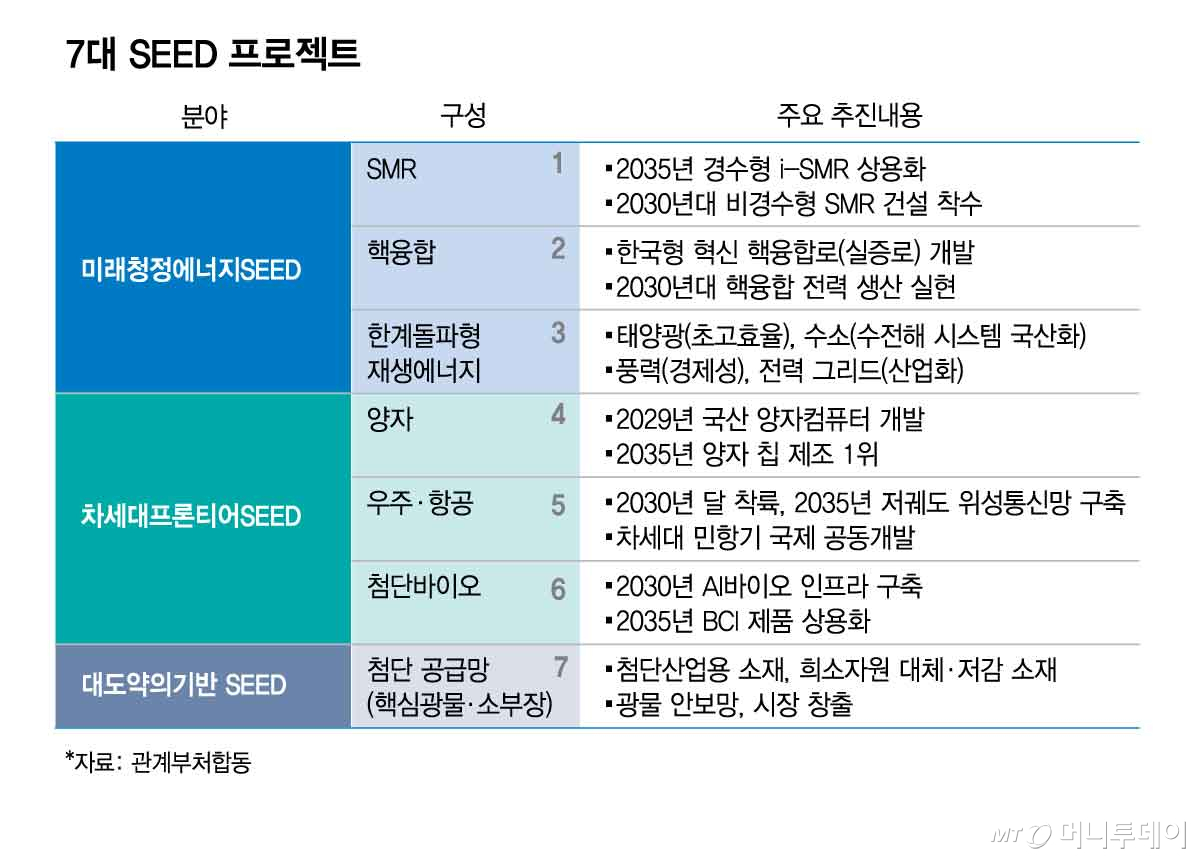
The Ministry of Science and ICT held the 'Report on the 7th Major SEEDs (Seeds) for Future Growth Drivers' meeting in conjunction with relevant ministries at Cheong Wa Dae's Chungmu Room on the 12th. The goal is to identify advanced technologies targeting a 10- to 20-year horizon and cultivate them as core assets for economic and national security. The projects are divided into three areas: △Future Clean Energy, △Next-Generation Frontiers, and △Advanced Supply Chains.
Future Clean Energy focuses on the development and commercialization of SMR, nuclear fusion, and renewable energy technologies. To meet explosive electricity demand, the government aims to commercialize light-water SMRs by 2035 and begin construction of non-light-water SMRs by 2030. SMRs are compact reactors that enhance efficiency and safety by integrating major core components into a single reactor unit. The regulatory framework for SMR licensing is also planned to be fully established by 2030.
Additionally, the government aims to generate its first electricity from nuclear fusion energy by 2030. Nuclear fusion mimics the principle of solar energy generation, and no country has yet succeeded in actual power production. The government plans to establish a Special Purpose Company (SPC) to build a Korean-style innovative fusion reactor by 2035 and supply commercial-grade electricity in the 2040s.
Development of renewable energies such as solar, hydrogen, and wind is also being accelerated. In particular, for solar energy, the goal is to proactively develop 'space-based solar power technology' by combining it with space data centers.
Through Next-Generation Frontier Seeds, the government will focus on cultivating △Quantum, △Space and Aviation, and △Advanced Biotechnology sectors. By 2029, it aims to secure a 100-qubit QPU (Quantum Processing Unit) capable of error correction. Furthermore, leveraging domestic semiconductor capabilities, the plan is to establish the QPU Yangsan system by 2035 and challenge for the world's top position in quantum computer manufacturing capacity. To achieve this, an SPC will be established centering on semiconductor foundry companies.
In the space sector, a lunar orbit communication satellite will be launched by 2029, and a 700kg-class small lunar lander will be launched under private leadership by 2030. A Korean-style low Earth orbit satellite communication network will also be completed by 2035. Additionally, the government will challenge next-generation commercial aircraft development through the 'Civil Aviation International Joint Development Public-Private Promotion Team.'
Biotechnology focuses on overcoming human biological limitations. The plan is to establish AI models specialized for cancer and autonomous laboratories operated by AI and robots by 2030, and to commercialize BCI (Brain-Computer Interface) chips connecting the brain and computers by 2035.
The Ministry of Trade, Industry and Energy is moving to secure critical minerals that will serve as the foundation for advanced technologies. By 2030, it aims to expand the recycling rate of ten major critical minerals to 20% and prepare subsidies and tax benefits. To secure overseas critical minerals, a committee of experts on vulnerable mineral types and an Industrial Resource Security Fund will be newly established.
The government is forming a public-private 'Future Pioneer Promotion Team' centered on the Vice Prime Minister, while detailed roadmaps for each project will be reviewed through the ScienceGi Sul-gwan-gye (Minister)Council.

 in TECH

