

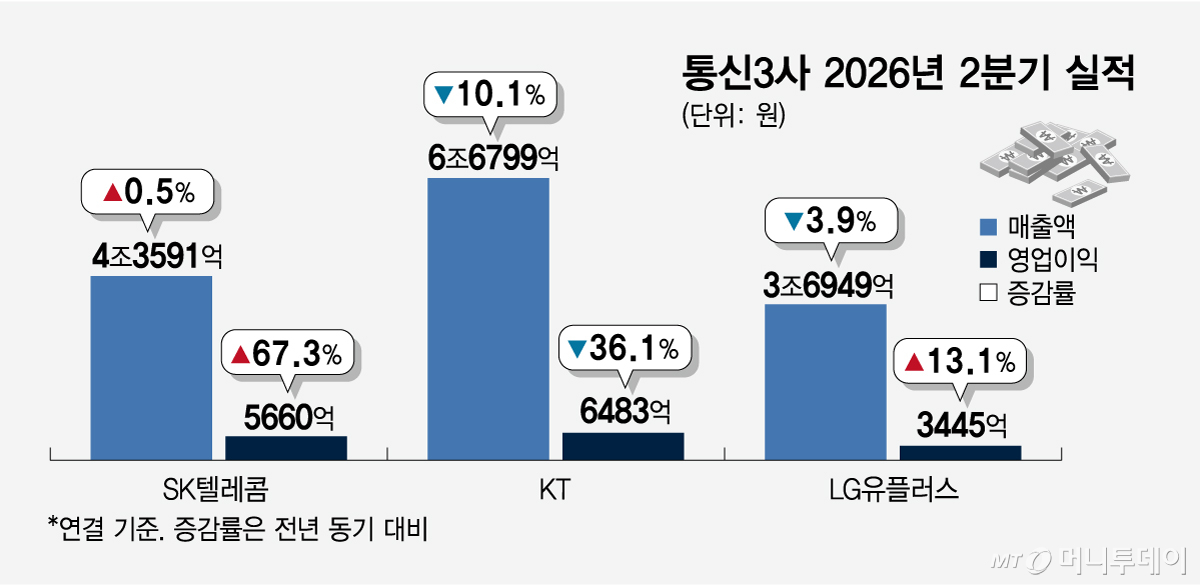
The second-quarter performance of South Korea's three mobile carriers diverged. SK Telecom and LG Uplus reported increases in operating profit, while KT saw a decline due to a reverse base effect from the previous year. However, KT also announced its presence as a new revenue source with double-digit growth in both its AI (artificial intelligence) and data center businesses.
According to the telecom industry on the 12th, SK Telecom recorded consolidated revenues of 4.3591 trillion won and operating profit of 566 billion won in the second quarter, representing increases of 0.5% and 67.3%, respectively, from the same period last year. The results were influenced by a base effect from costs incurred related to last year's hacking incident, growth in the data center business, and cost efficiency measures.
LG Uplus achieved its highest-ever quarterly operating profit. While revenues declined 3.9% to 3.6949 trillion won, operating profit rose 13.1% to 344.5 billion won. Service revenue increased by 2.0% to 3.765 trillion won. Mobile revenue grew 0.9% due to subscriber increases, while smart home revenue, including IPTV and ultra-fast internet, rose 4.3%.
In contrast, KT reported revenues of 6.6799 trillion won and operating profit of 648.3 billion won, down 10.1% and 36.1%, respectively. This was largely due to a reverse base effect from the previous year's second quarter, when sales and profits from the development project at the Gangbuk headquarters site were reflected. However, service revenue increased 1.8% to 5.9229 trillion won.
While overall results varied, all three companies confirmed growth in their AI data center businesses through financial performance. SK Telecom's AIDC (AI Data Center) revenues surged 92.5% to 136.2 billion won, driven by expanded operations at its Pangyo data center. The company is also expanding its business centered on 'SK Hyper,' which is dedicated to the AIDC business.
LG Uplus's AIDC revenues increased 28.9% to 124.1 billion won, supported by the expansion of its colocation business. The company is currently constructing a 200MW-class Paju AI data center with an investment of approximately 2 trillion won and plans to open the first computer building in the first half of next year.
KT continued its growth momentum in AI and cloud computing. Combined revenues from KT and KT Cloud, referred to as AX (AI Transformation), reached 367.8 billion won, up 22.3%. KT Cloud's revenues also rose 19.8% to 265.4 billion won, driven by increased utilization rates at the Gasan data center and expansion of data center design and construction projects.
The three telecom operators are expected to accelerate their expansion in AI and data center businesses during the second half of the year. With the core telecommunications business entering a mature phase, this strategy aims to leverage corporate demand for AI infrastructure as a new revenue source. SK Telecom will expand its AIDC business centered on SK Hyper, LG Uplus will secure additional hubs including the Paju center, and KT plans to develop AX and data center businesses as long-term growth pillars.
Shin Hee-cheol, a research analyst at IM Securities, stated, "The three telecom operators are securing new growth drivers through AIDC in response to the AI era while simultaneously pursuing integration into the value chain via AI investments." He added, "Revenue models centered on business-to-business (B2B) services such as colocation—leasing data center space and power—and GPU rental services will serve as breakthrough solutions to complement the wireless communications sector amid a low-growth environment."

 in TECH
