

As generative artificial intelligence (AI) rapidly permeates the learning and daily lives of teenagers, concerns are growing over exposure to harmful content and increased dependency. However, voices are calling for the establishment of safety measures tailored to age and developmental stages rather than outright banning AI use by teenagers. Critics argue that instead of directly importing overseas regulations, South Korea should first study the actual usage patterns of its own teenagers before setting flexible protection standards.
According to related industry sources on the 18th, efforts to establish protective measures for reducing risks associated with teenage AI use have gained momentum in the United States and Europe. California has mandated that AI companion chatbots used by minors include suicide and self-harm response protocols. These systems must also inform users that they are interacting with an AI rather than a human and provide reminders to take breaks every three hours. The European Union (EU) prohibits AI systems under its AI Act that could induce specific behaviors in vulnerable groups such as children or cause serious harm.
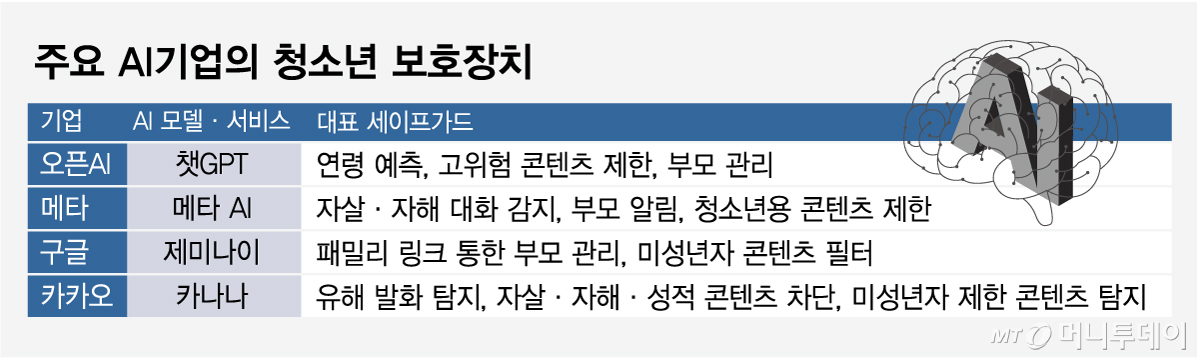
Global AI companies are also strengthening their protection mechanisms for teenagers. OpenAI has established "U18 Principles" within its "Model Specifications," which define behavioral standards for ChatGPT, specifically for users aged 13 to 17. Enhanced protective measures will be applied in high-risk areas such as self-harm and suicide, sexual or romantic role-playing, and dangerous activities. The company has also introduced an age prediction feature that applies a teen-friendly environment when it detects the possibility of a user being under 18.
Meta has implemented a feature that notifies supervising parents if a teenager engages in conversations with Meta AI related to suicide or self-harm. Google allows parents to manage their children's use of Gemini through "Family Link" and applies separate content protection measures for minors.
In South Korea, Kakao detects harmful utterances such as sexual content, child sexual exploitation, and suicide or self-harm through its proprietary AI safety model, "Kanana SafeGuard." It also operates a separate safety model to identify requests that require legal or policy-level caution, such as restricted content for minors.
While South Korea's AI Basic Law imposes obligations on high-impact AI providers regarding risk management and user protection, it does not specify age-based protection methods for teenagers' use of generative AI. Experts caution against simply importing overseas regulations or imposing blanket restrictions on teenage AI use. With AI now firmly established as a primary tool for learning and work, excessive restrictions could undermine teenagers' ability to utilize AI effectively, according to the Bank of Korea.
Lee Hee-jeong, a law professor at Korea University, stated, "While age-specific protection measures are necessary for teenage AI use, research should be conducted first to determine whether overseas approaches are suitable for South Korea's environment and teenagers." She added, "Rather than embedding specific protective measures uniformly in the law, it is preferable to adopt flexible approaches through enforcement decrees, guidelines, or self-regulation."

 in TECH
