

Since August, Google's app MAU (Monthly Active Users) on mobile has surpassed that of the Naver (NAVER) app, while Naver's in-house browser, Whale, also appears to be struggling to close the gap with Google Chrome's stronghold.
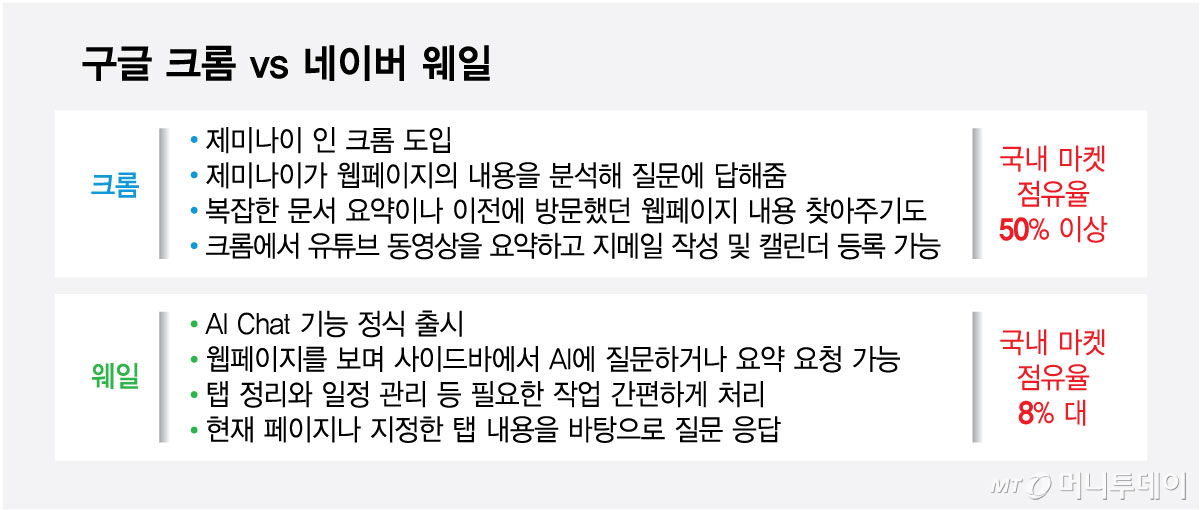
According to StatCounter on the 18th, Naver Whale's domestic market share has seen almost no change, rising from 7.98% in May 2021 to 8.51% last September. Over the same period, Google Chrome saw a slight decline from 54.38% to 50.36%, but still accounted for more than half of the market. In late April 2021, Naver announced that it would surpass global competitors and become the number one in the domestic browser market within the next three years. However, reality shows that it has not even surpassed Apple's web browser, Safari.
Naver Whale has reached its 10th anniversary of launch but continues to face issues with optimization and service stability. On the Naver Whale Research Institute platform, posts complaining about instability caused by updates are still trending as popular opinions. The sluggishness issue pointed out in the past also appears not to have been fully resolved. Opinions expressing inconvenience when accessing other platforms such as Instagram or Netflix through Whale have also continued.
The biggest gap between Chrome and Whale is the level of AI technology. In April, Google introduced "Gemini in Chrome" to its browser. This feature allows Gemini to analyze web page content and answer questions. It can also summarize complex documents or retrieve content from previously visited web pages. By integrating with its own services, it enables users to summarize YouTube videos, compose Gmail emails, and register schedules on the calendar directly within Chrome.
Google is strengthening its AI technology through overwhelming capital power and global search engine market share. Google accounts for approximately 90% of the global search market, including desktops, mobile devices, and tablets worldwide. It collects information from this source, trains its AI with it, and then provides services to users. Recently, it has also been focusing on processing long-tail queries and conversational search. According to a report released by Google Korea, 74% of Koreans use conversational search in Chrome.
Naver (NAVER) is also strengthening its features, believing that AI is ultimately the key to winning. On the 1st, it officially launched the "AI Chat" feature on Whale, applying a new brand logo and slogan. Users can ask questions to the AI or request summaries and translations from the sidebar while viewing web pages, and easily handle necessary tasks such as tab organization and schedule management.
AI Chat answers questions based on the content of the page currently being viewed or tabs designated by the user. Since users can check answers and continue with additional questions without leaving the current page, it reduces the hassle of switching between multiple screens. It also integrates with the existing "Quick Search" feature, which allows searching simply by dragging; after dragging a sentence or specific part on a web page that sparks curiosity, selecting AI Chat allows users to start a conversation based on that content.
A Naver official stated, "Whale has continuously improved its features to enhance user convenience in web usage," adding, "As an AI browser, we support seamless information exploration and task execution within the familiar browser environment through AI Chat, and will continue to advance necessary features."

 in TECH
