

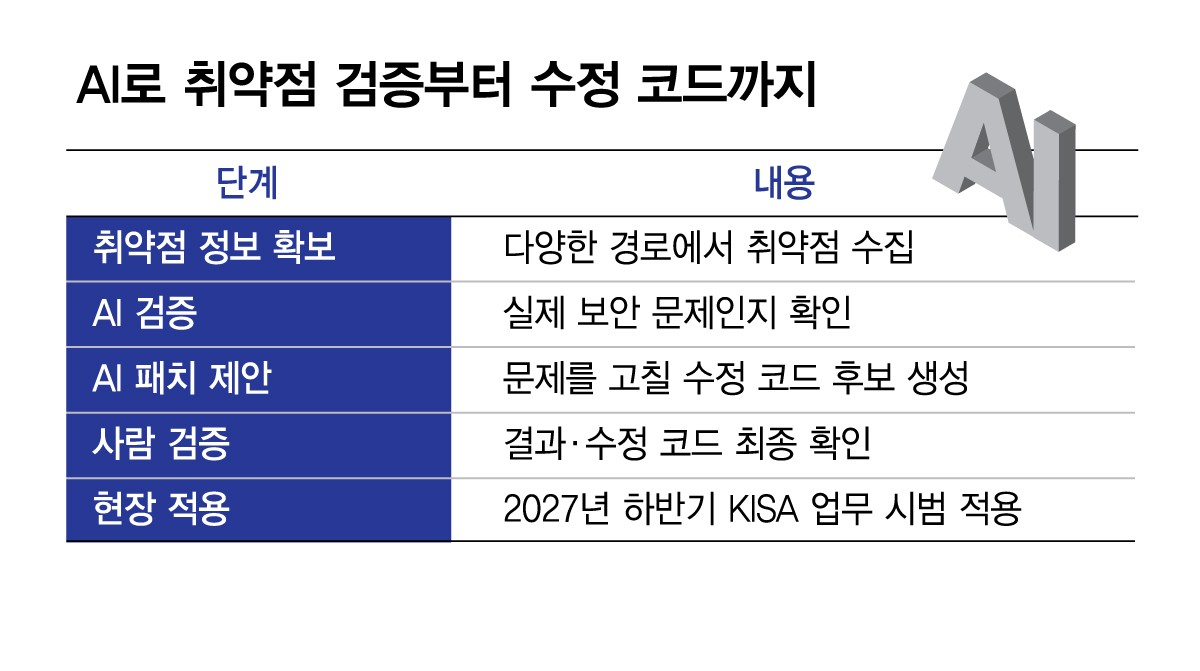
The Korea Internet & Security Agency (KISA) is developing a technology that uses artificial intelligence (AI) to verify security vulnerabilities and generate candidate code for fixes. This represents an effort to leverage AI not only for identifying security issues but also in the actual remediation process. KISA plans to complete development by the second half of next year and subsequently pilot-apply the technology to its vulnerability response operations.
According to KISA on the 19th, the technology under development verifies whether vulnerability information collected from various sources constitutes an actual security issue using AI. If a problem is confirmed, it proposes candidates for "patch code" that can fix the issue. Security vulnerabilities refer to weaknesses or errors in programs that hackers can exploit to intrude into systems.
A KISA official explained, "It is a technology that proposes revised patch code drafts based on verified information among vulnerability data collected through various channels." The initial detection of vulnerabilities is not included in the scope of this research. Once AI verifies the vulnerabilities and creates candidate fix codes, humans will perform final confirmation of the results at each stage.
The core objective is to reduce response time. Previously, when a vulnerability was discovered, security personnel had to confirm the actual risk, analyze the problematic code, and devise a method for correction. In contrast, attackers can use AI and automation tools to rapidly scan multiple systems and launch repeated attacks.
A KISA official stated, "The development related to security vulnerability verification and patch candidate generation is part of an effort to respond quickly to AI-automated attacks." Recently, in the case of a series of cyberattacks on the financial sector, financial regulators identified the intrusion type as "suspected automated attacks utilizing AI Agents."
KISA formulated its research plan earlier this year and began technology development as a national Research and Development (R&D) project in August. This is not a new initiative launched in response to recent incidents in the financial sector. Last month, KISA issued bids for the purchase of AI servers and Graphics Processing Units (GPUs) required for the research, and it proceeded with the procurement process for related graphics cards this month.
The target for completing development is the second half of next year. KISA explained that, under the national R&D agreement, the research period and content are already determined, making it difficult to arbitrarily advance the schedule at this time. Upon completion of the research, KISA plans to prioritize pilot application in its vulnerability response operations to verify accuracy and feasibility for field use.
Separately from this, the government is also promoting AI-based security responses, including the development of security-specialized AI models and the expansion of a continuous vulnerability reporting system. KISA's current research focuses on how quickly already-discovered vulnerabilities can be verified and fixed.
As attacks utilizing AI accelerate, it becomes increasingly important for defenders to determine how rapidly they can identify and block discovered weaknesses. If KISA's technology is applied in practice, response times are expected to decrease through a process where AI verifies vulnerabilities and presents candidate fix codes, followed by final human judgment.

 in TECH
