

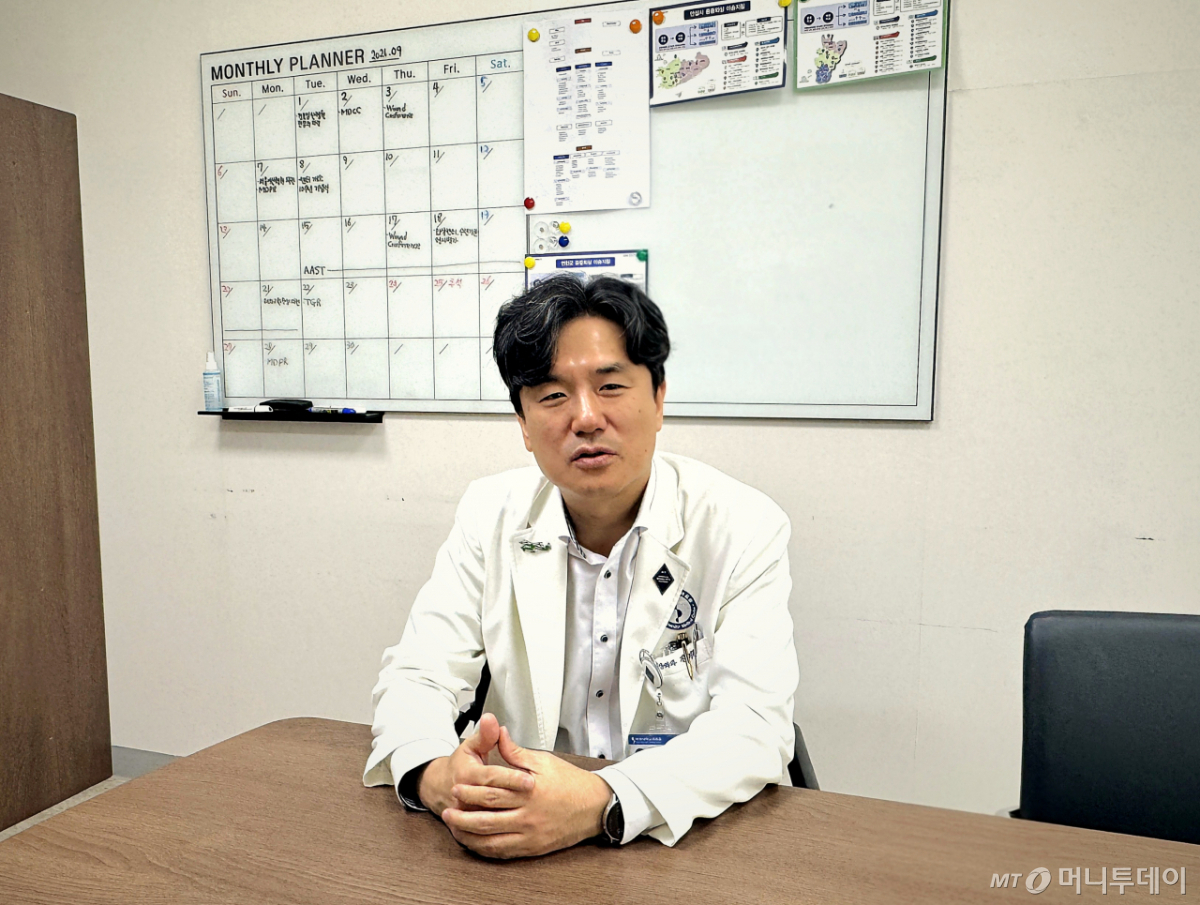
"We aim to expand our scale and treatment capabilities so that we can handle up to 90% of trauma patients in southern Gyeonggi Province."
Jung Kyung-won, Director of the Gyeonggi Southern Regional Trauma Center at Ajou University Hospital, stated this regarding the center's medium- and long-term goals during a recent interview with MoneyToday at the hospital. The Regional Trauma Center at Ajou University Hospital (hereinafter referred to as the Ajou University Trauma Center), which is celebrating its 10th anniversary of opening this year, is preparing for its next leap by challenging for selection as a 'Hub Trauma Center,' a new initiative by the Ministry of Health and Welfare. Hub Trauma Centers will assume the role of the "front line of the front line," taking responsibility even for severe trauma patients who are difficult to accommodate in certain regions. Two centers will be selected for the first time this year.
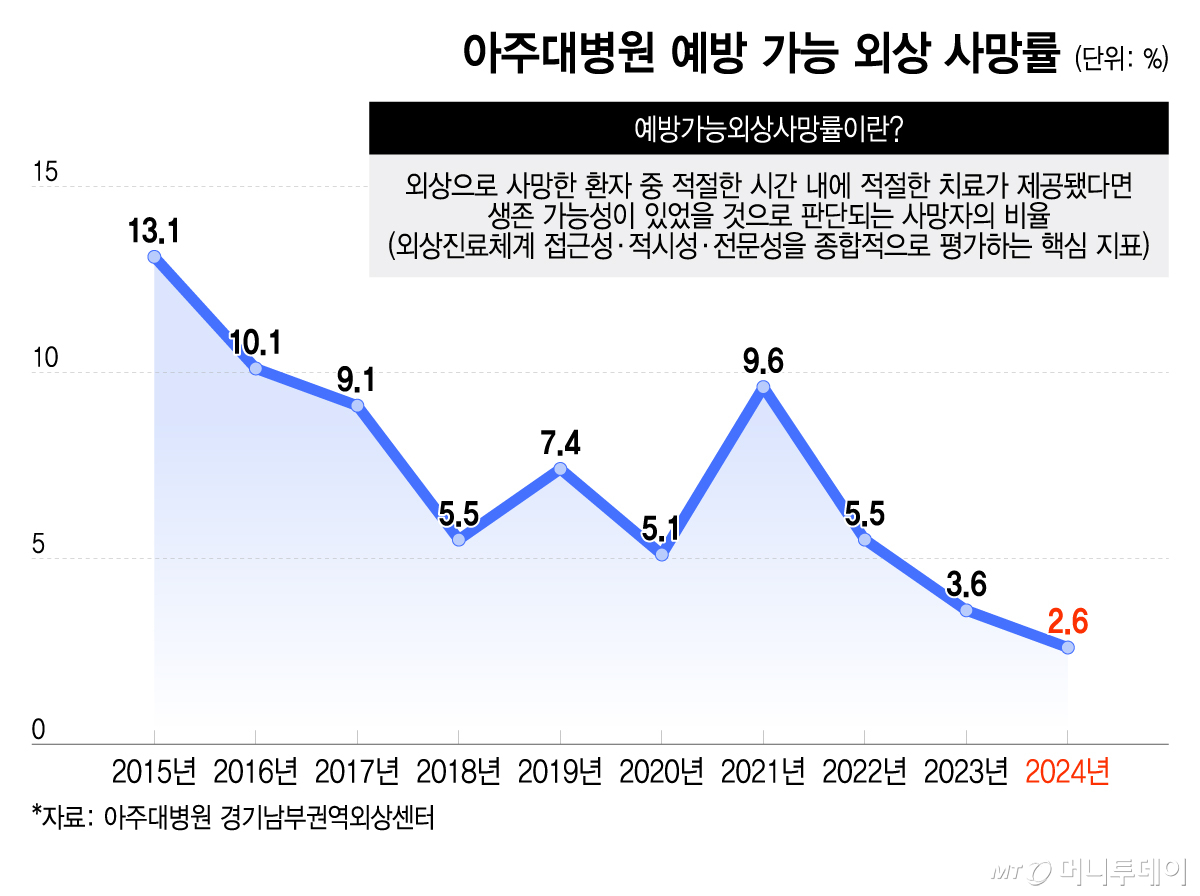
Ajou University Hospital has built high-level treatment capabilities by establishing the country's first severe trauma care system in 2002. It treats an average of 10 trauma patients per day, totaling 4,000 annually. Thanks to the efforts of medical staff, the "preventable trauma mortality rate" has decreased significantly from 13.1% in 2015 to 2.6% in 2024. This places it in the top 1% when compared with approximately 500 trauma centers in the United States.
Director Jung said, "If selected as a Hub Trauma Center, we plan to increase the number of intensive care unit (ICU) and general ward beds by more than double to strengthen our level of care," adding, "With increased bed capacity, we will be able to respond to 80% to 90% of patients in the region." Director Jung has been leading the Ajou University Trauma Center for six years, succeeding Lee Guk-jong, a senior surgeon and former center director who is currently the head of the National Armed Forces Daejeon Hospital. Below is a Q&A with Director Jung.
- Why are you challenging for the Hub Trauma Center construction project?
▶ The Ajou University Trauma Center, which solely serves southern Gyeonggi Province with a population of 10 million, still cites bed shortages as a chronic issue. If selected as a Hub Trauma Center, we can simultaneously expand bed capacity and strengthen the doctor helicopter (medical helicopter) transport system connecting the trauma center with remote areas. We are challenging for Hub Trauma Center status to more precisely complete a system that moves the "right patient" to the "right place" at the "right time."
- How do you evaluate the response capacity of the Ajou University Trauma Center?
▶ Our center currently handles 60% to 70% of patients in the region. We have achieved good results for a long time with an excellent trauma system from the beginning. However, due to the population size, the number of basic severe trauma patients is higher than in other regions, and recently, due to the issue of emergency room refusals (the "bouncing around" problem), patients are already being transferred from other regions, making scale expansion necessary. If designated as a Hub Trauma Center, we are considering expanding ICU beds from 40 to 60, general ward beds from 60 to 80, and ultimately up to 240 beds over the next five years.
- Why is there a particular focus on expanding general ward beds?
▶ As the level of initial transport and treatment for severe trauma patients has improved, the number of patients transitioning from ICU treatment to the recovery stage is increasing. Recent statistics show that the length of stay in general wards for severe trauma patients is more than three times longer than their stay in ICUs. If general ward beds are insufficient, patients who have completed ICU treatment cannot be transferred to wards in a timely manner, which ultimately delays the turnover of ICU beds and reduces the capacity to accept new severe trauma patients. We determined that it is necessary to expand general ward beds to approximately four times the size of ICU beds for efficient circulation of all trauma beds.
- You have worked as a trauma surgeon since the early days of introducing the severe trauma medical system in Korea. How do you view the current system?
▶ The decrease in preventable trauma mortality rate is a clear achievement. The figure, which was in the 50th% range in the late 1990s, dropped to the 9th% range in 2023. However, structural improvements are still needed. For severe trauma patients, all processes from the time of the accident to receiving treatment at the hospital must be completed within one hour. This is why it is called the "Golden Hour." Although the environment has improved significantly due to decades of efforts by numerous medical staff, there are still patients who could have been saved but were not. Recently, a severe trauma patient in Seoul took seven hours to reach our hospital because they could not find a hospital capable of performing embolization (a procedure to block blood vessels at bleeding sites). The treatment outcome for this patient was also poor.
- What do you see as the problem with the severe trauma patient transport system?
▶ Transporting severe trauma patients under the existing emergency medical system focuses on dispersing and transferring patients to emergency rooms. As a result, there is a limitation in that it does not sufficiently link with actual final treatment capabilities. If there are not enough specialists in surgery, neurosurgery, cardiothoracic vascular surgery, orthopedics, etc., who will ultimately treat severe trauma patients, or if there are insufficient operating rooms and ICU beds, it is difficult to provide the final treatment needed by the patient even if an emergency room exists. Currently, there is a structure where situations repeatedly occur in which hospitals have emergency rooms but cannot accept patients because they lack treating doctors and beds.
- There is an opinion that patient classification criteria also need to be reorganized.
▶ This is because there are no criteria to include patients with ambiguous high-risk classifications. "Overtriage" should occur at the emergency medical stage, where the severity of a patient's condition is judged higher than it actually is. This means that even if classification is somewhat excessive, we must ensure that no patients face life-threatening situations or deteriorating conditions. The reason why trauma specialists at the Ajou University Trauma Center, which operates in a standalone building, play the role of "gatekeepers" is also related to this. Instead of trauma specialists waiting in the operating room for patients to arrive, they are directly involved from the transport stage to judge severity and quickly accept appropriate patients into the trauma center. In fact, out of approximately 4,000 annual trauma center patients, only 700 to 800 come via general emergency rooms.
- What do you see as needing improvement regarding the operation of Regional Trauma Centers?
▶ Regional Trauma Centers should, in principle, be built on a large scale in areas with dense populations and high trauma incidence, while remote areas should be centralized via helicopter transport. The nationwide centers dispersed by province or metropolitan city need to have their scales readjusted step by step based on population and trauma medical demand. I also hope that the preventable trauma mortality rate can be improved from the current method of collecting data from all national Regional Trauma Centers every two years to a direction where real-time statistics can be established.

 in THEBIO

