

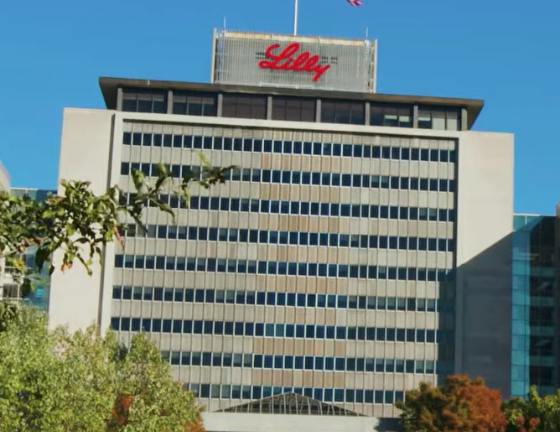
Eli Lilly (hereinafter Lilly), a powerhouse in the metabolic disease market, is expanding its territory in the oncology sector as well. This follows the formal approval by the U.S. Food and Drug Administration (FDA) of the combination therapy of its self-developed breast cancer drug 'Inluriyo' and its existing blockbuster anticancer agent 'Verzenio.' As AstraZeneca (AZ), which has a strong presence in oncology, recently also received FDA approval for a combination therapy combining an oral new drug with a CDK4/6 inhibitor for the same ESR1-mutated breast cancer, competition is expected to become even more fierce.
According to industry sources on the 21st, the U.S. FDA recently formally approved Lilly's oral estrogen receptor (ER) antagonist Inluriyo (active ingredient: imlunestrant) and CDK4/6 inhibitor Verzenio (active ingredient: abemaciclib) combination therapy for breast cancer treatment.
The target population consists of adult patients with ER-positive, HER2-negative locally advanced or metastatic breast cancer confirmed to have an ESR1 mutation by FDA-approved tests, whose disease progressed after one or more lines of endocrine therapy.
ESR1 mutations are a representative resistance mutation that can emerge during aromatase inhibitor (AI) treatment. Inluriyo is an oral ER antagonist, while Verzenio is a therapeutic agent that inhibits CDK4 and CDK6, which are involved in cancer cell division. With this approval, a new oral combination treatment option has been added for ESR1-mutated patients whose disease progressed after existing endocrine-based therapy.
In the Phase 3 clinical trial (EMBER-3) that served as the basis for the approval, 159 patients with ESR1-mutated metastatic breast cancer were analyzed. The median progression-free survival (PFS) in the Inluriyo and Verzenio combination group was 11.1 months, which was longer than the 5.5 months in the Inluriyo monotherapy group. The risk of disease progression or death was 47% lower in the combination group.
Verzenio is one of Lilly's representative anticancer drugs. Its global sales last year were $5.723 billion (approximately 795.5 billion won), an 8% increase from the previous year. Inluriyo received FDA approval on September 25 last year as a monotherapy for patients whose disease progressed after one or more lines of endocrine therapy in ESR1-mutated ER-positive, HER2-negative advanced or metastatic breast cancer. This approval for the combination therapy with Verzenio signifies an expansion of treatment options by combining an existing blockbuster anticancer drug with a self-developed new drug.
This is expected to bolster the diversification of Lilly's product portfolio, which has been skewed toward metabolic diseases. Lilly's recent sales growth has been driven by metabolic disease treatments. Total sales last year were $65.179 billion (approximately 90.16 trillion won), a 45% increase from the previous year. Sales of the Type 2 diabetes treatment 'Mounjaro' were $22.965 billion (approximately 31.77 trillion won), and sales of the obesity treatment 'Zepbound' were $13.542 billion (approximately 18.73 trillion won).
The combined sales of the two products exceeded $36.5 billion (approximately 50.5 trillion won), accounting for more than half of total sales. Both products contain the active ingredient tirzepatide, and in Korea, they were approved under the name Mounjaro without distinguishing product names by indication.
Additional development of Inluriyo is also underway. Lilly is conducting a Phase 3 clinical trial (EMBER-4) of Inluriyo to evaluate the efficacy of adjuvant therapy in patients with ER-positive, HER2-negative early breast cancer. More than 8,000 patients have been enrolled at more than 650 institutional investors in over 30 countries, and initial results are expected in 2027.
AZ also secured FDA approval for an ESR1-mutated breast cancer treatment this month. On the 4th of last month, the FDA granted accelerated approval to AZ's oral ER antagonist 'Etcamah' (active ingredient: camizestrant) and CDK4/6 inhibitor combination therapy as a treatment for ESR1-mutated HR-positive, HER2-negative locally advanced or metastatic breast cancer. The possibility of Etcamah being introduced in Korea has also been recently discussed.
AZ's combination therapy targets patients whose ESR1 mutation was confirmed by FDA-approved tests during treatment with AI and CDK4/6 inhibitors. It involves switching from AI to Etcamah before radiographic disease progression while continuing CDK4/6 inhibitor therapy. In the Phase 3 clinical trial (SERENA-6), the median PFS in the Etcamah combination group was 16.0 months, compared to 9.2 months in the group that continued existing AI combination treatment. The risk of disease progression or death was 56% lower.
Although AZ's and Lilly's combination therapies target the same ESR1-mutated breast cancer, they differ in patient population, timing of treatment, and clinical design. Lilly's Inluriyo and Verzenio combination therapy targets ESR1-mutated patients whose disease progressed after one or more lines of endocrine therapy. Unlike AZ, which received accelerated approval for a method of switching treatments upon confirming an ESR1 mutation before disease progression, Lilly received formal approval for a combination therapy used after disease progression.
An industry official stated, "The significance of Lilly's recent combination therapy approval lies in the fact that there is no need to perform additional tests for treatment switching, and it can reduce side effects associated with exposure to new drugs or the burden of testing on patients." The official added, "While AZ, which has a strong presence in its oncology portfolio, first presented a new option in the ESR1-mutated breast cancer field, Lilly is joining the competition by providing patients with another choice."

 in THEBIO
