


"The shortage of plasma-derived medicines has worsened recently. At this rate, critically ill patients and children could lose their lives. The government must take proactive action urgently."
Jung Kyung-joo, 58, president of the Korean Society of Health-System Pharmacists and head of the pharmacy department at Yonsei University's Yongin Severance Hospital, made the remarks in an interview with MoneyToday at her office on Sunday.
Worsening supply shortage of plasma fractionation products such as immunoglobulin and albumin used for critically ill patients
Particularly, it is pointed out that the crisis felt in medical settings has reached its peak as the supply chain for plasma fractionation products, which are directly linked to patients' lives, becomes unstable. Jung said, "There is a trend of an overall increase in drugs with unstable supply and demand, but plasma fractionation products are more serious," adding, "As a result, pharmacy staff are assigning usage priorities by department, checking whether supply continues, and scrambling to secure plasma fractionation products."
Plasma fractionation products, which are essential national medicines, are pharmaceuticals made by selecting only specific protein components in the blood, such as 'immunoglobulin' and 'albumin.' They cannot be produced artificially and can only be manufactured through human 'blood donation.' Immunoglobulin is mainly used for immune disorders and critically ill patients.
Target diseases include Kawasaki disease (an acute febrile vasculitis of unknown cause occurring in children), hematologic malignancies, sepsis, and infertility. Albumin is used to restore blood circulation function, systemic protein nutrition, and osmotic pressure to normal levels. It is primarily used in the treatment of hemorrhagic shock, liver cirrhosis, and hemodialysis patients.
Patients' lives may be at risk… Urgent need for diversification of blood raw material supply, drug price increases, and proactive government response
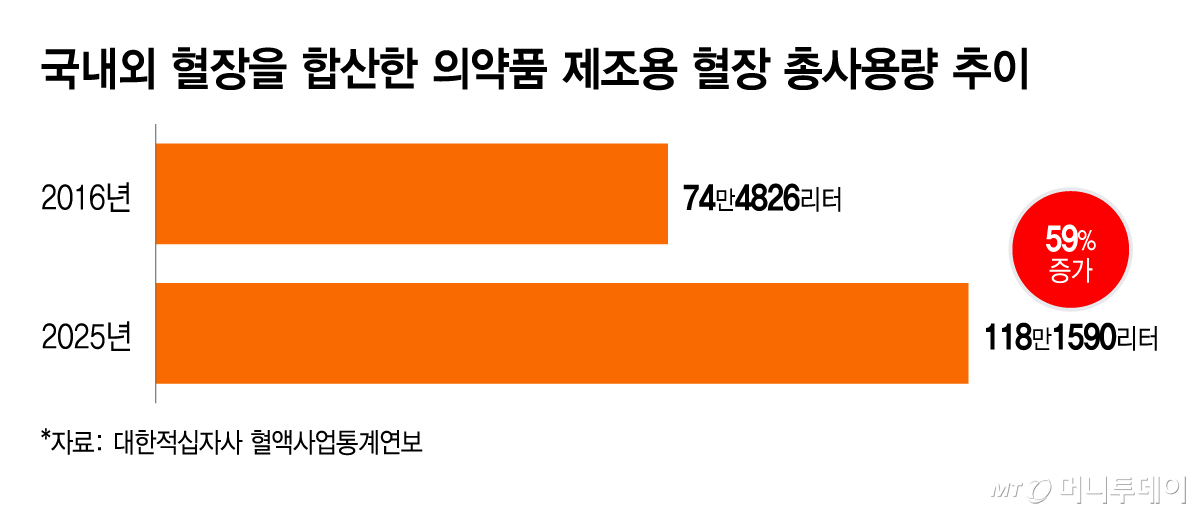
However, it is explained that while demand for such plasma fractionation products is increasing, supply has become insufficient, putting patients' lives in danger. In fact, according to the Korean Red Cross Blood Service Statistical Yearbook, the total usage of plasma for pharmaceutical manufacturing, combining domestic and foreign plasma, increased by approximately 59% over nine years from 744,826 liters in 2016 to 1,181,590 liters in 2025, setting a new record high.
Jung expressed concern, stating, "Patients whose lives hang by a thread, such as those with sepsis, severe liver disease, or extensive burns of third degree or higher, must be administered albumin because they cannot maintain plasma osmotic pressure; otherwise, they will die from hypovolemic shock."
She added, "If immunoglobulin is not used in a timely manner for pediatric immune disorders or severe infectious diseases, complications can arise and patients' lives can become critical, yet supply is not smooth."
Previously, a 'stockout crisis' of plasma fractionation products occurred in 2023. Subsequently, the government raised drug prices once in 2024 on the condition of increased production, which seemed to calm the supply and demand issues, but it is explained that supply instability has recently intensified.
Jung cited the increase in patients with severe diseases due to aging, the emergence of chimeric antigen receptor T-cell (CAR-T) therapies, and insufficient blood donations as causes of supply instability. She explained, "Fundamentally, demand for plasma fractionation products has increased as the number of patients with severe diseases has grown due to aging, and the emergence of new CAR-T treatments has further increased demand for immunoglobulin."
She added, "CAR-T therapy kills not only targeted cancer cells but also normal B cells in the body, so regular administration of immunoglobulin is essential to prevent hypogammaglobulinemia and secondary severe infections after medication. As the range of cancers applicable to CAR-T expands in the future, demand for plasma fractionation products is expected to surge even more sharply."
She also stated, "Plasma fractionation products can only be made from human blood, but since blood donation volumes are decreasing and blood is always in short supply, it is not easy to secure supply," adding, "As a result, recently, endoscopic procedures or robotic surgery are being promoted even during surgeries to reduce bleeding."
Furthermore, she raised his voice, stating, "Raw materials are also imported from the United States and other countries, but unit prices are high while the price of plasma fractionation products set by the government is low, so pharmaceutical companies say supply is difficult."
She continued, "If costs cannot be recovered, adjustments to raise drug prices are necessary. The state should diversify the supply chain and provide blood raw materials capable of manufacturing drugs."
She also urged proactive government response. She said, "Since there are no substitutes for plasma fractionation products, proactive government response is most important."
Jung pointed out, "Currently, when drugs run out of stock, they are designated as essential national medicines or medicines to prevent withdrawal from the market, and discussions take place to raise unit prices and resume production, but this typically takes one to two years."
Jung added, "During that period, patients bear the damage directly and may have to pay hundreds of times the cost to obtain the drugs," emphasizing, "The government must monitor drug supply and demand situations and take measures in advance to prevent stockout crises."

 in THEBIO

