

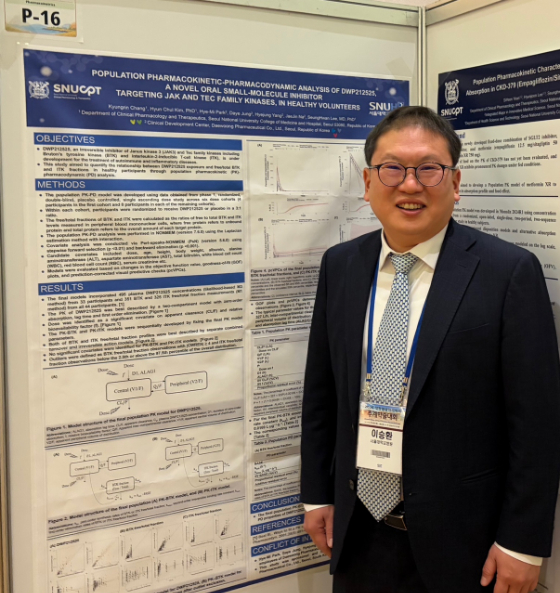
Daewoong Pharmaceutical has developed a model to predict in vivo drug concentrations and target protein responses for its autoimmune disease new drug candidate 'Flodicitinib.' By utilizing Phase 1 clinical data obtained from healthy adults, the company has established a basis for setting appropriate dosages in future patient-based clinical trials.
Daewoong Pharmaceutical announced on the 26th that it presented the results of its population pharmacokinetics-pharmacodynamics (PopPK-PD) modeling study on Flodicitinib (DWP212525) at the '2026 Korean Society for Clinical Pharmacology and Therapeutics (KSCPT) Autumn Academic Conference' held in Jeju starting from the 25th.
Flodicitinib is an oral new drug candidate being developed with the goal of treating autoimmune and inflammatory diseases. Its mechanism involves simultaneously inhibiting three proteins: JAK3, which is involved in cytokine signaling, and ITK and BTK, which mediate receptor signaling in T cells and B cells, respectively. Based on this mechanism of action, Daewoong Pharmaceutical is reviewing the development potential for various autoimmune diseases, including rheumatoid arthritis, systemic lupus erythematosus, and Sjogren's syndrome.
This study utilized data from 44 healthy adults who participated in the Phase 1 single ascending dose (SAD) trial of Flodicitinib. The research team analyzed 495 plasma drug concentration measurements and pharmacodynamic measurements for 351 BTK and 325 ITK instances.
First, a population pharmacokinetic model was constructed to describe the changes in in vivo concentration after drug administration. Based on this, a pharmacodynamic model was developed to quantify the relationship between drug concentration and BTK/ITK responses. The analysis results showed a tendency for in vivo drug exposure to increase as the administered dose of Flodicitinib increased. The constructed model was confirmed to generally well-reproduce the drug concentrations and BTK/ITK responses measured in actual clinical trials.
The significance of this study lies in establishing a foundation for setting dosages and strategies for subsequent clinical trials by numerically quantifying the relationship between drug concentration and target protein response. However, the optimal dose to be applied to patients has not yet been finalized, and verification through additional clinical data is required.
Daewoong Pharmaceutical is currently conducting multiple ascending dose (MAD) studies on Flodicitinib. The company plans to reflect additionally acquired data into the model to enhance predictive power and concretize subsequent clinical development strategies.
Professor Lee Seong-hwan, Department of Clinical Pharmacology, Seoul National University Hospital, who led this clinical trial, stated, "It is significant in that it quantitatively analyzed the in vivo drug concentration and major target protein responses of Flodicitinib." He added, "If we further acquire repeated dosing data to enhance the model's predictive power, it is expected to serve as an important basis for setting appropriate doses and dosing strategies in patient-based clinical trials."
Park Seong-su, CEO of Daewoong Pharmaceutical, stated, "The results of this precision modeling study are a significant achievement that scientifically proves the excellent pharmacological properties and immune target control capabilities of Flodicitinib with numerical data." He added, "Based on the ongoing multiple ascending dose study, we will concretize the dosages and dosing strategies for subsequent clinical trials and provide new treatment options to patients with refractory autoimmune diseases without fail."
Daewoong Pharmaceutical is aiming to complete the Phase 1 clinical trial of Flodicitinib in the first quarter of next year.

 in THEBIO
