

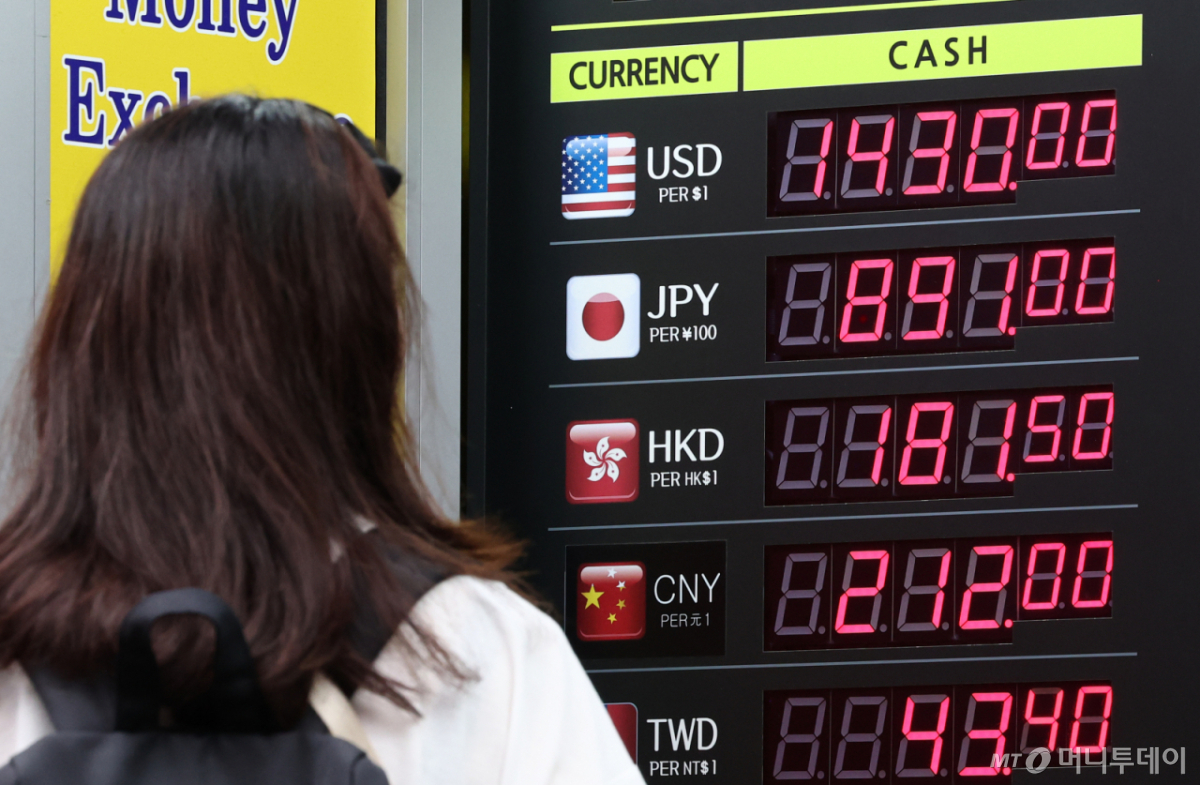
Speculation that Korean and Japanese currency authorities intervened in the market by selling dollars and buying their own currencies pushed the won/dollar exchange rate down to the early 1,420 won range. It was also reported that U.S. monetary authorities conducted a "rate check," a pre-intervention step, raising the possibility that Korean, U.S., and Japanese authorities coordinated efforts to stabilize exchange rates.
On the 31st, the won/dollar exchange rate closed at 1,424.0 won in Seoul's foreign exchange market, down 13.4 won from the previous trading day. Based on weekly closing prices, this marks the lowest level since January 28 (1,422.5 won), reaching a six-month low.
Overnight, the won/dollar exchange rate began falling sharply during night trading around 10:20 p.m., dropping to as low as 1,418.0 won by early morning on the 31st, setting a new nine-month low since October of last year. The exchange rate rebounded intraday to 1,440.6 won before falling again.
According to foreign media reports, Korean and Japanese currency authorities carried out market interventions around the same time the previous night by selling dollars and purchasing won and yen.
It was also reported that U.S. monetary authorities conducted a rate check, inquiring with major banks about exchange rates and trading conditions prior to any intervention. A rate check is a procedure where currency authorities consult with key banks regarding exchange rates and market conditions before intervening in the foreign exchange market.
Slowing inflation in the United States and the Federal Reserve's decision to hold its base rate steady also added pressure for a weaker dollar.
Foreign investors purchased approximately 7 trillion won worth of securities on the Korea Exchange today. The KOSPI closed at 6,595.45 points, up 1,001.89 points (17.91%) from the previous day, recording the largest single-day gain in terms of both point increase and percentage rise in history. However, some analysts noted that a significant portion of foreign capital flowed into Korea with hedging measures already in place, which may have limited downward pressure on the exchange rate.
Market observers are also considering the possibility that the won/dollar exchange rate could fall below 1,400 won.
Moon Da-um, a researcher at Korea Investment & Securities, stated, "Since July, factors such as dollar sales related to SK Hynix ADRs, inflows of WGBI funds, and expanded corporate hedging have sharply shifted the foreign exchange supply-demand direction toward selling dollars and buying won." He added, "In August, currency demand for mid-year corporate tax payments and continued weakness in the dollar could further drive down exchange rates."
He further noted, "If currency demand for mid-year corporate tax payments continues alongside a weak dollar, the exchange rate may fall below the appropriate range of 1,410–1,560 won projected for the second half of the year, potentially entering the 1,300 won range in the short term."
However, uncertainties remain. Oh Jae-young, a researcher at KB Securities, said, "Future variables in the foreign exchange market include the direction of the U.S.-Iran conflict, resulting international oil prices, and global interest rate trends." He added, "If attacks and retaliations continue in the Middle East, leading to sustained oil price increases, expectations for a Federal Reserve System (Fed) rate hike in September could grow, potentially acting as a factor strengthening the dollar."

 in ECONOMY
