

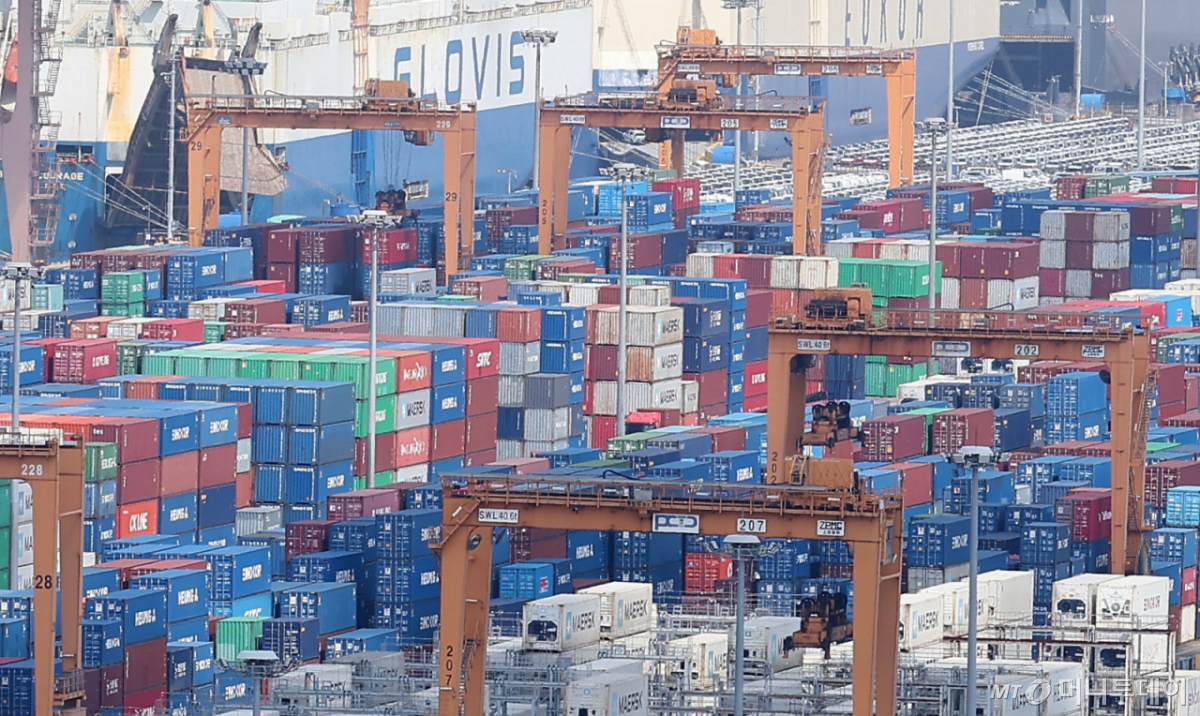
The warmth from key industries such as semiconductors, shipbuilding, and defense has spread to related SMEs (small and medium-sized enterprises) and domestic-focused companies, improving the manufacturing sector's perceived economic conditions. The recovery trend, which was previously concentrated among large exporters last month, is now showing signs of broader diffusion. However, the transportation and wholesale/retail sectors remained sluggish due to declining sea cargo volumes and high freight and logistics cost burdens.
According to the Bank of Korea's July 2026 "Corporate Business Survey Results and Economic Sentiment Index (ESI)" released on the 30th, the all-industry Corporate Business Sentiment Index (CBSI) for this month stood at 98.5, up 0.8 points from the previous month.
This marks a rebound after falling by 1.2 points last month and turning downward for three consecutive months. The CBSI outlook for next month also rose to 96.5, an increase of 1.3 points compared to the previous survey.
The CBSI is a composite index that aggregates key indicators such as business conditions, production, sales, and profitability across both manufacturing and non-manufacturing sectors. A reading above the long-term average of 100 indicates optimistic corporate sentiment, while a reading below suggests pessimism.
The manufacturing sector's CBSI rose to 103.2, up 2.0 points from the previous month. New orders and business conditions contributed to the index increase by 0.8 points and 0.7 points, respectively. The outlook for next month's manufacturing CBSI is also projected at 100.5, a rise of 2.3 points, which is expected to exceed the long-term average.
Notably, the improvement was particularly significant for SMEs (small and medium-sized enterprises) and domestic-focused companies, which had been relatively sluggish last month. The SME CBSI rose from 95.7 to 97.6, an increase of 1.9 points, while the domestic company index climbed from 98.0 to 100.0, a rise of 2.0 points.
Last month, the SME and domestic company CBSIs had each fallen by 0.5 points and 0.4 points, respectively. The large enterprise CBSI rose from 104.5 to 105.3 (up 0.8 points), and the export-oriented company index increased from 106.4 to 107.5 (up 1.1 points).
The manufacturing business conditions BSI rose to 82, up 3 points from the previous month. Production (93), new orders (92), and sales (96) also increased by 3 points, 4 points, and 5 points, respectively. The domestic sales BSI jumped from 85 to 93, an 8-point rise, while the profitability BSI climbed from 73 to 79, a 6-point increase, aided by a slowdown in raw material price hikes.
Lee Heung-hoo, an economist at the Bank of Korea, stated, "The strong performance in upstream industries such as shipbuilding, defense, and semiconductors appears to have positively influenced sentiment among SMEs by extending to related sectors like metal processing, machinery/equipment, and precision instruments. This indicates that corporate sentiment is improving across the board, not limited to a few key industries."
By industry, business conditions and new orders for other machinery and equipment—sectors affected by increased demand in shipbuilding, defense, and semiconductors—rose by 6 points and 10 points, respectively. In medical and precision instrument sectors, where demand grew due to data centers, overseas construction projects, and semiconductor production, production and new orders increased by 9 points and 14 points, respectively. Metal processing, influenced by expanded shipbuilding and plant demand and falling raw material prices, saw improvements in business conditions and financial situations by 5 points and 9 points, respectively.
In contrast, the non-manufacturing CBSI fell to 95.2, down 0.2 points from the previous month. Financial conditions dragged the overall index down by 0.5 points. In transportation and warehousing, declining sea cargo volumes centered on petrochemical products, combined with ongoing cost pressures, caused business conditions and profitability to drop by 9 points and 8 points, respectively. Business conditions in wholesale and retail also declined by 3 points.
Team Leader Lee noted, "Freight and logistics costs remain a significant burden. It is understood that the aftermath of the Iran war has had some impact on the service sector, particularly transportation and warehousing."
For non-manufacturing companies, the top management concern was weak domestic demand (18.4%), followed by an uncertain economic environment (17.8%) and labor shortages with rising wages (13.5%). In manufacturing, the primary concerns were rising raw material prices (21.8%), an uncertain economic environment (20.6%), and weak domestic demand (16.4%).
The ESI, which combines corporate and consumer sentiment, rose to 97.9, up 1.1 points from the previous month. The cyclical component of the ESI also increased by 0.2 points to 95.9. Team Leader Lee assessed, "While the long-term average has not yet been recovered, both corporate and consumer sentiment are gradually improving."

 in ECONOMY
