

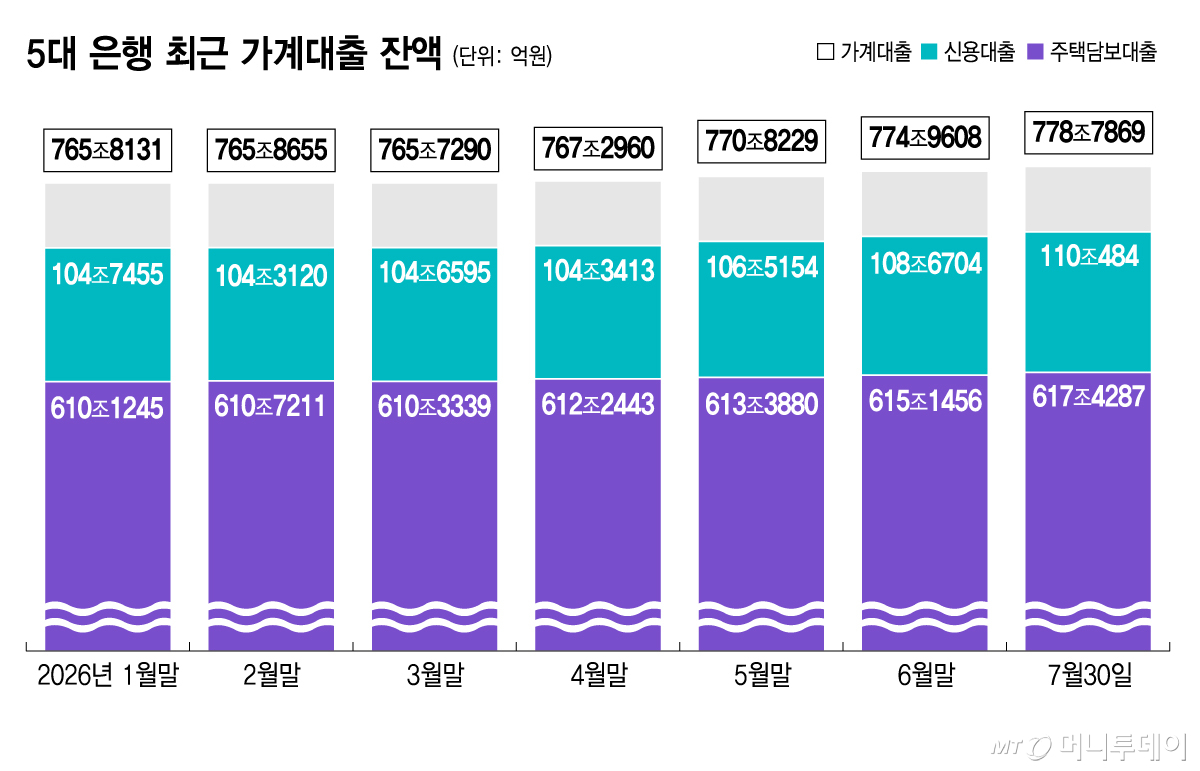
Mortgage loans at the top five banks have increased by the largest margin in 11 months. Within the banking sector, there are expectations that household loan growth could accelerate as total loan volume regulations ease for final payment loans starting in August and large-scale apartment complexes begin occupancy.
According to financial industry data released on the 31st, as of the end of last month, the outstanding balance of residential mortgage loans at KB Kookmin Bank, Shinhan Bank, Hana Bank, Woori Bank, and NH NongHyup Bank increased by 2.2831 trillion won compared to the previous month-end. This marks the largest increase since August 2025 (3.7012 trillion won), occurring after an 11-month gap.
The total outstanding balance of household loans rose by 3.8261 trillion won this month, a slight decrease from last month's increase of 4.1378 trillion won. Credit loans also increased by 1.3780 trillion won, showing a smaller rise than the previous month's 2.1550 trillion won, but continuing an upward trend for three consecutive months.
The surge in mortgage loans is attributed to the execution of numerous apartment-related loans tied to transactions made before the expiration of the temporary exemption from higher capital gains taxes on multi-homeowners in May. According to Korea Land & Housing Corporation data, apartment sales in Seoul reached 12,150 units in May, a sharp rise compared to the 7,000–9,000 unit range seen from January to April. However, last month saw a decline back to around 8,000 units.
The banking sector is also paying close attention to the possibility that household loan increases in August will exceed those of July. According to Real Estate 114, planned apartment completions nationwide in August total 19,272 households, surpassing the first-half monthly average of 16,082 households.
Notably, financial authorities have decided to exclude final payment loans for complexes sold prior to the implementation of stricter household debt regulations under the the 27th measures from the total loan volume cap for banks' household loans. This decision raises concerns that mortgage loans could rise further, particularly around large-scale residential complexes with upcoming completions.
A banking industry official stated, "As final payment loans for homes transacted in April and May continue to be executed, funding demand persists, and the upward trend is expected to continue through August and September." The official added, "Additionally, approximately 50 billion won in final payment loans are scheduled for Palisade Mae-gyo-yeok in August alone, and since there will be more large-scale complexes with completions planned for the second half of the year compared to the first half, the increase could be even larger."
Banks' capacity to manage household loans under the financial authorities' total loan volume regulations has already reached its limit. As of the 23rd, the outstanding balance of household loans at the top five banks, excluding policy-based loans, stood at 649.5398 trillion won—an increase of 4.5637 trillion won from year-end last year. This exceeds the annual growth target submitted by banks to financial authorities for this year (4.33 trillion won) by 233.7 billion won. By the end of this month, it is highly likely that the amount exceeding the target will have grown further.
To manage total loan volumes, banks are raising lending thresholds even higher. KB Kookmin Bank reduced its maximum mortgage loan limit to 300 million won starting from the 10th and, as of today, raised interest rates on mortgage loans, rental loans, and credit loans by up to 0.53 percentage points (P).
As a result, five-year fixed-rate mortgage loan interest rates at the top five banks rose from 4.26–7.10% annually at the end of May to 4.37–7.37% by the end of June, and further to 4.74–7.50% as of July 30 (today). Six-month variable-rate interest rates also increased from 3.63–6.03% annually during the same period to 4.07–6.37%, and then to 4.13–6.38%. With rising market rates and strengthened loan volume management, the upward trend in lending rates is expected to continue for the foreseeable future.

 in FINANCE
