

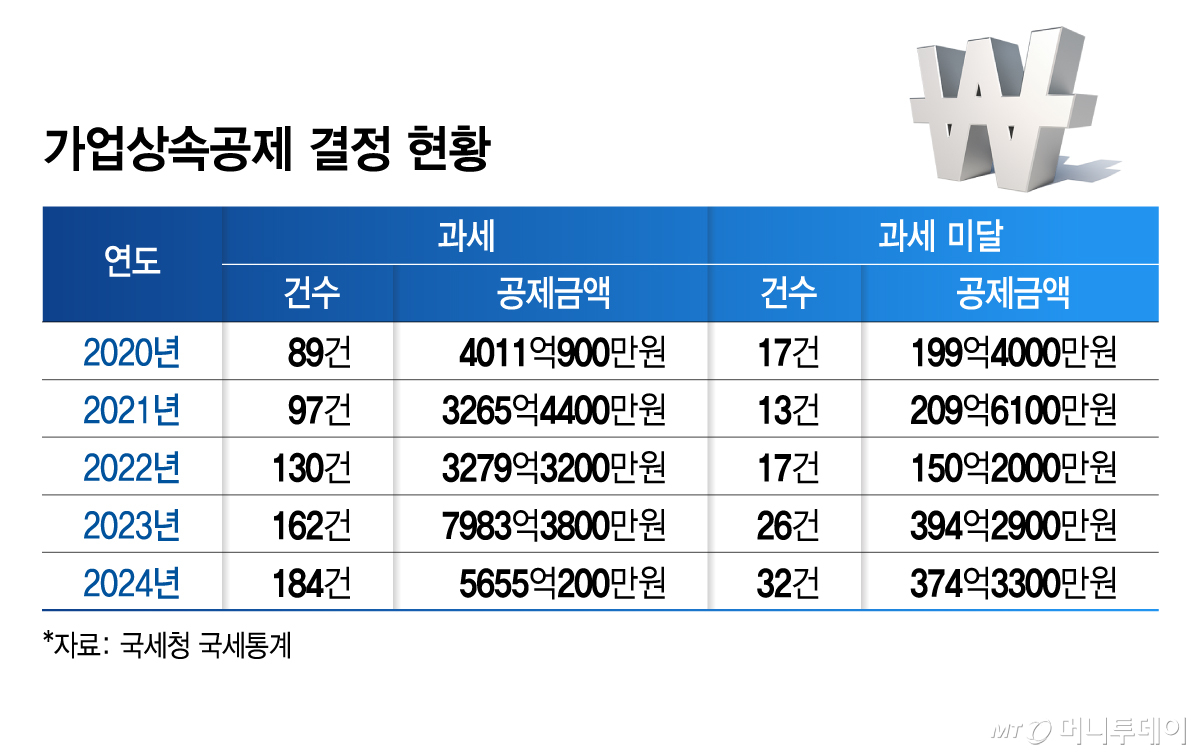
The Business Inheritance Tax Exemption, which raised concerns about "evasionary inheritance," is set for a major overhaul after 30 years. As anticipated, facilities such as parking lots, hospitals, pharmacies, and marts will be excluded from the exemption scope. Post-inheritance management requirements will also be strengthened, while exceptional benefits will be provided to businesses that have maintained operations for over 30 years.
According to the "2026 Tax Reform Plan" released by the Ministry of Economy and Finance on the 3rd, future eligibility for the Business Inheritance Tax Exemption will be determined based on the detailed classification of the Korean Standard Industrial Classification (KSIC). Currently, eligible industries are defined primarily under broad or medium-level categories. This change aims to specify exemption targets more precisely.
The Business Inheritance Tax Exemption was introduced in 1997 with the goal of reducing inheritance tax burdens on SMEs (small and medium-sized enterprises) to foster long-lasting premium companies. Its core function is to reduce inheritance taxes when an heir inherits a business operated by the deceased for a specified period. For years, the government has operated this exemption with a focus on "relaxation," expanding eligibility and increasing deduction amounts.
Currently, if a deceased person operated an SME or a mid-sized company with annual sales under 500 billion won for at least 10 years before death, inheritance tax deductions of up to 60 billion won are granted upon transfer to the heir.
However, concerns about "evasionary inheritance" emerged, particularly regarding large bakery cafes and parking lots that were previously eligible. According to an investigation by the National Tax Service into 25 major bakery cafes in the Seoul metropolitan area, potential abuse of the exemption was identified in 11 companies (44%). A representative case involved businesses registered as confectionery shops but lacking actual baking facilities.
Consequently, the government will apply stricter criteria to the Business Inheritance Tax Exemption. Marts, bus and taxi transportation services, parking lot operations, warehouse businesses, hospitals, and pharmacies will be excluded from eligible industries. Companies designated as "Century-Old Small Businesses" or "Prestigious Long-Running Enterprises" will be deemed to meet industry eligibility requirements. While specialty coffee shops are generally ineligible, those officially designated as "Century-Old Small Businesses" will qualify.
A review committee specifically for the Business Inheritance Tax Exemption will also be established. Even if a company falls within eligible industries, tax deductions will only apply after the committee confirms its support viability through review. The committee will also determine whether to approve changes to restricted industries based on principle.
The current requirement of 10 years for the deceased's management period will be raised to 30 years. The heir's post-inheritance management period, currently set at 5 years, will be increased to 10 years. If the deceased managed the business for 20 to under 30 years, the heir's management period will be extended by the shortfall from 30 years.
Land deductions will be reduced. Currently, business-use land is categorized as "urban area" or "non-urban area," with deductions ranging from 3 to 7 times the building's floor area (e.g., 3x for commercial zones, 4x for industrial zones, and 7x for non-urban areas). Going forward, deductions will be capped at 3 times the building's floor area. In the Seoul metropolitan area, the deduction multiplier will be limited to 2 times.
The maximum exemption amount is calculated by multiplying the deceased's years of business operation by 2 billion won. For example, a 45-year operating history qualifies for up to 90 billion won in deductions. The overall cap will be raised to 100 billion won. Currently, limits are set at 30 billion won for 10 years, 40 billion won for 20 years, and 60 billion won for 30 years of operation.
A new tax special measure to support business succession by third parties will also be introduced. Sellers will receive a 20% reduction in capital gains tax on shares or business assets. However, eligibility requires meeting conditions such as operating the business for over 20 years within eligible industries and having a majority shareholder aged 60 or older. The deduction cap is calculated by multiplying the number of operating years by 0.5 billion won annually.
Buyers who have operated the same industry for at least 10 years or worked at the selling company for over 5 years as employees or executives will receive a 10% reduction in income and corporate taxes, up to 500 million won annually, for five years.
Key regulations related to the Business Inheritance Tax Exemption will take effect starting from inheritances initiated after July next year, contingent on the passage of this year's reform plan by year-end. The tax special measure for third-party business succession will apply from January 1, 2028, onward.

 in ECONOMY
