

The government's real estate tax reform plan targets the so-called 'wealth tax,' the comprehensive real estate tax. It adjusts not only the basic exemption amount that sets the threshold for taxable properties but also the fair market value ratio and tax rates that directly affect the tax amount. In broad terms, the structure imposes a heavier burden on non-residential homes and multi-home ownership while reducing the burden on single-family homes used as residences.
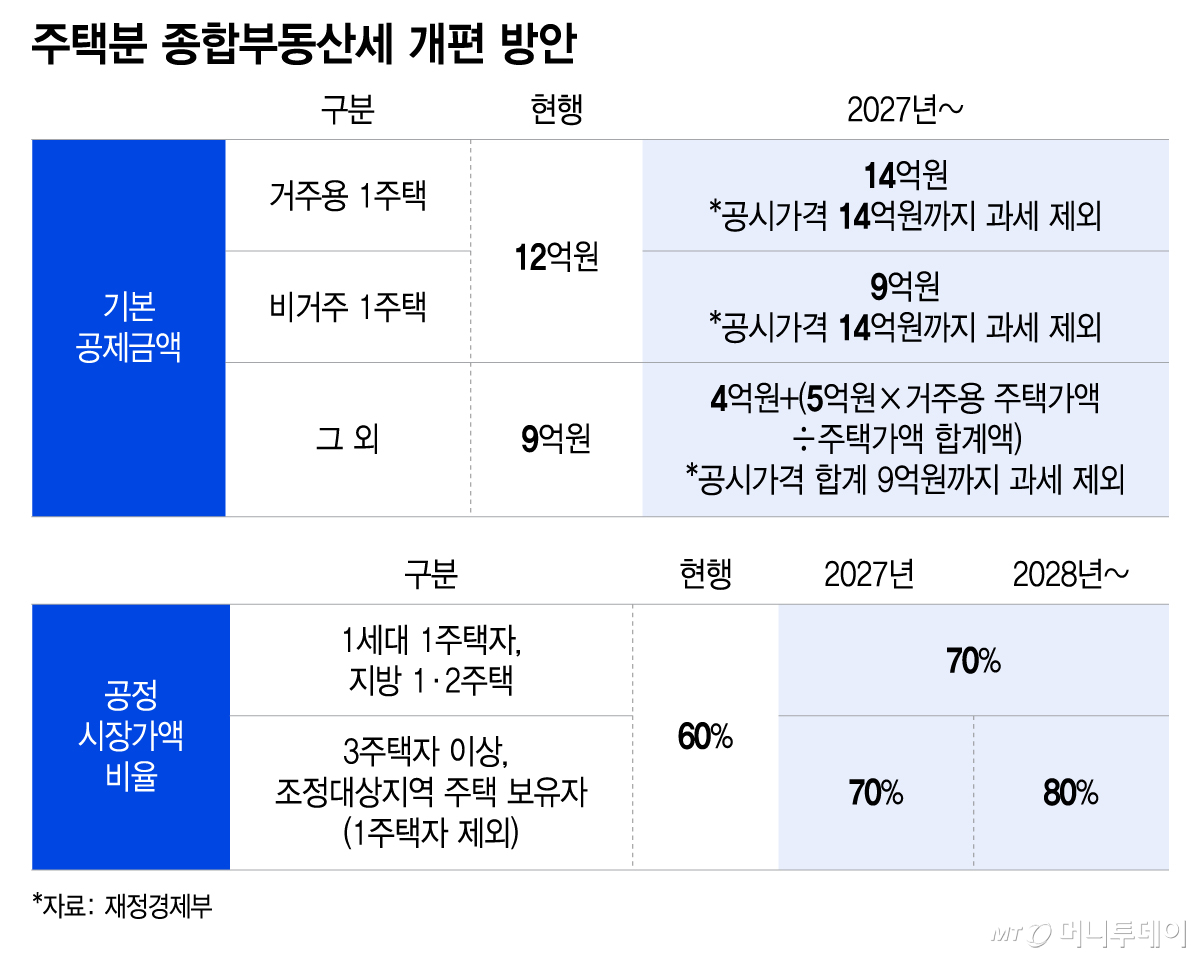
The reform plan itself emerged after a complex process. The comprehensive real estate tax is levied on individuals holding high-value real estate, with the basic exemption serving as the threshold for defining such properties. Currently, the basic exemption amount (based on announced price) is 0.9 billion won. Single-family home owners receive preferential treatment at 1.2 billion won.
Under the reform plan, the taxable threshold for single-family homes will rise from the current 1.2 billion won to 1.4 billion won. For all other cases, the taxable threshold remains at 0.9 billion won as before. Until now, the taxable threshold and basic exemption were identical; going forward, this relationship will differ except for single-family home owners.
The basic exemption for a single-family home used as a residence is set at 1.4 billion won, matching the taxable threshold. In contrast, the basic exemption for a non-residential single-family home remains at 0.9 billion won. Although non-residential single-family homes also become subject to tax only when exceeding 1.4 billion won, only the 90th million won basic exemption applies. An increase in the basic exemption reduces the comprehensive real estate tax; conversely, it increases the tax.
The basic exemption for multi-home owners is calculated using the formula: '(Value of residential property ÷ Total property value) × 0.5 billion won + 0.4 billion won'. For example, if a person owns two homes with a combined property value of 3 billion won and the residential portion is valued at 1.5 billion won, the exemption amounts to 650 million won. The basic exemption for multi-home owners without any residential property is 0.4 billion won.
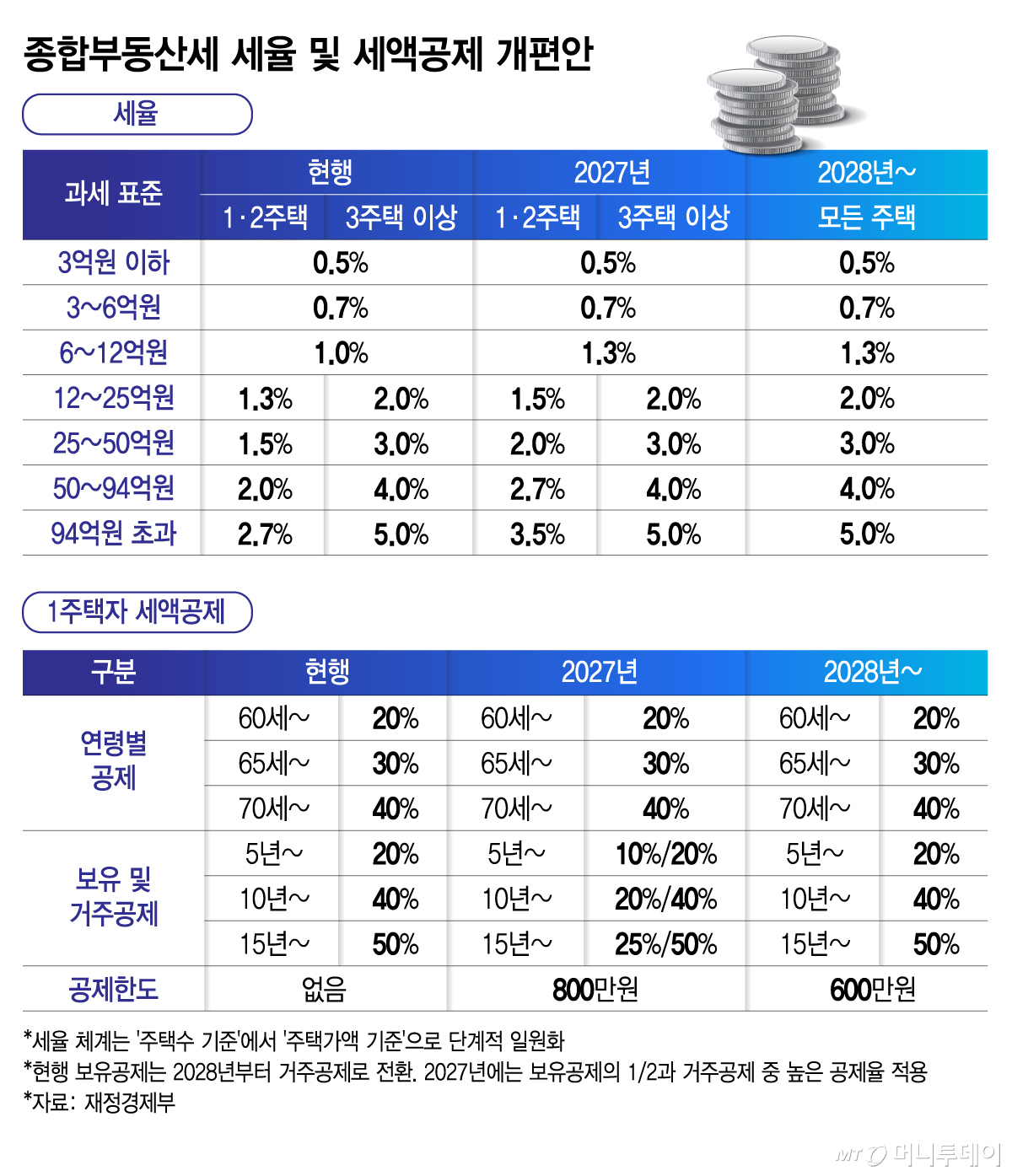
The current fair market value ratio of 60% will also change. For single-family home owners and those holding one or two homes in local areas, the ratio will rise to 70% after next year. For owners of three or more homes and holders of properties in adjustment target areas (excluding single-family home owners), the ratio will be adjusted to 70% by 2027 and to 80% thereafter from 2028. An increase in the fair market value ratio is a factor that raises the comprehensive real estate tax burden.
The comprehensive real estate tax rate system will shift from being based on 'number of homes' to 'property value'. Currently, tax rates differ for one- or two-home owners (1.3%–2.7%) and those with three or more homes (2.0%–5.0%) once the taxable standard exceeds 1.2 billion won. From 2028 onward, the rate system will be unified under the framework applicable to owners of three or more homes.
For taxable standards of 1.2 billion won or less, current tax rates for one- or two-home owners and those with three homes are identical at 0.5%–1.0%. Going forward, tax rates for taxable standards up to 0.6 billion won will remain unchanged, while rates for the 60th million won to 1.2 billion won range will rise from the current 1.0% to 1.3%. In effect, comprehensive real estate tax rates will begin increasing from a taxable standard of 0.6 billion won.
The holding deduction affecting the comprehensive real estate tax amount also emphasizes residency. Currently, there are age-based deductions (20%–40%) for those aged 60 and above and holding-period deductions (20%–50%) for properties held five years or longer. The combined deduction rate cannot exceed 80%. Going forward, the age-based deduction will remain unchanged, while the holding deduction will be converted into a residency-based deduction. A previously unspecified cap on deductions will be set at 8 million won in 2027 and reduced to 0.6 billion won thereafter from 2028.
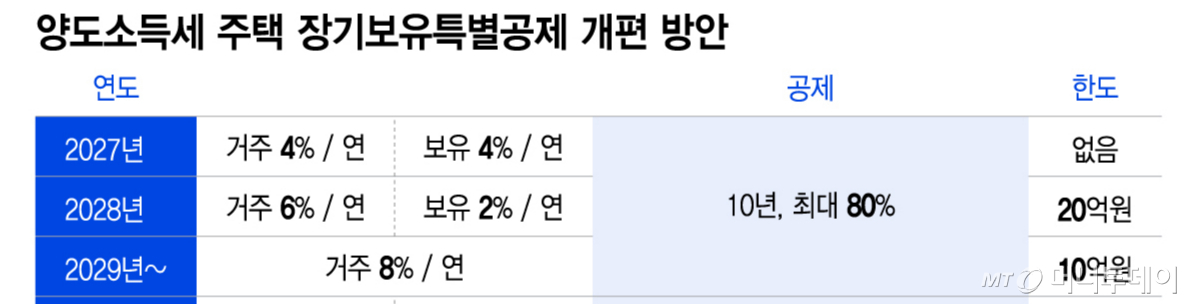
The special long-term holding deduction for housing capital gains tax will also be renamed the 'long-term holding income deduction'. Currently set at a maximum of 40% for residency and 40% for holding period (based on single-family home owners), this deduction will undergo phased reforms after a one-year grace period, abolishing the holding deduction from 2029 onward and increasing the residency-based deduction to a maximum of 80%. The deduction cap has been set at 2 billion won in 2028 and reduced to 1 billion won thereafter from 2029.
Additionally, the cap on comprehensive real estate tax burden increases, previously tied to 150% year-over-year, will be expanded to 200%. The special exemption for capital gains tax on multi-home owners, which resumed in May, will be temporarily relaxed from next year through 2028. For single-family homes with a sales value of 3 billion won or less that have been held and occupied for over ten years, the basic exemption for capital gains tax will rise from the current 2.5 million won to 25 million won.
The comprehensive real estate tax reform plan combines both strengthening and easing measures. It imposes higher taxes on non-residential homes, multi-home ownership, and high-value properties. Conversely, it reduces the burden for single-family homes used as residences with a market value of 3 billion won or less (announced price of 2 billion won).
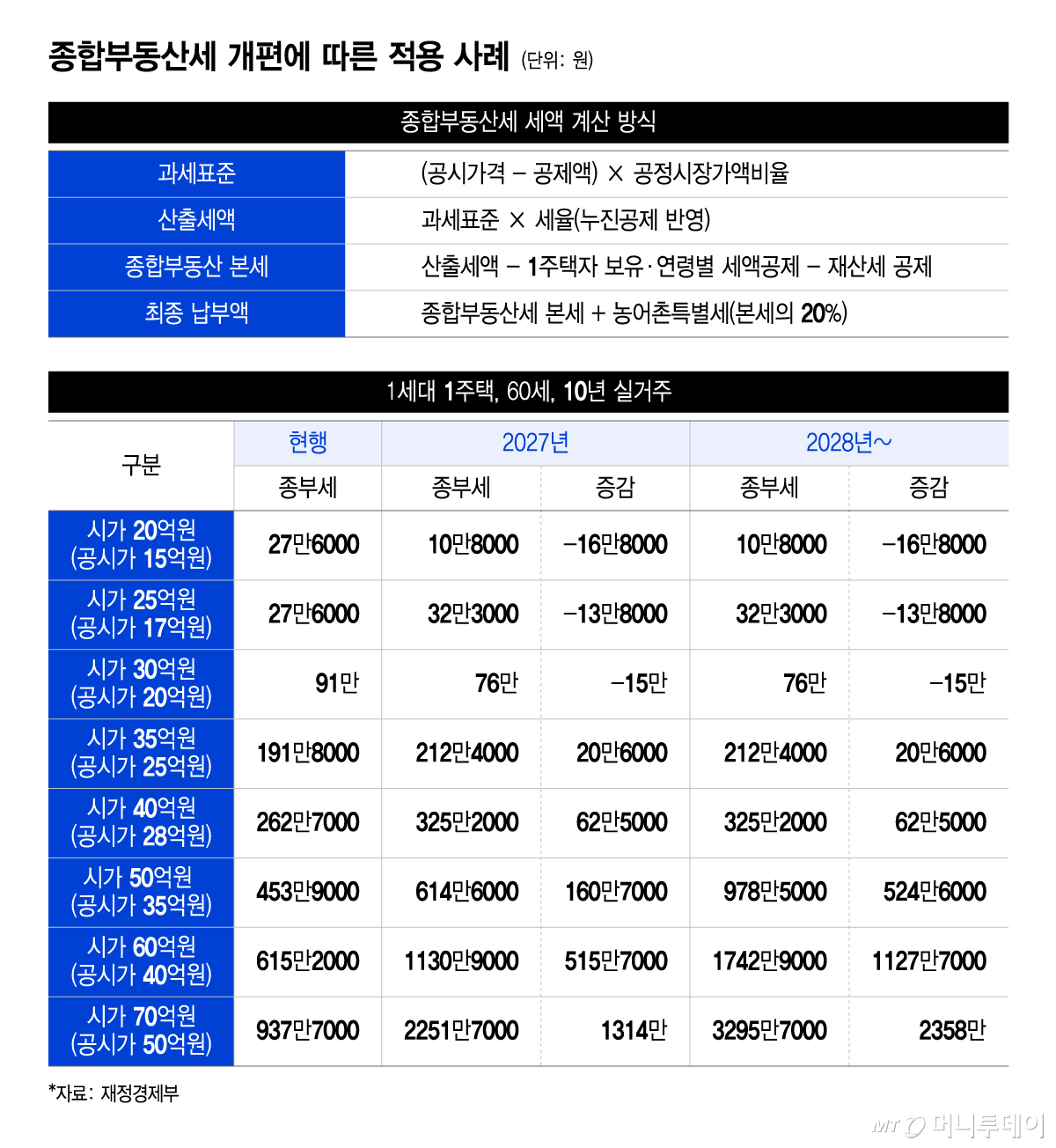
The taxable standard for comprehensive real estate tax is calculated by subtracting the basic exemption from the announced price and then multiplying by the fair market value ratio. Multiplying the taxable standard by the applicable tax rate yields the calculated tax amount. Subtracting both the tax deductions based on holding period and age for single-family home owners and the property tax levied on the comprehensive real estate taxable standard from this calculated amount gives the base comprehensive real estate tax. Adding the 20th% special rural area tax to the base tax allows calculation of the final payable amount.
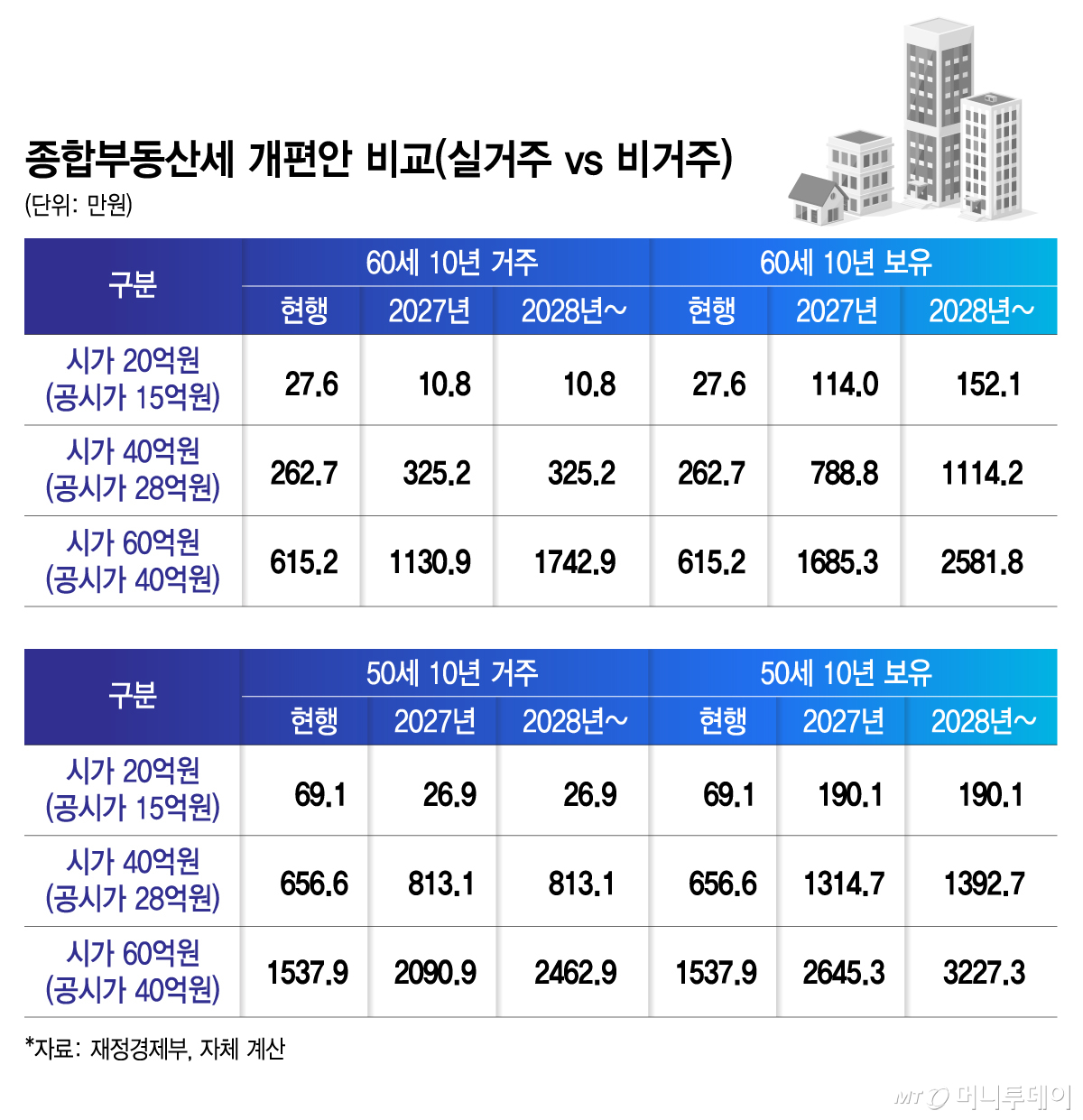
For example, assuming a single-family home occupied for two years and held for two years both have an announced price of 1.5 billion won (market value of 2 billion won), the current comprehensive real estate tax is identical at 691,000 won. Under the reform plan, the tax on the home occupied for two years will decrease to 269,000 won after 2027. In contrast, the tax on the home held for two years (without residency) will increase to 1.901 million won after 2027—a 2.75-fold rise—assuming no changes in announced prices.
This occurs because the basic exemption for a single-family home used as a residence increases to 1.4 billion won, while only 0.9 billion won applies to non-residential single-family homes, fundamentally altering the taxable standard. When age-based and holding-period tax deductions are applied, the gap in comprehensive real estate tax between residential and non-residential single-family homes widens further.
For instance, the current comprehensive real estate tax for a 60-year-old who has resided in a single-family home for ten years is 276,000 won. Under the reform plan, this will drop to 108,000 won from next year onward. However, for a non-residential single-family home under identical conditions, the tax currently at 276,000 won will rise to 1.14 million won (4.1 times) next year and to 1.521 million won (5.5 times) by 2028. These figures do not account for the cap on comprehensive real estate tax burden increases.
Overall, for single-family homes used as residences, the comprehensive real estate tax will decrease up to an announced price of 2 billion won (market value of 3 billion won). For the range of 2 billion won to 2.8 billion won in announced price (market value of 3 billion won to 4 billion won), the tax will begin to increase. Conversely, for properties with an announced price of 2.8 billion won or more (market value of 4 billion won or higher), the comprehensive real estate tax will rise significantly.

 in ECONOMY


