

The government and operators building the National AI (Artificial Intelligence) Computing Center announced a policy to flexibly determine the scale and models of GPU (Graphics Processing Unit) procurement in line with market conditions and technological changes. The plan to build 15,000 GPUs by 2028 is also a target value presented when the project was established, and NVIDIA GPUs such as B200, which were the standard at the time of the project proposal, are not yet confirmed products for introduction.
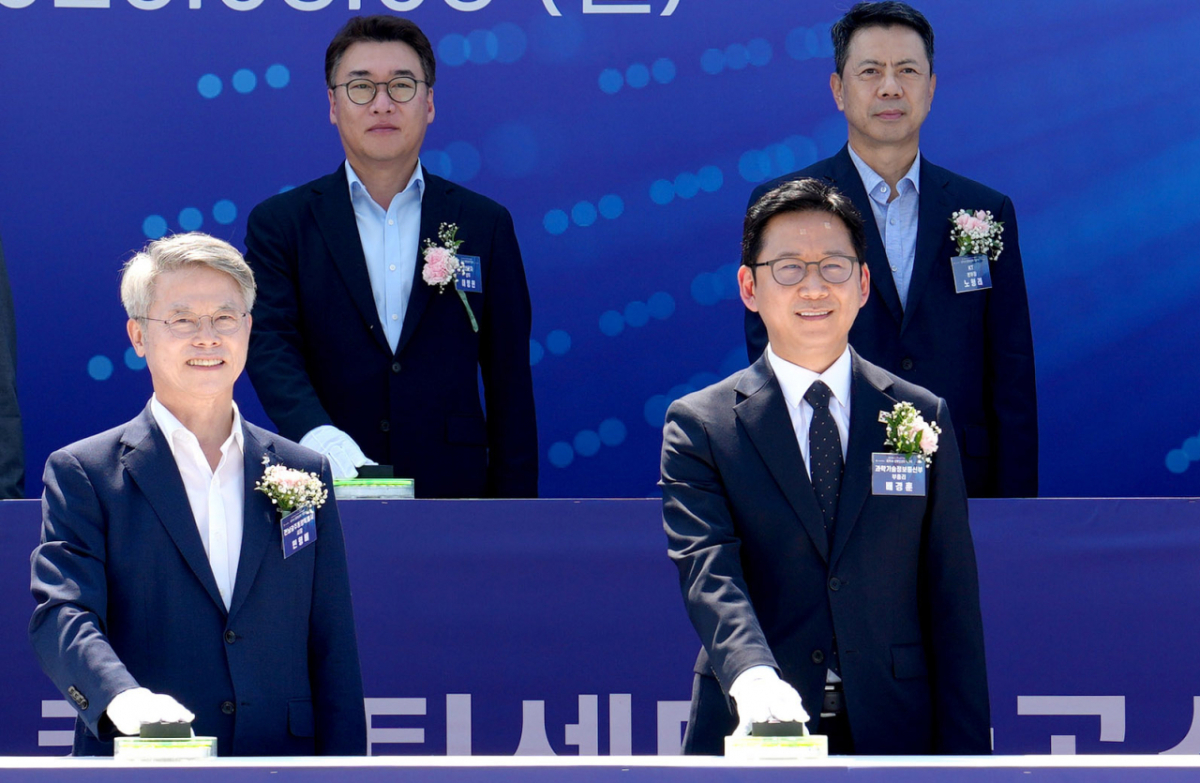
The Ministry of Science and ICT and Korea AI Computing Center (KOACC) made these remarks after meeting with reporters following the groundbreaking ceremony for the National AI Computing Center held at the Data Center Park in Haenam-gun, Gwangju Metropolitan City, Jeollanam-do on the 3rd.
The government announced plans to build 15,000 GPUs by 2028 through the National AI Computing Center and expand national-level AI computing resources to a scale of 50,000 units by 2030. However, the Ministry of Science and ICT explained that the 15,000-unit figure is also a target value presented when establishing the project plan, and they intend to respond flexibly in line with future market conditions and demand changes.
A Ministry of Science and ICT official stated, "The scale currently presented is based on the standards at the time the original plan was formulated," adding, "Establishing a public-private joint venture was also done to respond flexibly to demand changes, so it is difficult to definitively state future scales at this point." The official further added, "If additional demand arises, we will not rule out expansion possibilities and will decide through consultations between the government and operators."
The models of GPUs to be introduced have also been decided not to be fixed. Although the Samsung SDS consortium submitted its plan based on NVIDIA B200 at the time of the project proposal, given that AI semiconductor generations are changing rapidly, they have adopted a policy of not being tied to specific products and prioritizing the review of the latest products at the time of introduction.
A Ministry of Science and ICT official explained, "It is correct that we proposed based on B200 at the time, but new products are continuously being released now," noting, "B200 has not been confirmed; the principle is to secure the most suitable latest AI semiconductor at that point in time."
Recently, interest also focused on whether AMD GPUs would be introduced following the Ministry of Science and ICT signing a Memorandum of Understanding (MOU) for AI cooperation with AMD, but the government stated, "There are no confirmed matters at present," leaving possibilities open while not revealing specific plans.
The proportion of utilization in the public sector has also not yet been determined. The government explained that since the National AI Computing Center operates under a private-sector structure, the ratio of GPU allocation between public and private sectors will be decided through future consultations between KOACC and participating companies. However, they noted that they are reviewing a direction to prioritize support for government AI projects and industry-academia-research (R&D) demands.
Support measures to secure initial demand are also being pursued. The Ministry of Science and ICT is reviewing plans to prioritize the use of the National AI Computing Center in government AI projects, while KOACC announced it will support both public and private AI computing demands and secure data center competitiveness by utilizing Haenam's renewable energy and power infrastructure.

 in TECH
