

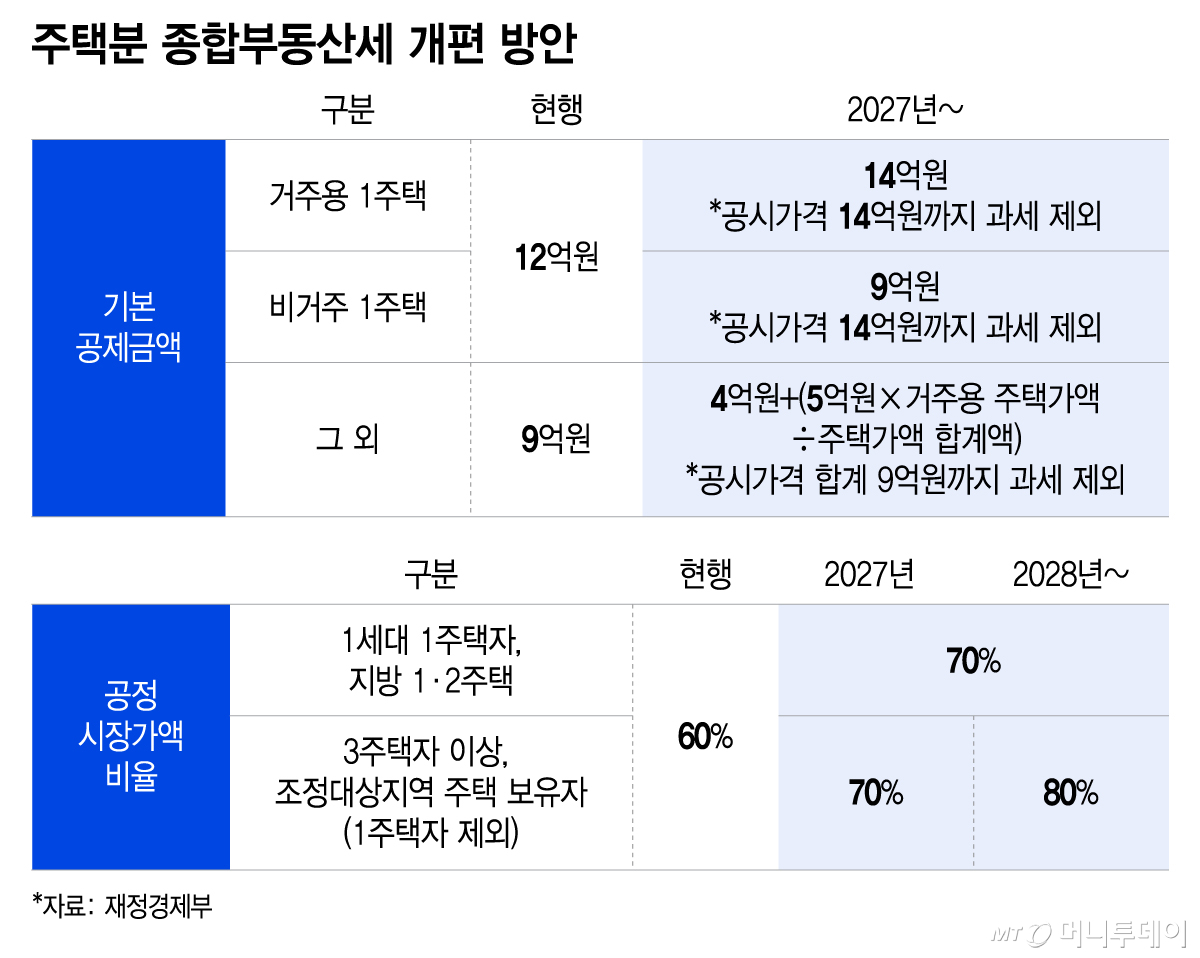
The government is reforming the comprehensive real estate tax by imposing greater burdens on non-residents, ultra-high-value properties, and multi-homeowners. In particular, non-residential homes are designed to pay more comprehensive real estate tax even if they own only one home, by reducing various deductions. The long-term special deduction for capital gains tax on housing is being reformed with a focus on residence, setting the deduction limit at up to 1 billion won.
The Ministry of Economy and Finance held the Tax Development Deliberation Committee on the 3rd and finalized the '2026 Tax Reform Plan.' The core of the reform plan is the overhaul of real estate taxes. Among real estate taxes, changes to the comprehensive real estate tax are the most significant. For single homeowners, the taxable base for the comprehensive real estate tax will rise from the current 1.2 billion won to 1.4 billion won based on the announced price. The remaining taxable bases remain unchanged at 900 million won.
The government has revised all factors affecting the comprehensive real estate tax amount: the basic deduction, fair market value ratio, tax rates, and tax deductions. The comprehensive real estate tax is calculated by subtracting the basic deduction from the announced price and multiplying it by the fair market value ratio and tax rates. If the deduction increases, the tax decreases; if the fair market value ratio and tax rates rise, the tax increases.
The basic deduction for single homeowners, currently 1.2 billion won, will be adjusted to 1.4 billion won for residential use and 900 million won for non-residents. The fair market value ratio, currently at 60%, will be raised to 70%. For owners of three or more homes and those holding properties in adjustment target areas, the fair market value ratio will rise to as high as 80%.
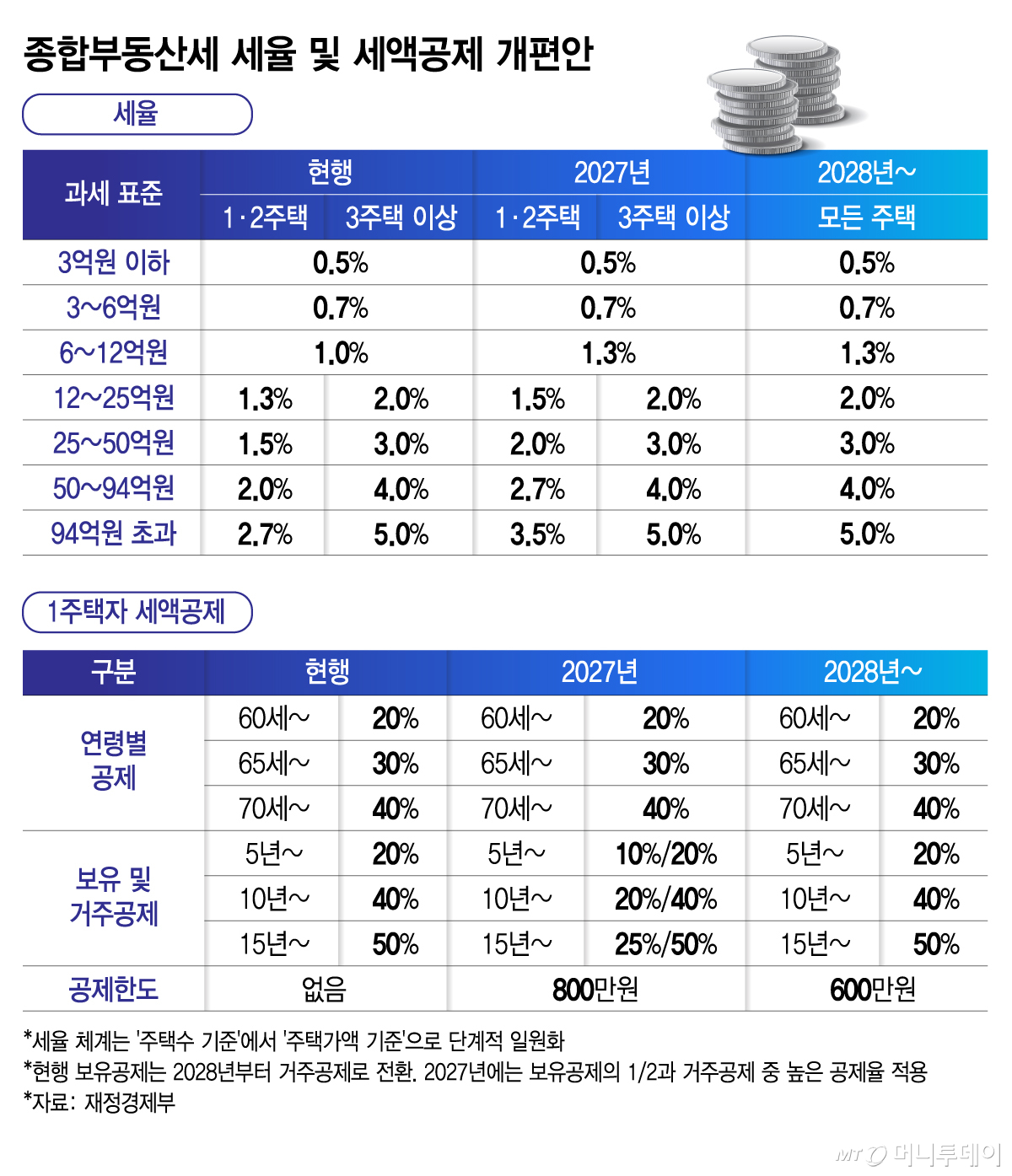
Considering the issue of 'one solid home,' the standard for comprehensive real estate tax rates will be unified from 'number of homes' to 'home value.' In this process, tax rates will increase starting from the taxable base segment of 600 million won or more. The holding deduction, which reduces the comprehensive real estate tax for single homeowners by 20% to 50% depending on the period, will be converted into a residence-based deduction. The 'unavoidable non-residence' condition has been specified as enrollment in school, job transfer, caring for parents, etc.
According to the Ministry of Economy and Finance, for single homeowners with residential use, the comprehensive real estate tax will decrease up to a market value of 3.44 trillion won (announced price of 1.7 billion won). Conversely, the tax begins to increase from a market value of 3.44 trillion won, and the magnitude of increase expands from 4 billion won or more.
The long-term special deduction for capital gains tax, which applies up to 80% (40% holding + 40% residence), will have the residence condition removed and be adjusted to a maximum of 80% based solely on holding period. It will be implemented gradually after a one-year grace period. The deduction limit will ultimately be set at 1 billion won.
Deputy Prime Minister and Minister of Economy and Finance Koo Yun-cheol stated, "Under the principle that 'buying is not living,' we will reasonably reform real estate taxes to establish a housing market centered on residence."
Meanwhile, the tax reform plan includes the introduction of a domestic production promotion tax system and stricter application of the business inheritance deduction. The revenue effect from the tax reform is 344.3 billion won. The government will submit the tax reform plan to the National Assembly in early September.

 in ECONOMY

